Reader Rep: If The News Is Fake, At Least Be Transparent About It
“Sponsored content” is crumbling the once solid wall between advertising and news.
Mililani’s “spacious homes, recreational facilities and schools make it an ideal place to raise a family,” especially if you are a Mililani-based real estate agent trying to sell homes, according to a recent Living 808 segment of KHON News.
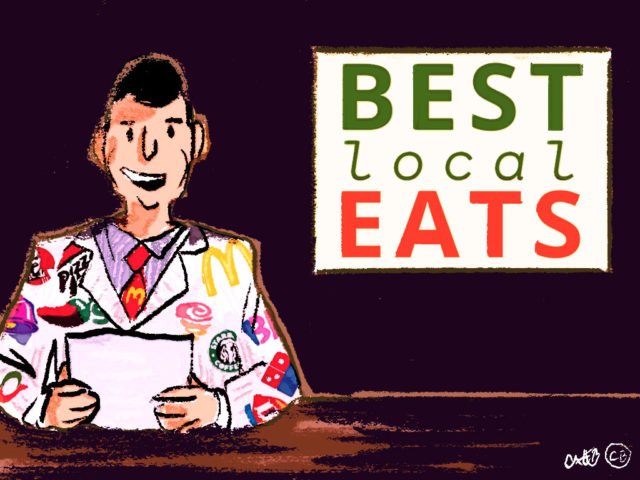
Living 808 might never be confused with “60 Minutes,” but it also represents one more reason why audiences members have become rightfully skeptical of “the news.” Those who peruse the web archive of Living 808 will find a lot of curious examples and a vague disclaimer about how KHON presents the Living 808 content, but “sponsors” are responsible for it.
What the channel should say, in plain language, is that advertisers buy these blocks of airtime, control the content and force the station’s staff to pretend to be jolly journalists as a way to trick the audience members into thinking they are watching real news.
In the industry, these illusions are known by various names, including advertorial, sponsored-content and infomercial. You also could call them “fake” news.
The Mililani segment caught my attention because one of my friends had moved to Mililani a few years ago seeking a better place for his family. He had lived in a lot of cities with bad traffic, around the country and world (including New York, Los Angeles and New Delhi), and he told me he generally liked to drive, even in congestion.
But he quickly found the commute from Mililani to Honolulu to be, as he described it, “soul crushing.” After a few months of it, he abruptly relocated his family of four back closer to the city.
So while Mililani is a wonderful place for many, the KHON segment didn’t even mention some of its downsides, such as traffic congestion, which creates an incomplete (and also false) narrative of the place.
This example is a symptom of a larger and recurring issue in our media ecosystem and democracy, in which a once-solid wall between advertising and news content now has shrunk and become porous and crumbling. If anyone wants to rebuild a giant wall anywhere, to strengthen our country, I’d suggest starting there.
“Fake” news is not new, of course. University of Hawaii journalism historian Julien Gorbach wrote in a recent paper on this subject that: “Fiction disguised as a fact dates back to what some media historians consider the very birth of the journalistic report in 1722, when readers mistook Daniel Defoe’s ‘A Journal of the Plague Year’ to be a true memoir.”
Gorbach added that the “mainstream media” controlling broad societal conversations actually is anomalous in the long-term view of our communication ecosystem, rather than a norm. Such an institution, according to Georgetown University professor Jonathan Ladd, never existed in America before the 20th century. Even Edward R. Murrow, though, enriched himself via “sponsored content,” and the trusting Walter Cronkite years were extremely fleeting.
So what we have now is a president-fueled devolution of our news media, combined with an economic desperation in the industry to remain “big” business, drawing us back into the dark ages.
The New York Times, journalism’s paragon, has become one of the most conflicted contributors to this conflated situation. While it continues to collect Pulitzer prizes at an unparalleled rate, it also is leading the development of “sponsored content” into unprecedented depths of editorial confusion.
Its nebulously named T Brand Studio creates the most sophisticated and bewildering advertising-news mix humans probably have ever encountered, and that’s just one of the many information operations around the world trying to, as T Brand’s mantra states, “influence the influential.”
Look over some of their work, and you can see where all of this could be headed. A story about dance, led by discourse about the quality of dancers’ shoes, is sponsored by shoemakers. A story about the incarceration of women – yes really – is sponsored by the television show “Orange is the New Black.” A story that argues “college still is worth it” gets funded by the Discover Student Loan program.
While I might make similar arguments (and maybe even use much of the same core information as the “sponsored-content” does), not everyone agrees, just like not every family flourishes in Mililani.
Such a tainted argument – sponsored by a company that directly benefits from people choosing to take out loans to invest in their education, regardless of the pedagogical payoff – is troubling. This mixed-loyalties report might benefit readers. But it most certainly benefits the company trying to entice more people to make more loans.
News organizations betray their audiences when they make these backroom deals, not so much by “partnering” with a business but by disguising the details of that partnership. The New York Times, for example, marks its T Brand content with a thin blue line of text at the top of each story, pervasively indicating the “paid for” relationship.
What’s not clear from this label is what exactly they are paying for, including what influence the company had over the content in the piece, especially what was excluded because of sponsor control. Besides links to company web resources, the relationship isn’t explained, and readers are left to wonder.
Journalists need to label their sources, and each story progressively builds integrity in a community. Readers need to trust the journalists, through the work, to believe what they are reading.
But how can I trust these pieces of “sponsored content,” despite their slickness and appearance of credibility, if I can’t trust that the producers of it really are working for me? Call me cynical, but I can only assume they are not.
“Fake” news is a charge, aggressively pushed by a fraud of a president, that cannot be sidestepped, or looked past, any longer. “Fake” news is a ubiquitous scourge at this point, from the filler story about the can of Coke serving as a good snack for kids, to the Living 808 clip about how to pick a contractor, sponsored by a single contractor, to the polished T Brand packages.
Journalists can’t reclaim higher moral ground by making more clever cloaked advertisements. They need to go in the opposite direction – to regain trust and re-establish their niche – displaying full transparency about their processes and products. They need to better differentiate their work, such as following a specific Code of Ethics, and to hold themselves accountable to that foundational standard.
The current path of many – a complete decline of journalism into irrelevance – isn’t worth the money.