Hawaiians Deserve The Right To Determine Use Of Their Lands
The Office of Hawaiian Affairs is moving forward with development of its Kakaako Makai property.
March 2, 2021 · 4 min read

About the Author
My maternal grandparents were pure Hawaiian, and both they and my mother were manaleo — native speakers of ‘olelo Hawai’i. My paternal grandparents were pure Japanese immigrants from Hiroshima.

Growing up in our sugar plantation Niuli‘i community in Kohala, we were taught to honor our family, mālama the ‘āina including the wai, contribute to our community, work hard and be honest in our words and deeds.
These valued teachings were modeled and exemplified by resilient grandparents, parents, families and the community as a whole, not only in times of economic downturn or natural disasters, but in quiet, daily conversations and through actions of honest hard work and deliberate daily deeds.
In 2012, the state and OHA agreed to settle the 32-year past-due Public Land Trust revenue debt of $200 million by conveying 30 acres of land on 10 parcels in Kaka‘ako Makai to OHA. Mai poina — don’t forget — the conditions and value of the settlement.
The state’s own appraiser valued the land at approximately $198 million, assuming a 400-foot height limit for bookend Parcels E and I, located along Ala Moana Boulevard (see Figure 1).
Figure 1. – Kakaako Makai Map
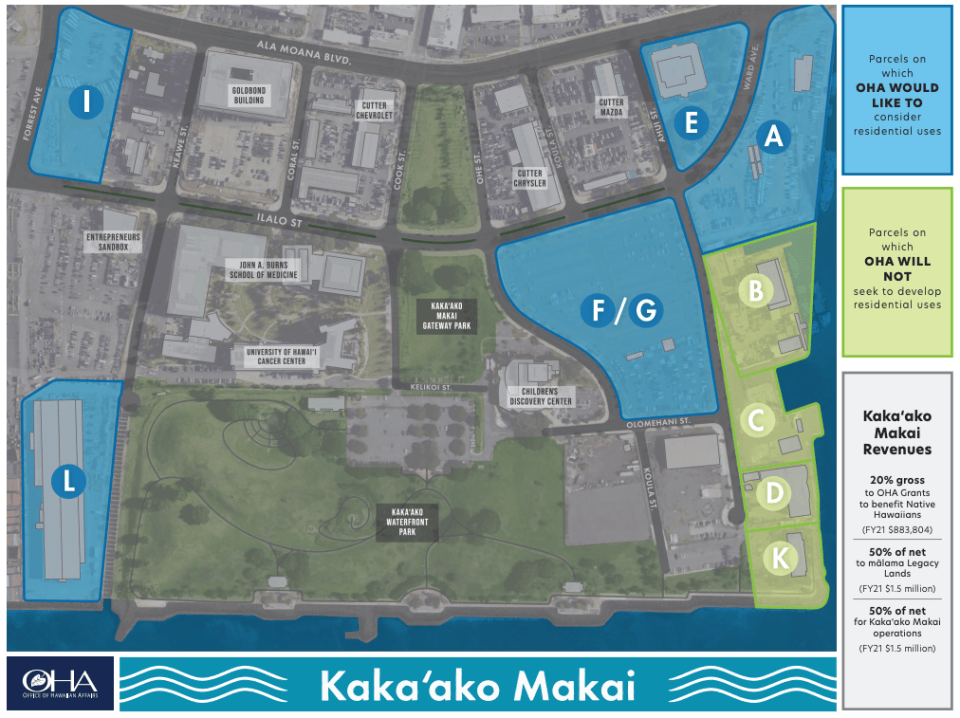
The reality is that the state conveyed parcels E and I to OHA with only a 200-foot height limit — half of the state’s own appraiser’s assumption — and prohibited residential uses throughout the area. This clearly represents inequitable conditions that have devalued and disabled the true value of the 2012 “settlement.”
While there were promises made by the executive branch, proposed legislative fixes, and even judicial considerations, after nearly a decade of hindsight, it is difficult not to feel short-changed and that OHA is now the recipient of “less than settlement.”
Fiduciary Duty
The Kakaʻako Makai parcels are Native Hawaiian Trust Lands, not public lands. Acceptance of the 30-acre settlement reclassified those lands from “public lands” to Native Hawaiian trust lands. The value of the settlement transaction aside, OHA trustees made the best decision possible given the facts and circumstances in 2012.
In the spirit of Indigenous self-determination, Native Hawaiians deserve the right to decide and be accountable for decisions made about Native Hawaiian trust lands. OHA has a fiduciary duty to determine decisions made surrounding all of its managed trust lands, including Kakaʻako Makai.
The following elements inform master planning of “A Vision – E Kuʻu Kakaʻako:”
- Our goal is to create a Hawaiian sense of place where our culture is lived, practiced, and celebrated, part of an integrated vision that is palatable with all of our senses, especially our naʻau;
- we want to create an inviting urban oasis where families and communities can thrive;
- address the needs of Native Hawaiians;
- apply and incorporate ancestral values, wisdom and practices while also utilizing new and emerging data that informs urban responses; and
- perpetuate effective resource management practices.
This 2021 session, OHA is supporting legislation (Senate Bill 1334) that would provide us the opportunity to develop residential housing on our Kakaʻako Makai parcels.
The bill would lift the residential prohibition on five lots (E, A, F/G, I and L) and raise the height limit to 400-ft. for two of those five lots (E and I) on Ala Moana Boulevard.
As we move forward to plan and develop our Kakaʻako lands, all we are asking for is the setting of fair and equitable height and residential use considerations as contained in SB1334.
Accordingly, OHA is exploring all options to maximize revenues in Kakaʻako Makai to best serve our beneficiaries, including both residential and commercial use considerations.
The ability to develop residences in Kakaʻako Makai will not only provide OHA with increased revenue opportunities, but also empower the agency to better meet a range of housing needs. We are evaluating multi-use, multiple project scenarios that include, but are not limited to, affordable, workforce, kupuna and market rate housing.
While my grandparents and parents have passed, and my education, work and family have kept me an Oʻahu resident for over 40 years, the teachings to honor family, mālama the ‘āina, contribute to community, work hard, and be honest in our word and deed, endures regardless of people, place or politics.
To the state, through its 2021 legislature and legislators, be honest in word and deed, and restore the height and residential use conditions of Kakaʻako Makai to truly quantify the $200 million settlement to Native Hawaiians.
 Sign up for our FREE morning newsletter and face each day more informed.
Community Voices aims to encourage broad discussion on many topics of community interest. It’s kind of a cross between Letters to the Editor and op-eds. This is your space to talk about important issues or interesting people who are making a difference in our world. Column lengths should be no more than 800 words and we need a photo of the author and a bio. We welcome video commentary and other multimedia formats. Send to news@civilbeat.org. The opinions and information expressed in Community Voices are solely those of the authors and not Civil Beat.
Read this next:

Local reporting when you need it most
Support timely, accurate, independent journalism.
Honolulu Civil Beat is a nonprofit organization, and your donation helps us produce local reporting that serves all of Hawaii.
ContributeAbout the Author