Lee Cataluna: An Anonymous Death Toll Is Hard To Process
The number of Covid-19 deaths in Hawaii is staggering, but without names attached the figure becomes a mere statistic.
November 3, 2021 · 5 min read

About the Author

In May 2020, The New York Times published a dramatic front-page graphic of names to represent all the people in the U.S. who had died from Covid-19. A team of journalists gathered the names from obituaries published in newspapers across the country.

Simone Landon, the editor who put together the project, said it was an attempt to convey both the vastness and the variety of lives lost. “Both among ourselves, and perhaps in the general reading public, there’s a little bit of fatigue with the data,” Landon said.
At that point, 100,000 lives had been lost to Covid in America. Now, that number is over 746,000. There’s more than a little bit of fatigue with the data. It is a loss too great to understand.
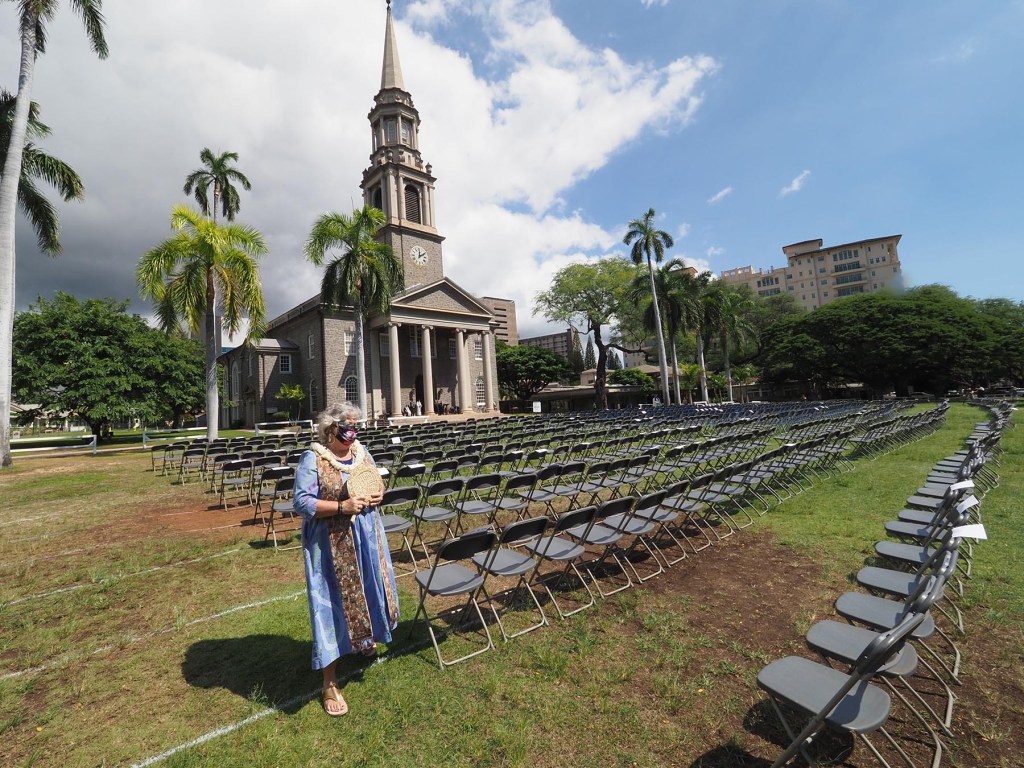
At the start of this week, Hawaii has reported 916 Covid-related deaths. On Monday, Central Union, the historic church building on South Beretania Street, held a memorial to recognize each person with an empty chair and the date of death. There were no names, though. Just rows of empty chairs set up on the wide church lawn.
For some reason, the number of deaths here doesn’t make much of an impact. There’s an update every day, but the growing number doesn’t sting. It should.
It should be a hard number for people to say. There should be tears every time. Television anchors should choke up a bit or, at the very least, lower their voice in an approximation of concern. Instead, it’s like a score or a tally. That awful, growing number remains merely a statistic, a point of data untethered to the reality of human suffering.
Maybe part of the reason those numbers don’t shake the community to the core is because they’re just numbers without names attached. We can’t do that Hawaii thing where we read a last name and start trying to connect them to people we know:
“Oh, I think that’s George’s uncle.”
“I used to live next door to a family with that name. I wonder if that’s the grandpa?”
Local news outlets have done stories about individuals who have died during the pandemic, but there is no master list, no accounting of names that could go on a memorial plaque or be remembered in pages and pages of newsprint.
The anonymity of the death toll is horrific. It is inhuman.

It is a factor in the disconnect between the parts of the community blithely determined to charge forward as if the pandemic had passed with no lasting effects and the reality of all that has been lost.
A secondary effect of not knowing the names of all the victims will surface down the line when, decades from now, future generations want to know what happened. They will search for the historical empathy that comes with understanding a different era. They will search for meaning and get numbers.
To understand a tragedy, it is important to know the names. The 9/11 memorial at Ground Zero lists nearly 3,000 names of the people killed in the terrorist attack. This changes the perspective to see the individual suffering in the singular event. It is a reminder of the worth of every life lost.
War memorials list the names of every known service member who gave their lives in the effort. Roadside memorials often spring up at the site of fatal crashes and sometimes remain for years.
It has taken historians decades to document the names of people who died at the Hansen’s disease colony in Kalaupapa, which is perhaps a closer comparison to Covid deaths than war memorials or Ground Zero or roadside memorials. In the case of Kalaupapa, though, there was the connection of geography. There may never be a way to know everyone who died from Covid.

One reason for the lack of a master list is, of course, the privacy of medical records. It’s not the right or responsibility of the Department of Health to release the names.
Let’s not go backward in legal protection of and common respect for people’s privacy, particularly when it comes to medical records.
Such a decision to disclose should be up to surviving family members or perhaps the last wishes of the victim. For some families, there may be a stigma attached to Covid-19, whether it be an anti-vaccination stance that kept the decedent from protecting themselves from severe illness, or the sad fact that they were not able to isolate themselves from exposure.
The wish for privacy is understandable; but so is the need to know who we lost. Those opposing forces may never be reconciled, and in this case, privacy should win out.
When doing research, especially personal family research, every detail matters. It matters how an ancestor died and the context in which that death occurred. Without a full accounting of who was lost to the pandemic, the story of our time will never be completely told in the future.
In the present, it is a sad thing that days can pass with 10 new deaths in Hawaii that barely get any attention. It’s sad that we don’t know how to understand who has been lost.
 Sign up for our FREE morning newsletter and face each day more informed.
Local reporting when you need it most
Support timely, accurate, independent journalism.
Honolulu Civil Beat is a nonprofit organization, and your donation helps us produce local reporting that serves all of Hawaii.
ContributeAbout the Author