Chad Blair: Is It Just Me Or Are Protests Turning Nasty?
Anti-mask and anti-vax rants have sometimes been ugly. But Hawaii remains a relatively peaceful place to take to the streets.
June 1, 2022 · 7 min read


About the Author

In November 2011, tens of thousands of government and business leaders and their families along with journalists and others descended upon Honolulu for the Asia-Pacific Economic Cooperation summit.

Hosted by the Hawaii-born U.S. President Barack Obama and featuring the leaders of 20 other member states including China, Russia, Japan, Mexico and Canada, security was on the highest alert. In addition to the heavy presence of the U.S. Secret Service, Civil Beat reported that local law enforcement spent more than $700,000 for crowd-control weaponry in apparent preparation for large-scale violent protests.
We covered APEC closely, not only because it was historic but because protest was very much in the air. Past annual APEC meetings had attracted protests including in Japan in 2010, in Peru in 2008, in Sydney in 2007 and in South Korea in 2005.
In 2011 the Occupy Wall Street movement against economic inequality and the power of money in politics began that September in Zuccotti Park in New York City’s Wall Street district. Here at home Occupy Honolulu set up camp in Thomas Square and groups like World Can’t Wait Hawaii circulated leaflets that called for halting and reversing “the terrible program of war, repression and theocracy that was initiated by the Bush/Cheney regime and the ongoing crimes that continue to this day.”
There were indeed protests in Honolulu, primarily on the outskirts of Waikiki where the main APEC events were held. But they were a largely civil affair and probably not worth all the time and money put into preparing for and covering them. They also attracted a variety of special interests.
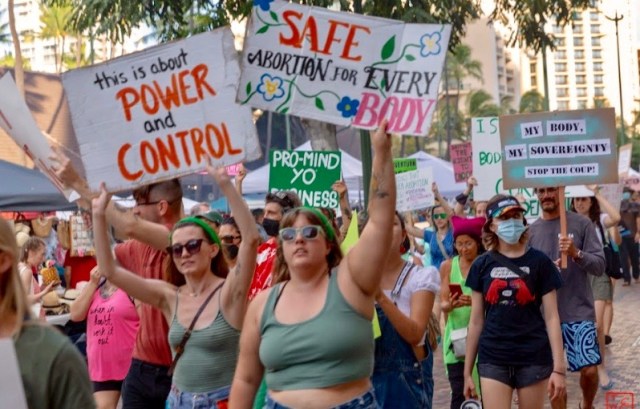
As Civil Beat reporters wrote about a march of 300 people, “The group combined the anti-capitalist creed of Occupy Honolulu with the impassioned let-us-be pleas of Moana Nui’s indigenous Pacific peoples, as well as a collection of Vietnamese criticizing their own government. Earlier in the day, Waikiki saw Falun Gong demonstrators call for justice from the Chinese government and bikini-clad youths take their anti-APEC message to the beach.”
In the end, APEC 2011 is remembered locally by the performer Makana singing a protest song at the APEC dinner for world leaders, the one where an inebriated Honolulu City Councilman Tom Berg got into an argument with the Secret Service when he briefly left to retrieve his cell phone.
The most serious violence that occurred at APEC, of course, came from a U.S. State Department agent named Christopher Deedy, who fatally shot resident Kollin Elderts at a Kuhio Avenue McDonald’s after a drunken altercation. Protests followed that incident, peaceful but passionate.
A lot has changed in 11 years, including the nature of protests in Hawaii. While demonstrations remain largely respectful, some people opposed to mask mandates and Covid vaccination in the islands have been particularly loud and rude.
The Times They Are A-Changin’
I talked to two local akamai activists about what they are seeing on the ground these days, and what they make of it all.
For Carolyn Hadfield of Refuse Fascism Hawaii and Rise Up 4 Abortion Rights Hawaii — the purpose of each group is reflected in their name — what changed is due primarily to Donald Trump.
“He gave license to anybody who has those feelings to come out with them,” she said. “I know those feelings were already there, but usually you would hear just some talk or a rude comment. Now there is a small number of people who will say the most ugly, vicious thing you have ever heard, and it is done openly.”

One example, said Hadfield, is people without masks approaching her and fellow protesters and yelling directly into their faces despite the fact that Covid is spread through the air. Another example: being called baby killers or murderers.
“People are usually respectful here, but I have never seen so much ugliness in the past three years or so,” said Hadfield, 80, a former teacher and paralegal whose activism dates to the Vietnam War. “In Hawaii, that stuff is not acceptable.”
Hawaii News Now reported on Thursday how an abortion rights rally at Thomas Square “got heated” as opposing groups on the issue “came face to face shouting and throwing signs to the ground.”
But Hadfield, who used to run Revolution Books in Puck’s Alley and was part of World Can’t Wait Hawaii during APEC, also noted that some folks who oppose her views sometimes apologize for the antagonistic behavior of their colleagues.
“They feel shame,” she said, adding that the positive response to her protests — thumbs up, waving, cheering — overwhelm the negative.
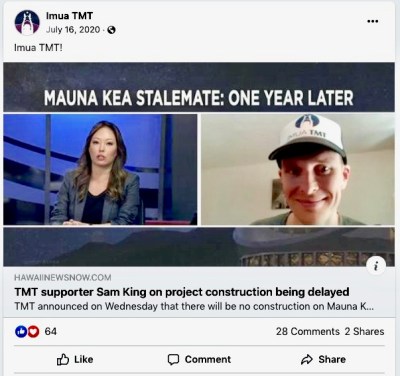
For Samuel Wilder King II, whose Imua TMT is a group of Native Hawaiians in support of the Thirty Meter Telescope atop Mauna Kea, Trump is not the person to blame for the change in tenor.
“I would never say it is all because of one person,” he said. “Trump was a cause and a symptom. He pushed the envelope of speech in way that created a lot of angst, especially through Twitter. But it’s not just him.”
For King, a 38-year-old attorney who is running for a trustee seat this year on the board of the Office of Hawaiian Affairs, what’s changed is the world online, in particular social media. He pointed to postings of false information about the TMT, for example, that are quickly shared and gain a life of their own.

“That is terrifying,” he said. “Everybody in the world seems to be in their silo with algorithms feeding us only what we want to hear. It is really hard for people to read media that disagrees with them.”
And, while King and Hadfield likely agree on very little politically, they do agree that the tone has turned nasty.
“Yes, it’s true that protests are largely peaceful here — physical violence is not a large thing,” said King. “But emotional aggression is, at least in my perception of highly vitriolic cyber-bullying and cyber-attacks related to TMT.”
Some Things Are Worth Fighting For
Even while Hawaii has generally been a tolerant locale for protest, we have not lacked for serious issues that from time to time understandably bring many to the streets.
They include the labor strikes of the last century, the successful effort to stop the bombing of Kahoolawe, the eviction of farmers from Kalama Valley and of dwellers at Mokauea Island, the struggle over water rights at Waiahole-Waikane, the sovereignty movement, the fuel leaks at Red Hill, and the continuing opposition to military training at Makua and Pohakuloa.
Meanwhile, the planet as a whole currently seems to be building to one of its greater stress points: the Russia-Ukraine war, a possible China-Taiwan conflagration, the Supreme Court’s imminent decision on Roe. v. Wade, the endless blood shedding from mass shootings, rampant inflation and a pandemic that has not gone away.
But Carolyn Hadfield will not stop her work. She said she is stimulated by talking to young people who want to debate the issues and learn more.
“It’s a constant thing to find out what they are thinking rather than to believe what the newspapers are saying,” she said. “A lot of times things are very nuanced or not as clear as this or that.”
As for Sam King, he said he doesn’t want to talk about who is at fault but rather how to move forward.
“We are in a struggle for democracy on Earth,” he said. “I talk to a lot of people and what I am hearing is that people want healing.”
 Sign up for our FREE morning newsletter and face each day more informed.
Local reporting when you need it most
Support timely, accurate, independent journalism.
Honolulu Civil Beat is a nonprofit organization, and your donation helps us produce local reporting that serves all of Hawaii.
ContributeAbout the Author