Naka Nathaniel: What We Can Learn From The Way Koaiʻa Trees Support Each Other
My hope for Native Hawaiians living on the mainland is that they get to be together in kipukas that raise majestic trees that survive and thrive.
June 28, 2023 · 7 min read

About the Author

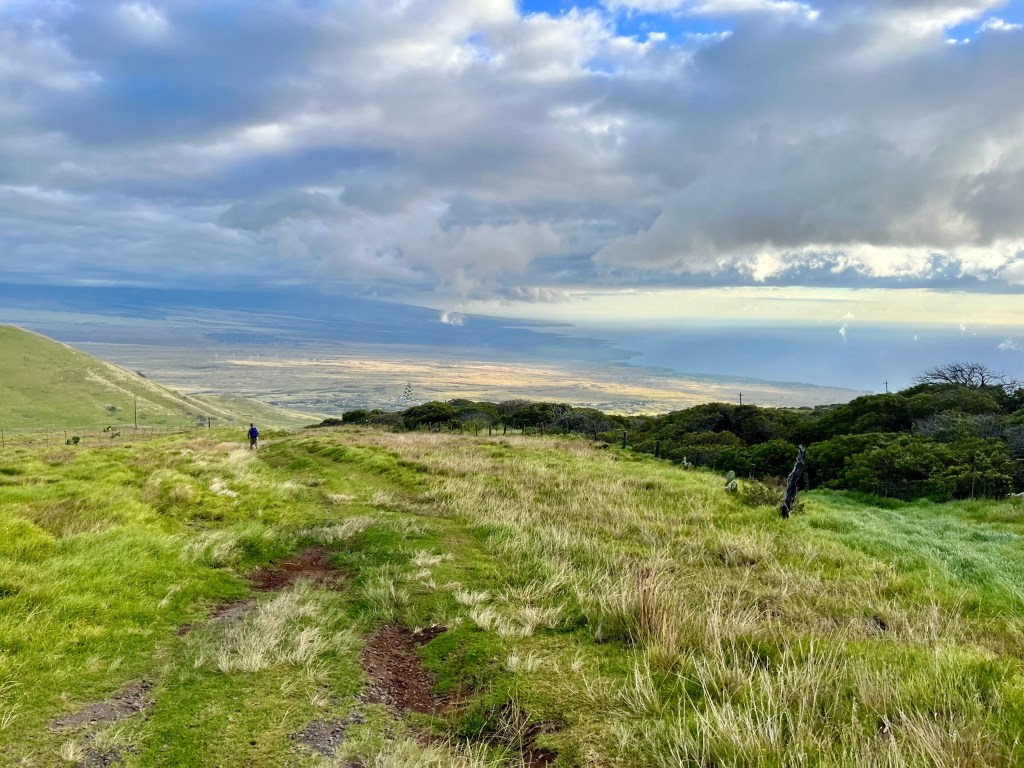
The day after I got back from covering the Council for Native Hawaiian Advancement conference in Las Vegas I hiked up Kohala mountain with my son. From the lands above the Kohala Mountain Road we could take in the kilakila (majesty) of our island.
Our island home.

This island home belongs now to him, just as it belonged to his Grandfada born in Hilo, his great grandfather born in Kurtistown and his ancestors born in Kohala and Ka’u.
My son was there to find a pair of ohia trees he thought might have been alive at the same time as Kamehameha I. He has a reverence for the legendary woods of Hawaii and for woodworking. He has ongoing projects carving ohia and koa. He also has a good size hole in his hand from a slip of a chisel.
The Koaiʻa Tree Sanctuary is a kipuka on the side of the ranched mountain. A kipuka is technically a forested area surrounded by lava flows. This is a forest surrounded by pasture. When you look up higher into the cloud line you see the forest and the way the land was when Kamehameha was a boy.
In Atlanta, my son was raised in a beech and poplar grove. Beech trees are remarkably patient trees. They will remain in the shelter of their parent tree until the moment when a patch of sunlight opens in the canopy, then it will sprint to take its place.
The sheltered tree develops the strongest wood and will majestically take its place in the canopy, and when the strong winds come, the tree will work with the others to lean into each other and help all the trees stay upright.
The grove we walked through was planted with koaiʻa, dwarf koa. These trees won’t grow into the trees worthy of canoe hulls. The hillside was too barren and windswept for the full-sized koa. Yet, here was a worthy start. These trees clumped together support, shelter and nurture each other.
We hiked out of the grove and up the pasture land getting pelted by the sharp, wind-driven rains. We paused in the lee of a livestock gate and pulled out the binoculars. We looked down into Kawaihae Harbor where my son sails and paddles and back to the new solar field above Waikoloa Village. If we hiked higher up into the Pu’u o Umi Forest Preserve we would not have this vista. Instead, we’d be mauka forest surrounded by lushness and birdsong.
Which one is the ideal?
This week, I’ve been answering the question “How was Vegas?” with the honest answer: “Sad.”
It wasn’t that the conference itself was sad. Kuhio Lewis, the CEO of CNHA, successfully brought the convention to the audience he intended to reach. The conference was on par with others in terms of showmanship.
Before the event he said that “it wasn’t a rinky-dink convention.” He was right. However, he was contrasting his vision against the impression that most Hawaiian events are just a few pop-up tents at the beach. But for me, after being in Las Vegas, a pop-up tent on the beach seemed pretty great.
The reason I answered “sad” was because of the realities that have led to the exodus of Native Hawaiians and the location of the conference in Las Vegas instead of Hawaii.
Besides my one word answer, I have been sharing two phrases I heard in Las Vegas.
The first was from Chicago born-and-based Leialoha Lee on the “Should Mainland Hawaiians Be Part of the Lahui?” panel: “I don’t know how you guys survive in Hawaii.”
Indeed. It’s a great question. How do we survive in Hawaii? Each person here has their individual struggle to survive here.
The second one I have been sharing was from outgoing Hawaii Tourism Authority CEO John De Fries about a lesson imparted to him as a young man by the legendary entertainer Don Ho.
Ho told him: “As you start to do business in Hawaii, you’re going to learn that there are two types of people: Temporary and permanent.”
De Fries recalled Ho expressing concern “that for too long values growth had been controlled and dominated by temporary people. And he said it wasn’t their fault. He went on to say that permanent people, like you and me, have to build our capacity, have to be able to go eye-to-eye, toe-to-toe in any sector with anybody from around the world. Because it’s not their fault. And once we take that responsibility on, we are taking back our kuleana to care for our island home.”

De Fries said that message was “much more poignant today” because it wasn’t about ethnicity. Ho wasn’t saying Hawaiians are permanent and everybody else is not.
“It’s about people who commit to raising their grandchildren, great-grandchildren and are committed to being in Hawaii. As I tell you this story, I can sense that all of you are going through your mental Rolodex and beginning to sort the people that you deal with,” De Fries added.
“You’ll begin to look at this in a very different way because it has everything to do with how much energy you and I choose to invest with temporary people versus people who are permanent.”
Again, it’s sad that you can’t automatically think of Native Hawaiians being permanent in Hawaii.
Much had also been made about Las Vegas being “the ninth island.” That’s not the right geographic designation. Las Vegas is a mainland kipuka. It’s a trapped pocket of Hawaiian vibrancy, just like the forest grove in Kohala. Just like Native Hawaiian communities in Los Angeles, Sacramento and Washington state.
I’m a sap like others for the idea of Hawaiians getting in their koa canoes and venturing out into the wide ocean and safely returning as the rationale for why we should accept the situation with more Native Hawaiians living outside of Hawaii than inside Hawaii.
However, that “safe return” for Native Hawaiians who leave is getting harder and harder.
My family is beyond fortunate to be able to have had a safe return. This is once again our island home. This is the island home of my father and grandfather, but this island home also belongs to everyone else who lives here. This island home belongs to GrandMaC, born in Minnesota, who gave her house in Volcano so her mo’opuna (grandchildren) could be nurtured and not threatened. This was the island home of my Vovo whose recipes and quilts fill us with warmth here in Hawaii. De Fries was right: It’s not about ethnicity.
People say that there isn’t an ocean in Las Vegas, but guess what else is missing? Forests.
My hope for the Native Hawaiians living on the mainland is that they get to be together in kipukas that raise majestic trees that survive and thrive. And I hope that these metaphorical trees help the people return to their island homes.
 Sign up for our FREE morning newsletter and face each day more informed.
Local reporting when you need it most
Support timely, accurate, independent journalism.
Honolulu Civil Beat is a nonprofit organization, and your donation helps us produce local reporting that serves all of Hawaii.
ContributeAbout the Author