Building More Housing And Protecting Tenants Should Go Hand In Hand
Our islands cannot survive if our middle class is hollowed out.
July 28, 2023 · 5 min read

About the Authors



The debate over how to solve our severe housing affordability crisis and finally create a Hawaii affordable for local people has recently been marked by both hope and despair.

Hope in Gov. Josh Green’s emergency proclamation, which could deliver the abundant, affordable housing that politicians have been promising for generations. And despair as tenants threatened with displacement by housing development voiced their struggles before the Honolulu City Council.
The easy answer is to turn to developers and demand they solve all these problems for us at once. But it’s the role of our political leaders to ensure we maintain strong tenant protections without compromising efforts to reverse our housing supply shortage. It’s time for them to step up.
We are leaders of advocacy groups dedicated to the dual mandate of expanding our housing supply and supporting strong tenant protections to guard against the harms of high rents and displacement. Our organizations have recently testified in favor of measures to protect and support low-income tenants.
These include state legislative bills like House Bill 1439, to expand eviction mediation and keep people in their homes, and Senate Bill 55, to reduce the financial burden of rent on the working class.
But each of these bills failed to pass during the legislative session. And that’s emblematic of a larger problem.
Harm To Families
At the last Honolulu City Council meeting, tenant advocates expressed anger at developers for displacing existing tenants and building housing for middle-income families rather than only “truly affordable” housing for low-income families. We hear and understand their anger, but we think halting construction of middle-income housing would do more harm than good — including harm to low-income families.
Too often in the debate over affordable housing, advocates invoke the phrase “truly affordable” to criticize the construction of middle-income workforce housing. These advocates are especially offended by the waivers and subsidies that support middle-income housing development.
It’s truly appalling that our housing crisis has worsened to the point that local middle-class families can’t afford the median home price. But unfortunately, that’s where we are.
If we regress to only supporting housing for families in the lowest income brackets, the harms of losing our teachers, our firefighters, our nurses, and other essential workers will continue to accelerate. The effects of their departure on the essential services that impact our health, our safety, and our children’s education will fall disproportionately on low-income families.
In other words, if we try to create a future where only “truly affordable” housing is supported, and where only the highest- and lowest-income families can afford to stay in Hawaii, we will not succeed. Our islands cannot survive if our middle class is hollowed out.
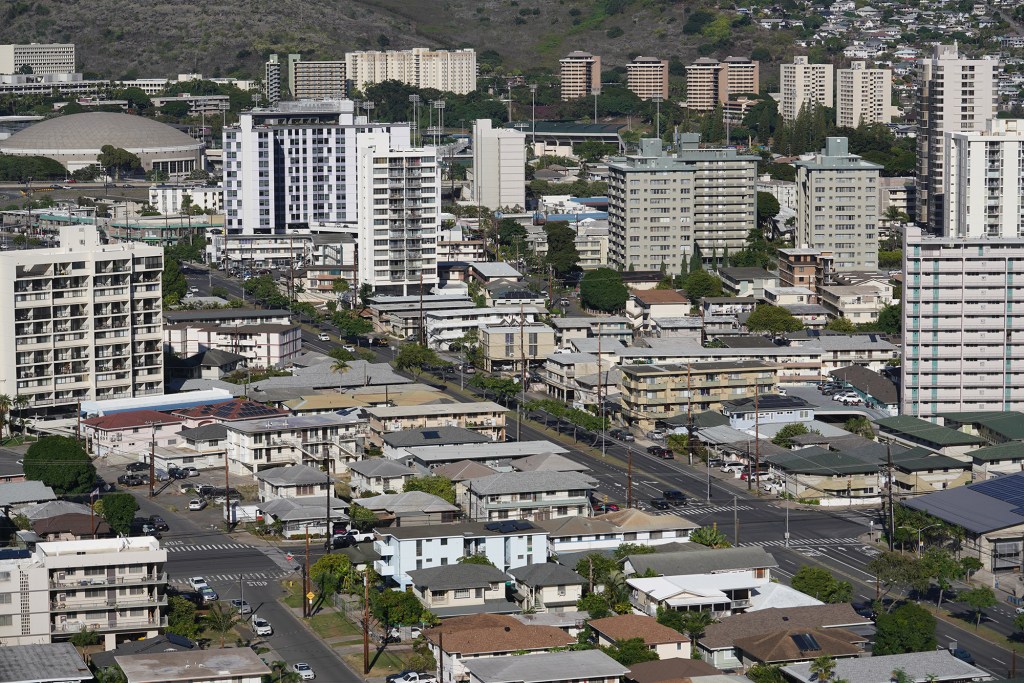
It’s undeniable that increasing our housing supply will require rebuilding some existing developments with more density. Hawaii, and especially Oahu, has neither the available land nor the political inclination to sprawl endlessly into green space, so we will need to build up instead, which will inevitably mean some smaller buildings will be replaced by larger buildings.
In other words, we must make the city “city” to keep the country “country.”
Tenant advocates are right: our protections for displaced residents are inadequate, especially compared to other progressive states. But halting badly needed housing development in response is not the answer. Stopping housing construction will worsen the severe housing crunch already devastating families across the islands.
We must find a way for expanded housing development and stronger tenant protections to coexist.
The voices demanding displacement protections, both elected officials and tenant advocates, have largely focused their demands on developers. In a state with deeply progressive values, why are we content to push responsibility for vital social safety net protections onto private industry?
We must make the city “city” to keep the country “country.”
It’s time for our state and local government to step up. We are heartened by the governor’s bold action on housing. Our mayors, state legislators, and county council members need to match it with bold action to protect vulnerable renters from the harms of displacement. It’s a hole in our social safety net we have long neglected patching, and one that will become more important as we build much-needed housing at a faster pace.
If we don’t act, we will face more outcries from residents displaced by infill development and failed by our lack of government protection — and rightly so. This won’t just harm displaced tenants, it will slow the process of plugging the gap in our housing supply.
No one should face homelessness because the cost of housing is too high. And no one should face homelessness because they’ve been evicted and can’t find a new place to live. It’s our kuleana to build toward that vision of a better Hawaii.
 Sign up for our FREE morning newsletter and face each day more informed.
Community Voices aims to encourage broad discussion on many topics of community interest. It’s kind of a cross between Letters to the Editor and op-eds. This is your space to talk about important issues or interesting people who are making a difference in our world. Column lengths should be no more than 800 words and we need a photo of the author and a bio. We welcome video commentary and other multimedia formats. Send to news@civilbeat.org. The opinions and information expressed in Community Voices are solely those of the authors and not Civil Beat.

Local reporting when you need it most
Support timely, accurate, independent journalism.
Honolulu Civil Beat is a nonprofit organization, and your donation helps us produce local reporting that serves all of Hawaii.
ContributeAbout the Authors