Catherine Toth Fox: Hawaii Schools Should Embrace AI Technology As A Tool
But educators need to play a critical role in teaching students how to use it effectively and ethically.
August 4, 2023 · 5 min read

About the Author

When I was teaching journalism at Kapiolani Community College, I had a blanket statement about academic integrity, which included plagiarism. Basically, it wouldn’t be tolerated.
“Lifting information from the internet without attribution is also considered plagiarism,” I had written in the syllabus. “Journalists who are dishonest lose all credibility (and their jobs).”

The internet has long been a concern for educators (and editors) because of the proliferation of information so easily accessible and — worse yet — from uncertain and, frankly, unreliable sources.
But there was no way to force students to use academic journals (what are those?) or decipher the Dewey Decimal system at the library (is that English?) to find credible sources, not when Google gave them all the answers in seconds — and without them having to leave their bedrooms.
My job, then, was to teach students how to properly use the internet, how to determine which sources are reliable, and how to correctly attribute information in their assignments. It also forced me to shift my lesson plan: I put more emphasis on in-class work, group projects and primary sources (through interviews).
To me, the introduction of AI technology, primarily free chatbots like ChatGPT, is not dissimilar. It’s another tool — and one that provides a convenience with which we can’t compete or outlaw.
So let’s not.
That’s the plan for Hawaii public schools, says Winston Sakurai, director of the curriculum innovation branch in the DOE’s Office of Curriculum and Instructional Design. While some schools in Alabama, New York and Australia have banned ChatGPT, the state wants to find useful and effective ways to integrate the tool into public classrooms instead.
“This is the type of thing that moves our education forward in ways we don’t even understand yet,” says Sakurai, who has been in education for 30 years. (In 2016 he was named National Digital Principal of the Year, so this is his jam.) “This is really an exciting time.”
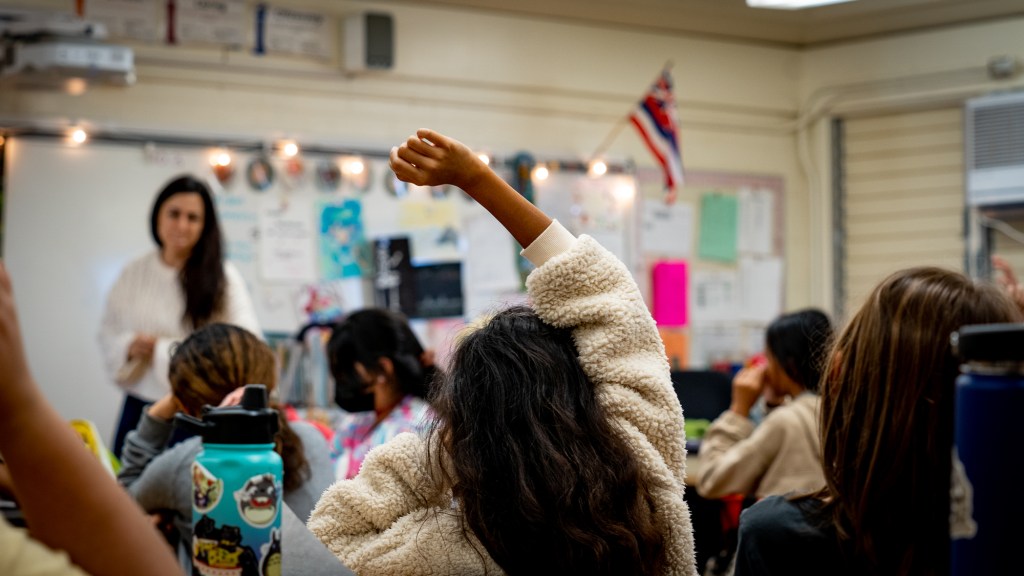
With school back in session next week, educators here and all over the country have legitimate concerns about ChatGPT, which can spit out a college application essay or solve complicated math problems in seconds. The biggest fear is cheating, that students will try to pass off AI-generated work as their own.
According to a recent survey by Study.com, an online learning platform, 26% of K-12 teachers have caught a student cheating by using ChatGPT, which launched in November 2022. Concerned teachers now have to cross-check students’ assignments using software that detects AI-generated content — ChatGPT is good at doing this, too, ironically — which can take up more time.
But plagiarism — and cheating — aren’t new. These are issues educators have had to deal with for generations. In fact, according to a story in NPR in 2021, reports of cheating soared during the Covid-19 pandemic, in some cases triple from the year before. This was well before ChatGPT.
“You can go all the way back to the calculator and Spell Check,” Sakurai says. “Those were new tools that were misunderstood … but these tools can help improve learning in the classroom when used properly.”
The key is “used properly.”
Even OpenAI, the company that created ChatGPT, acknowledges its shortcomings: On its homepage, it says the free version (ChatGPT-3.5) may occasionally generate incorrect information, produce harmful instructions or biased content and has limited knowledge of the world and events after 2021.
This is where teachers come in.
With the right training and guidance — which the state is working on — educators can confidently instruct and guide students on how to use these tools in a way that’s beneficial (and not harmful) to learning.
And it’s already happening. According to a recent survey by the Walton Family Foundation, since its launch, 51% of K-12 teachers reported using ChatGPT, and 53% anticipated increased use this year.
Even ChatGPT itself, when I asked it, agreed that while it offers benefits to students like brainstorming help and language support, there are concerns, including academic integrity, an overreliance on the technology that hinders critical thought, and an incomplete or shallow understanding of the subject matter.
“Ultimately, the responsible use of ChatGPT in academic settings involves striking a balance between leveraging its benefits while addressing its potential drawbacks,” the chatbot responded. “Teachers should play a crucial role in guiding students on how to use AI tools effectively and ethically in their learning process.”
Tools like ChatGPT aren’t going anywhere; in fact, the technology is only going to improve. Like other tech advancements — e-commerce, email, smartphones — AI will continue to integrate with our lives at work, at home and, yes, in classrooms.
Schools need to embrace AI technology as a tool, a resource, a skill students can master. And teachers can utilize it, too, from personalizing lesson plans to generating ideas for classroom activities.
“At the end of the day, it’s about the responsible use of technology,” Sakurai says. “The possibilities are endless.”
Civil Beat’s education reporting is supported by a grant from Chamberlin Family Philanthropy.
 Sign up for our FREE morning newsletter and face each day more informed.
Read this next:

Local reporting when you need it most
Support timely, accurate, independent journalism.
Honolulu Civil Beat is a nonprofit organization, and your donation helps us produce local reporting that serves all of Hawaii.
ContributeAbout the Author