Remembering Rosalynn Carter's Ties To Hawaii And Project Dana
Her connections to the islands were sustained over a period of decades through her unwavering support of family caregivers.
December 10, 2023 · 8 min read

About the Author
Watching several members of the Carter family wearing flower lei during the funeral service of former first lady Rosalynn Carter on Nov. 29, I and other viewers tuning in to the service online learned that the gesture was a symbolic nod to the family’s ties to Hawaii dating back to when former president Jimmy Carter served in the U.S. Navy in the late 1940s.

But not many people may know that Mrs. Carter’s connections to the islands were sustained over a period of decades through her unwavering support of family caregivers. In her gracious and unassuming way, she let us here at Project Dana know that she was thinking of us and was supportive of the work that we were doing to support frail elders in Hawaii and their caregivers.
That someone of her stature and prominence would keep a relatively small nonprofit organization like ours in mind many thousands of miles away from her home and even mention us in her book about caregivers is a reflection of the true inner beauty and sensitivity of this remarkable woman.
Project Dana is a Faith In Action program that provides a variety of services to frail elders and family caregivers to ensure their wellbeing, independence, and dignity in an environment of their choice. We lost a longtime friend when Mrs. Carter passed away on Nov. 19.
In 1987, she founded the Rosalynn Carter Institute for Caregivers in her home state of Georgia. She was no stranger to the role of caregiver.
“I know firsthand the demands of caregiving,” she wrote in an open letter on her institute’s website. “When I was 12 years old my father became terminally ill with leukemia. I was one of four children and as the oldest and a daughter, my 34-year-old mother depended on me,” Mrs. Carter wrote.
“Since returning home from the White House,” she continued, “we have supported many members of Jimmy’s family who have died of cancer, and I helped care for my mother until she died in 2000 at the age of 94. As I’ve traveled this country speaking about caregiving, person after person has stepped forward to tell me their own stories. So many people giving care to their loved ones feel isolated, inadequate, despairing.”
She ended her letter with a call to action: “At a time when more and more Americans are called on to give care, it is critically important that we do all we can to support caregivers.”
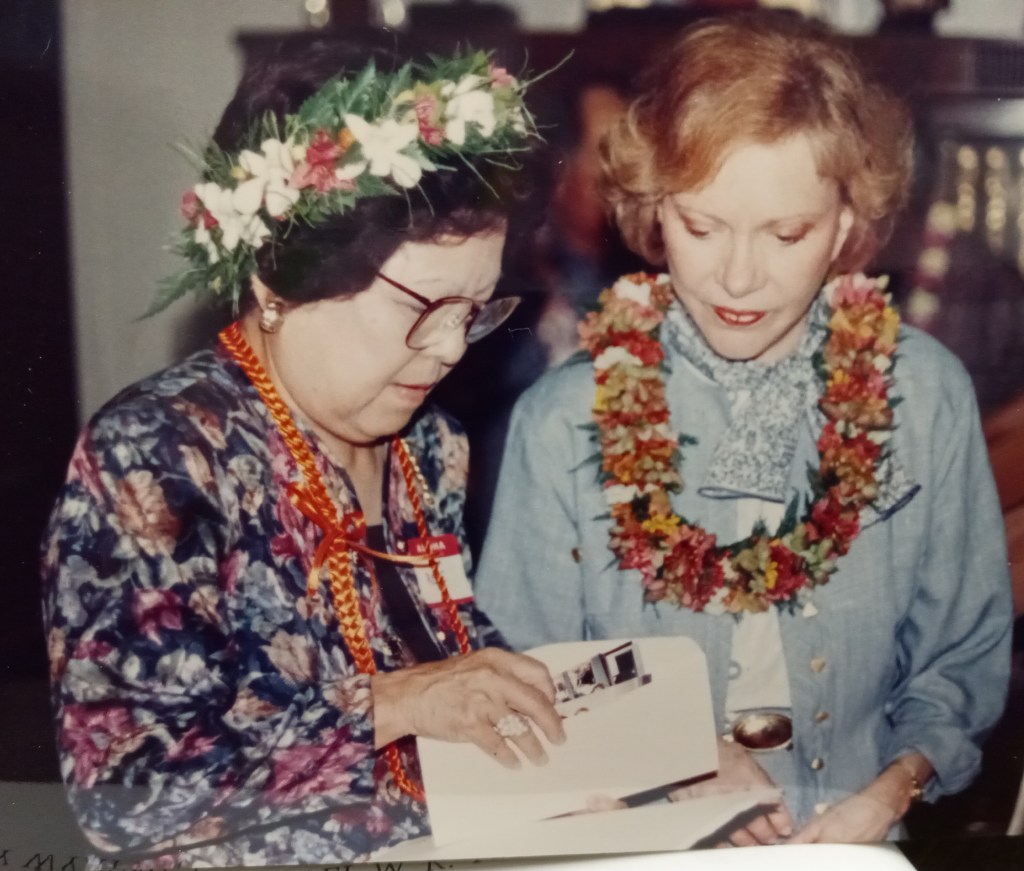
It is not exactly clear how Mrs. Carter learned about Project Dana so many thousands of miles away, but somehow she found out about this grassroots interfaith organization based at Moiliili Hongwanji Mission not long after it was co-founded in 1989 by the late Mrs. Shimeji Kanazawa and the late Mrs. Rose Nakamura, the organization’s founding administrator, to provide compassionate support and services to older adults in Hawaii and their caregivers.
In 1993, Rose Nakamura was recognized with the inaugural Rosalynn Carter Caregiving Award. She was selected for this award out of nominees from throughout the United States.
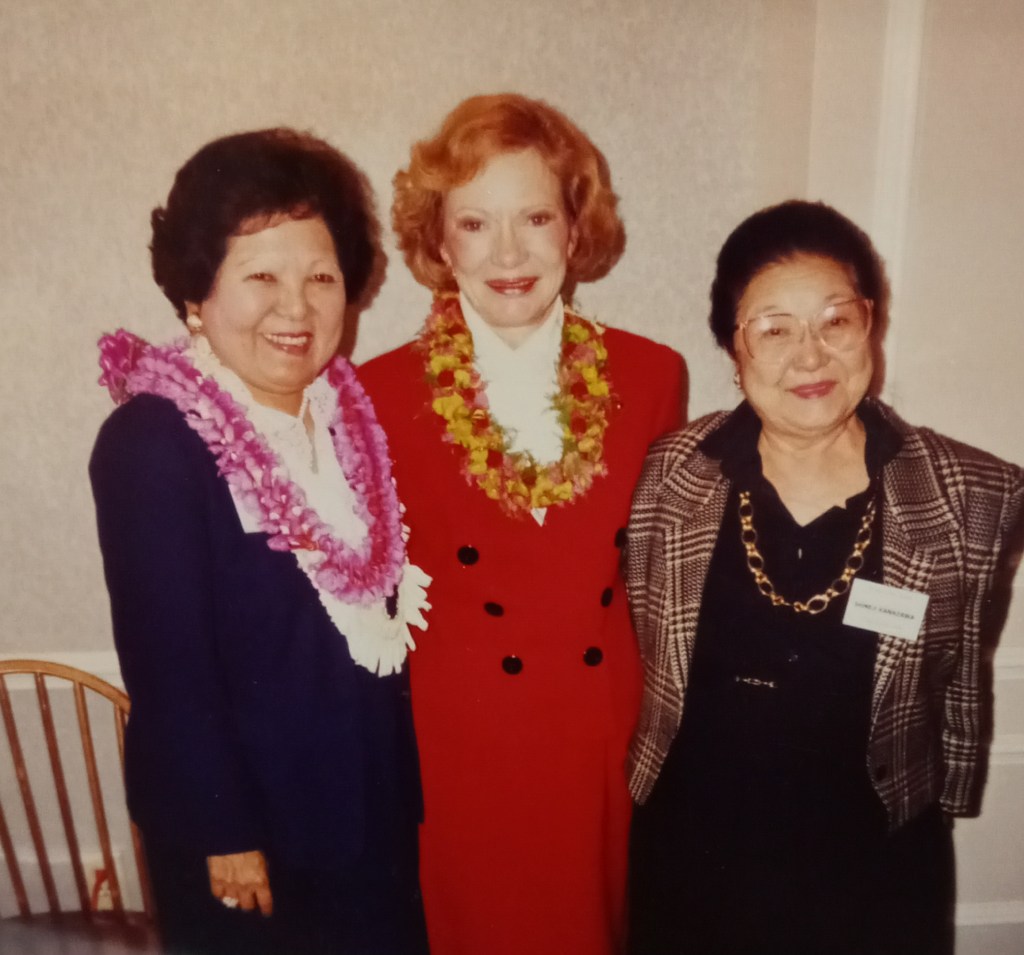
On Feb. 22, 1994, Mrs. Carter was welcomed in Hawaii by approximately 200 Project Dana volunteers who had gathered in the social hall of the Honpa Hongwanji Mission headquarters on Pali Highway. She was in Hawaii for only two days and made a special appearance to meet Project Dana volunteers and staff members. Photos from that event show Project Dana volunteers shaking her hand and posing for photos.
In her remarks, Mrs. Carter said that she thought the best way to put one’s faith into practice was to help those who were less fortunate. She said that Project Dana was a program that needed to be replicated across the country.
But that wasn’t the end of Mrs. Carter’s connections to Project Dana. In her book, “Helping Yourself Help Others: A Book for Caregivers,” which was first published in 1994 and reprinted a number of times since then, Mrs. Carter devotes a section of the book to interfaith volunteer caregivers. Within that section, she specifically mentions the work of Project Dana and names Rose Nakamura and Shim Kanazawa for their roles in setting up and sustaining the program. She also acknowledges the many hundreds of volunteers who practice dana, the act of selfless giving.
Interfaith volunteer caregivers help those in need regardless of their faith and “do so with-out any attempt to proselytize,” she wrote. While they don’t replace formal services, they can help fill in the gaps.
“Motivated by faith, the volunteers quickly develop a lasting relationship with the people they serve and often become family to one another. They receive training from professionals so that they are comfortable, confident, and competent when called upon to provide assistance.” Project Dana received two autographed copies of her book.
When Project Dana celebrated its 25th anniversary on Sept. 20, 2014, Mrs. Carter recorded video remarks that were shown to the audience in the Pomaikai Ballroom at Dole Cannery in Iwilei, and Dr. Leisa Easom, Executive Director of Rosalynn Carter Institute for Caregiving at Georgia South-western State University, delivered the keynote address in person. Dr. Easom then wrote about Project Dana in the December 2014 edition of “The Caregiver’s Advocate,” the institute’s newsletter.
“Take a moment to think about this,” Dr. Easom wrote, reflecting on her time in Hawaii as part of Project Dana’s 25th anniversary celebration. “If we in our own congregations could set up a volunteer program to assist each other, especially those that are aging and/or disabled. We could spend two to four hours each week reaching out to those that are hurting. Our actions could make a huge difference in combating the isolation and challenges faced by many caregivers.”
Even as far away as Mrs. Carter’s hometown in Americus, Georgia, Project Dana – at that time headquartered in the “little blue house” on Nakookoo Street in Moiliili – was on the mind of those who operated the institute named in honor of the former first lady.
As the years passed, Mrs. Carter and her husband won praise and widespread respect for their efforts “to resolve conflict, promote human rights, improve global health, and build democracy in some 65 countries,” as described in her brief biography on the White House’s website. She was also known for helping build houses through the organization Habitat for Humanity.
That organization released a statement after Mrs. Carter’s death saying, “With Rosalynn Carter’s passing, Habitat for Humanity has lost one of our most ardent and dedicated volunteers. As we join the world in mourning the death of a remarkable leader, we reflect on the life of a woman who used her platform to make a difference for those in need of affordable housing.”
The statement ended with these words: “We are strengthened by her example and comforted by the memory of a life dedicated to helping others.”
In May, Mrs. Carter’s family publicly revealed that she had dementia. They wanted to share this information with the public to encourage people to talk about dementia with their own family members and healthcare providers to help decrease the stigma surrounding mental health, a cause that had been near and dear to Mrs. Carter’s heart.
Project Dana is privileged to have enjoyed a longtime connection to Rosalynn Carter, whose highly visible and vocal support of caregivers was genuinely transformative and groundbreaking. She took the time and effort to recognize and remember Project Dana over a period of decades, and for that Project Dana is deeply grateful and will honor her memory through a continuation of the mission envisioned by Project Dana’s founders.
It is no wonder that among former first ladies, Rosalynn Carter is remembered with such affection, respect and reverence. She was the real deal, and she did much good for people outside the glare of public attention. Her engagement with Project Dana is but one of many examples of this, I’m sure. Although her residency in Hawaii was relatively short, she embodied the aloha spirit and spread it wherever she traveled. The flower lei worn by her family members was a poignant reminder of that.
Aloha ‘oe, Mrs. Rosalynn Carter, and mahalo.
 Sign up for our FREE morning newsletter and face each day more informed.
Community Voices aims to encourage broad discussion on many topics of community interest. It’s kind of a cross between Letters to the Editor and op-eds. This is your space to talk about important issues or interesting people who are making a difference in our world. Column lengths should be no more than 800 words and we need a photo of the author and a bio. We welcome video commentary and other multimedia formats. Send to news@civilbeat.org. The opinions and information expressed in Community Voices are solely those of the authors and not Civil Beat.

Local reporting when you need it most
Support timely, accurate, independent journalism.
Honolulu Civil Beat is a nonprofit organization, and your donation helps us produce local reporting that serves all of Hawaii.
ContributeAbout the Author