

Miske Trial: ‘Master Manipulator’ Or ‘Self-Made Businessman’?
After a prolonged jury selection process, the trial of the accused Honolulu racketeering boss began with opening statements.
Michael Miske Jr. appeared as a lone defendant Monday in U.S. District Court in Honolulu after his half brother pleaded guilty to a racketeering charge hours before opening statements began.
The defense and prosecution painted starkly different pictures of Miske. Prosecutors described him as a “master manipulator” who ran an extensive enterprise of “thugs” engaged in violent robberies, assaults, kidnapping and murder.
Defense lawyer Michael Kennedy touted Miske’s success as a businessman and said he had helped save many “iconic places” with his fumigation business, Kamaaina Termite and Pest Control.
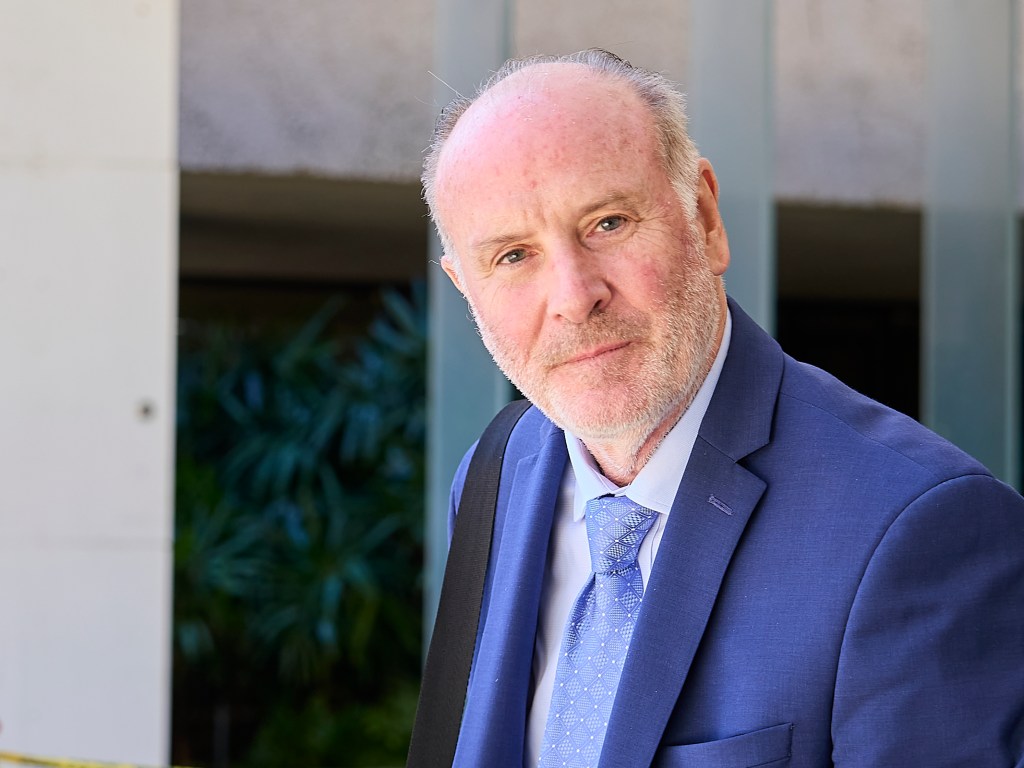
Miske is under a 22-count indictment, with charges including murder in aid of racketeering and murder-for-hire conspiracy resulting in death, both of which carry mandatory minimum life sentences upon conviction. He has pleaded not guilty to the charges and has remained in federal custody since his arrest in July 2020.
His half-brother John Stancil — the last remaining co-defendant in a case that at one point included a dozen of them — entered into a last-minute deal with prosecutors. Stancil pleaded guilty to one charge of racketeering. His attorney, Walter Rodby, said it was “not a cooperation agreement.”
He faces a maximum term of imprisonment of 20 years and a fine of up to $250,000 on the racketeering conspiracy charge, as well as supervised release of up to three years after completing the prison sentence.
All but two of Miske’s original co-defendants have agreed to testify against him.
As opening statements began, the gallery was nearly filled with members of the media, public observers, and individuals with personal connections to the case, including relatives of Miske and the mother of Johnathan Fraser, the 21-year-old whom Miske is accused of conspiring to kidnap and kill in 2016.
Prosecutors Emphasize Miske’s ‘Reputation For Violence’
Assistant U.S. Attorney William KeAupuni Akina spoke first and told the 18 jurors present that Miske used “fear, violence and intimidation to get what he wanted,” which he said was money, control and revenge.”
He also summarized multiple crimes Miske and his associates are accused of committing over the course of 20 years.
Akina said Miske wanted to kill Fraser as revenge for his son’s death from injuries suffered in a 2015 car accident, even though evidence later showed Caleb had been behind the wheel at the time.

Akina said that, despite the fact that Fraser’s body has never been found, jurors will know “beyond a reasonable doubt” at the end of the trial that Miske and his associates kidnapped and killed the young man.
“There could only be one price to pay for the death of the defendant’s son,” Akina said. “A life for a life.”
He described a language of codes and analogies he said Miske used to dictate the level of violence he wanted to see carried against various targets. “First base” meant assault, “second base” was a signal to send someone to the hospital, “third base” meant he wanted the victim in a coma, and a “home run” was a murder, Akina said.
Miske, who owned multiple businesses, including Kamaaina Termite and Pest Control and a few nightclubs, worked with a circle of violent people, some of whom he groomed from a young age, Akina said.
He gave jurors multiple examples of Miske’s vengeful behavior, such as a time he invited the owner of a rival nightclub into his office and beat him so badly that the man’s “face looked like hamburger meat” when it was over. Miske then also released a potent chemical, chloropicrin, that he obtained through his fumigation business into the rival club causing “panic and mayhem” among patrons, Akina alleged.
“It didn’t matter if it was a customer, if it was a stranger, if it was a police officer,” he said. “The defendant embraced his reputation for violence.”
Defense Focuses On Miske’s Business
When it was Kennedy’s turn to make his statement, he walked back and forth in front of jurors as he spoke, gesturing with his hands and at times walking over to Miske to lay a hand on his shoulder.
For around 30 minutes, the defense played clips of TV news stories detailing various fumigation projects carried out by his Kamaaina Termite company. Some clips showed a young Miske telling a reporter that he’d complete a $200,000 fumigation project at the Neal S. Blaisdell Center free of charge as a gift to the city.
“Iconic places, innovative projects, cultural treasures,” Kennedy said. “That’s what Kamaaina Termite is known for.”
Special Report
 Read all of Civil Beat’s coverage on the Michael Miske case. Subscribe to our free Morning Beat newsletter to never miss an update.
Kennedy also described Miske’s difficult childhood after his father died by suicide when Miske was six. Miske wiped his eyes with a tissue as Kennedy told jurors that he’d lived with a sense of abandonment all his life.
“Mike grew up real hard,” Kennedy said. “Mike grew up on the streets trying to figure out how to make it, how to work, how to get somewhere.”
When Kennedy spoke about the accident involving Fraser and Miske’s son, his story contradicted the prosecution’s version. He said Miske never blamed Fraser for the accident, but rather blamed the driver of a truck who had turned left at high speed in front of the car Fraser and Caleb were in.
Caleb died as a result of an infection that developed in his leg and spread to his heart and then his brain, Kennedy said. Miske blamed himself for his son’s death because he had previously decided not to have doctors amputate his son’s leg, Kennedy said.
He also said Fraser should still be considered a missing person and his client had nothing to do with his disappearance.
“After all these years, (prosecutors are) going to ask you to convict Mike of kidnaping and murder without answering, ‘How? Who? Where? When? And why?” he said.

