Just $1,025 remaining of our $10,000 match! Give now and DOUBLE your support for local, independent news. 

Join over 40 new donors who have made a gift to Civil Beat so far!

Double my donation

Just $1,025 remaining of our $10,000 match! Give now and DOUBLE your support for local, independent news. 

Join over 40 new donors who have made a gift to Civil Beat so far!

Double my donation

David Croxford/Civil Beat/2024

About the Author

Ben Lowenthal

Ben Lowenthal grew up on Maui. He earned his undergraduate degree studying journalism at San Francisco State University and his law degree at the University of Kansas. He is a deputy public defender practicing criminal defense in trial and appellate courts. He also runs “Hawaii Legal News,” a blog covering Hawaii appellate courts. The author's opinions are his own and don't necessarily reflect those of Civil Beat.

Plans for converting Honolulu’s Bethel Block into affordable housing won’t make a dent in the shortage any time soon.

It’s undeniable that we are facing a housing crisis. On Maui and certainly on Oahu, there just are not enough places to live and the cost of living continues to rise. Many now expect that working class and middle-class families will be priced out.

Most folks get it.

The median price of a single-family home last month on Maui came to $1.3 million. On Oahu it’s not too far behind where the median is around $1 million.

There certainly is a need to build more affordable homes across the state as quickly as possible.

Which is why House Bill 2328 aimed at converting the Bethel Block between downtown Honolulu and Chinatown into affordable rental units is strange.

The bill gives the Hawaii Public Housing Authority the power to acquire the property, buy the buildings on the block, and “plan, design, and construct any improvements necessary to use the parcels for affordable housing purposes.” 

So far it’s passed through two of the three committees and is awaiting review by the House Finance Committee. But even if it does make it through, and if the state does acquire the Bethel Block in the name of affordable housing, more obstacles lie ahead.

The Bethel Block stands between Bethel Street and the Fort Street promenade on one end, and between Pauahi Street and the narrow Chaplain Lane on the other. While it is not located within Chinatown’s historic district, the buildings have a long and rich history.

The three-story building on the corner of Fort Street and Chaplain Lane is a grand, stone building that used to be the Blaisdell Hotel. It got its name from Cora Blaisdell, whose grandson, Neal, went on to become a moderate Republican and mayor of Honolulu in the 1950s and ‘60s.

The former Blaisdell Hotel has seen a variety of tenants and businesses over the years and is on the land parcel that has been identified as a location for affordable housing. (David Croxford/Civil Beat/2024)

When the Blaisdell opened in 1913, it was Honolulu’s “Newest and Most Modern Hotel” with a telephone in every room. It featured a birdcage elevator with brass-colored trim, dim lights and required a living, breathing, elevator operator to run the machine up and down the building. The elevator, complete with an operator, is still around, making it the last of its kind in the state.

Over the years the low rent and different owners of the Blaisdell Hotel and the other buildings on the block brought a variety of businesses and tenants. In the 1980s and ‘90s, it was the headquarters of the Gay Community Center and the American Civil Liberties Union.

This was the nerve center for gay activists in Hawaii. It’s where same-sex couples planned on getting their marriage license and strategized on the legal challenge that eventually made its way to the Hawaii Supreme Court in 1993. That made us the first state to recognize same-sex marriage — a good 22 years before the Supreme Court of the United States came around to it in 2015.

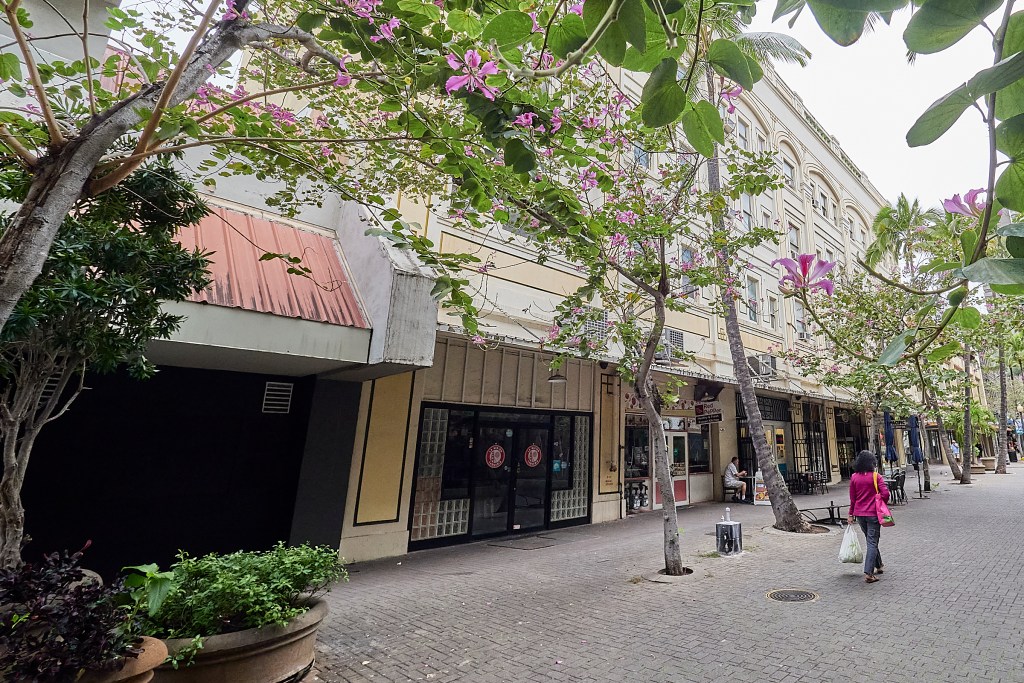
These days, the Bethel Block attracts an eclectic group. There’s a rehearsal space for punk rock and metal bands who practice on weeknights. Next to that is Proof Social Club, a small bar tucked away on Chaplain Lane that features feminist art shows, live music and on most nights is a quiet place to have a drink. Around the corner on the other end of the block is Scarlet, a nightclub and home of a regular drag show.  

In short, the block fits perfectly among the art galleries, bars and theaters in the space between Chinatown and downtown. But all of that may be a thing of the past if the state turns it into residential units.

It would be a terrible loss for the city. The Blaisdell Hotel and the other buildings along Bethel Street including the modernist Ohia Building built in 1961 and the Whitlow building from 1952 are considered “historic property” by law.

They could also qualify under various state and national registers because of their historical status and architecture. 

The Bethel Block fits perfectly among the art galleries, bars and theaters in the space between Chinatown and Downtown and includes historic buildings like the old Blaisdell Hotel, the Whitlow and the Ohia buildings, all named in legislation proposing their conversion into affordable housing. The Proof Social Club can be seen center right. (David Croxford/Civil Beat/2024)

That means before the state can renovate, refurbish or even tear down and build affordable housing, the project proposal would have to be sent over to the State Historic Preservation Division for review and “written concurrence.” And that is likely to slow down any renovation process dramatically.

Which is what makes the Bethel Block such a curious choice for affordable housing in the middle of an acute housing crisis.

It’s true that Hawaii must do something about the severe shortage of affordable housing in the short term. Too many people are feeling the squeeze and are looking to leave the state for a more affordable cost of living. Politicians have made their promises to deliver affordable housing projects stat. Developers, contractors, labor unions, and others looking to profit from the building project are certainly on board too.

But turning those buildings on the Bethel Block into affordable housing will not only displace the tenants, artists and businesses, but no affordable housing will be coming to the area any time soon. And all the while, a privately owned underdeveloped parking lot sits right across the street.

It’s deeply troubling. The housing crisis is certainly one of the great issues of our generation here. As my colleague, Naka Nathaniel, recently put it, “we seem close to the threshold of becoming a place where only the wealthy thrive.”

We must do something about it, but not at the expense of destroying historic spaces where businesses, artists, and local culture already thrive.


Read this next:

Shootz! A Rally For Sara Yara And A Sensational Court Appearance


Local reporting when you need it most

Support timely, accurate, independent journalism.

Honolulu Civil Beat is a nonprofit organization, and your donation helps us produce local reporting that serves all of Hawaii.

Contribute

About the Author

Ben Lowenthal

Ben Lowenthal grew up on Maui. He earned his undergraduate degree studying journalism at San Francisco State University and his law degree at the University of Kansas. He is a deputy public defender practicing criminal defense in trial and appellate courts. He also runs “Hawaii Legal News,” a blog covering Hawaii appellate courts. The author's opinions are his own and don't necessarily reflect those of Civil Beat.


Latest Comments (0)

Thanks for the research and very well-written insight into another band-aid project. Unless enjoined as with the Felix decree, the state and its subdivisions will continue to violate the mandatory requirements of Hawaii's constitution including:Correct me if I am wrong, but aren't there approximately 4 million acres of land in Hawaii with the state government owning most of it? Isn't it also correct that when Hawaii became a state, about 1.4 million acres of this land went to the State of Hawaii? A fair amount of this hoarded land is flammable. And. of the total acres that the state owns, only 198,896 acres are designated to the Hawaii Department of Hawaiian Home Lands?

solver · 2 years ago

This does not appear to be the most efficient (i.e., highest and best) use of government resources for an HPHA project (funded by taxpayers).Despite it's historical shortcomings, I try to be open to public housing projects given our housing crisis, but this small block of very old buildings (as noted, designated for historical preservation) will require intense redevelopment work in an already heavily congested area. To clarify, I'm not objecting to the common NIMBY concept that the project will cause congestion, rather I'm saying the existing congestion will cause significant delays and cost overruns (that will be borne by the taxpayer). And the historical status will cause incremental delays also resulting in wasted spending for taxpayers.The HPHA already has a huge backlog of much larger projects (e.g., Mayor Wright, School street) and there are areas of the island where it'd be much cheaper to build larger scale projects.Like other commenters have suggested, I'm suspicious and would love to understand if there's any relationship between the owner of the land/buildings and the introducer/proponents of the bill (introduced by Scott Saiki based on my quick search).

Ross_ · 2 years ago

It's so easy to say No to housing. No housing here because of the tenants, no housing in Manoa because of "drainage", no housing in Ho'opili because we need agriculture, no housing in Kailua because of shadows. At least the author is willing to acknowledge the housing shortage. But the thing is, most NIMBYism is prefaced with "I believe we need Affordable Housing-- just not here, not in my backyard. My neighborhood is too special. And this article falls into the same trap, in that we don't need housing in this one place. However, if everyone on O'ahu says that housing isn't needed in this one place (and has a veto on it) no housing gets built anywhere. It's hard to say yes to change. It takes leadership and courage, which most politicians lack (save for Gov. Green, and Sen. Chang on occasion). And I bet if you polled everyone on the island, stated the facts of the case, they'd say "build it". But because it's so easy to say no, you get the angry mobs in Manoa shouting down housing for seniors on a vacant lot, and you get articles like this pointing out all the reasons why housing can't go here. When are we going to start saying yes?

george808 · 2 years ago

Join the conversation

About IDEAS

Ideas is the place you'll find essays, analysis and opinion on public affairs in Hawaiʻi. We want to showcase smart ideas about the future of Hawaiʻi, from the state's sharpest thinkers, to stretch our collective thinking about a problem or an issue. Email news@civilbeat.org to submit an idea.

Mahalo!

You're officially signed up for our daily newsletter, the Morning Beat. A confirmation email will arrive shortly.

In the meantime, we have other newsletters that you might enjoy. Check the boxes for emails you'd like to receive.

  • What's this? Be the first to hear about important news stories with these occasional emails.
  • What's this? You'll hear from us whenever Civil Beat publishes a major project or investigation.
  • What's this? Get our latest environmental news on a monthly basis, including updates on Nathan Eagle's 'Hawaii 2040' series.
  • What's this? Stay updated with the latest news from Maui.
  • What's this? Weekly coverage of Hawaiʻi Island news and community.

Inbox overcrowded? Don't worry, you can unsubscribe
or update your preferences at any time.