Beth Fukumoto: 5 Rules For A Great Political Speech
Captivating speeches should compel the audience to do something about a collective problem or continue acting on a successful solution.
February 2, 2024 · 6 min read


About the Author

The start of the Hawaii State Legislature ushers in a week of elected officials’ ritualistic speeches outlining policy announcements and legislative priorities for the coming year.

Coverage of the policies introduced in legislative leaders’ opening day remarks and the governor’s State of the State address is abundant. Infrastructure and housing are Gov. Josh Green’s “top statewide priority.” The Senate president plans to improve food security through farm-to-school programs. The speaker of the House wants to ensure that “the needs of local people come first.”
While sound policies and evidence-based solutions should be the backbone of a politician’s statements, political speeches – especially these big ones – do more than deliver information. During my tenure in the state House, I gave three opening day speeches. In addition to introducing my caucus’ priorities, each speech was an opportunity to show the audience why we cared and set the tone for our engagement in the upcoming session.
Crafting these speeches requires accurately assessing your audience and strategically developing a persuasive argument that will resonate with that audience to lay the groundwork for collective action. Through the process of drafting my remarks, I learned many dos and don’ts. These five are the most important for both delivering and decoding political speeches.
You Can’t Escape Context
As a speaker, you need to know the situation you’re in. Understanding the political climate, the audience’s anxieties, and what’s happening in the world allows you to tailor your voice, ensuring your message lands with your audience.
In each of their speeches, the governor, Senate president, and House speaker centered their remarks on Maui’s devastating fires and the exacerbated issues of housing, health care, and environmental protection. Their policy announcements were linked mainly to these issues that apply to Lahaina’s current crises and the state’s ongoing needs.
As a listener, peeling back the layers of context can help decipher the speaker’s intentions or the pressures they’re facing. For example, if polls suggest that the cost of living will impact the next election, you can bet politicians will start discussing solutions in their speeches.

There Must Be A Call To Action
Captivating speeches should compel the audience to do something about a collective problem or continue acting on a successful solution. Most speakers will have an explicit call to action that’s the central theme of their speech.
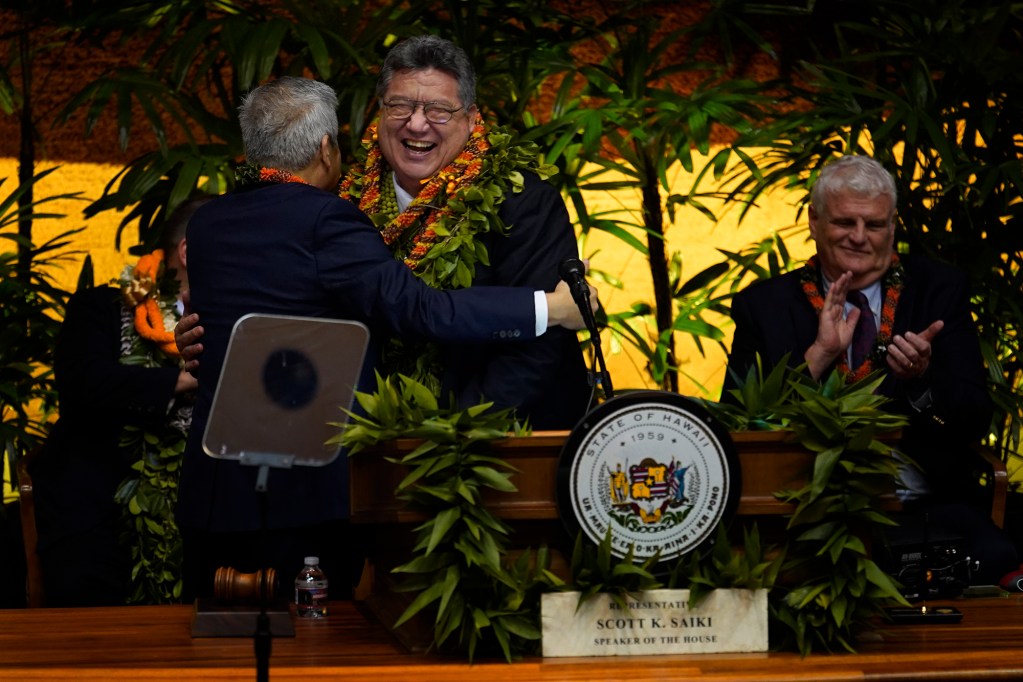
House Speaker Scott Saiki closed his opening day speech, stating, “Hawaii requires much of us, and we can together do our part.” Later, in her remarks, House Minority Leader Lauren Matsumoto calls on her colleagues to lead with “kindness and respect.”
While calls to action are most commonly the closing line of a speech, implicit calls should be scattered throughout. Stories and emotional appeals push audiences to actively participate in the speaker’s vision, making explicit calls to action more likely to succeed.
Sharing a vulnerability, a struggle, or a moment of triumph can instantly bridge the gap and create empathy.
Supporters, Opponents And Those In Between
For better or worse (usually worse), being part of a tribe tends to motivate people. So, most speakers outline “in-groups” and “out-groups” when calling people to action in their speeches.
Saiki spent a significant portion of his opening day remarks introducing new House members, recognizing community members, and praising individual House members for their participation in various House working groups. The audience he focuses on, the in-group he creates, appears to be legislative insiders and active community members. He later expands that group by stating that the House will put the needs of local people first after citing an ongoing incursion of outside interests, his out-group, on the state.
Green exercised this concept differently when addressing his “Emergency Proclamation Relating To Housing,” working to draw those who opposed the proclamation back into his in-group.
“Make no mistake. I know I ruffled a few feathers when we took this action, but we have to provide housing for our local people,” he begins, acknowledging his dissenters yet defending his initial action. Then, he continues by recognizing their concerns and pointing out his effort to compromise through an updated proclamation to “build more affordable housing while protecting our precious natural and cultural resources and preserving the unique character of Hawaii.”
A Personal Connection Is The Quickest Path To Credibility
While a laundry list of accomplishments might seem like the best way to establish credibility, it often leaves audiences feeling disconnected from the topic or the speaker. Sharing a vulnerability, a struggle, or a moment of triumph can instantly bridge the gap and create empathy.
Of course, oversharing or using personal stories as a smokescreen for a lack of substance can backfire. The key is to find the right balance and develop an emotional connection with your audience without sacrificing the weight of policy and experience.
Senate President Ron Kouchi walked that line well on opening day when he announced the Senate’s plan to expand access to pre-K. While he articulated the state’s need clearly, he illustrated the need for a solution by describing a FaceTime call with his grandson, who is now in his wife’s care full time. His wife’s decision to focus on child care involved a sacrifice that, he says, other families are also forced to make. He speaks directly to those families and says, “You can count on me.”
Delivery Will Make Or Break Your Impact
Last but not least, speakers need to remember that delivery starts when you step on stage. Everything from your gait, posture, and gestures to your voice’s pitch, pace, and volume affects how your words will land with your audience.
Again, Kouchi does this well with an uncanny ability to transition between serious and casual tones instantly. Very few speakers can successfully wedge a Martin Luther King Jr. quote about the “fierce urgency of now” between the words “good food waiting” and “I’ll shut up.”
By following these five rules, speakers can deliver more effective speeches. But, more importantly, as listeners, we can use these rules to better understand how politicians’ speeches are impacting us. In doing so, we have the opportunity to be more discerning about which calls to action we actually want to take up and less likely to get caught up in pure rhetoric.
 Sign up for our FREE morning newsletter and face each day more informed.

Local reporting when you need it most
Support timely, accurate, independent journalism.
Honolulu Civil Beat is a nonprofit organization, and your donation helps us produce local reporting that serves all of Hawaii.
ContributeAbout the Author