Supporting Biki Means Supporting A Robust Bike Share Program For Oahu
Bicycles offer affordable transportation and mental and physical health benefits.
May 13, 2024 · 4 min read

About the Author

In a recent transportation news story published by Honolulu Civil Beat, readers learned some of the backstory about why Biki is raising rates.

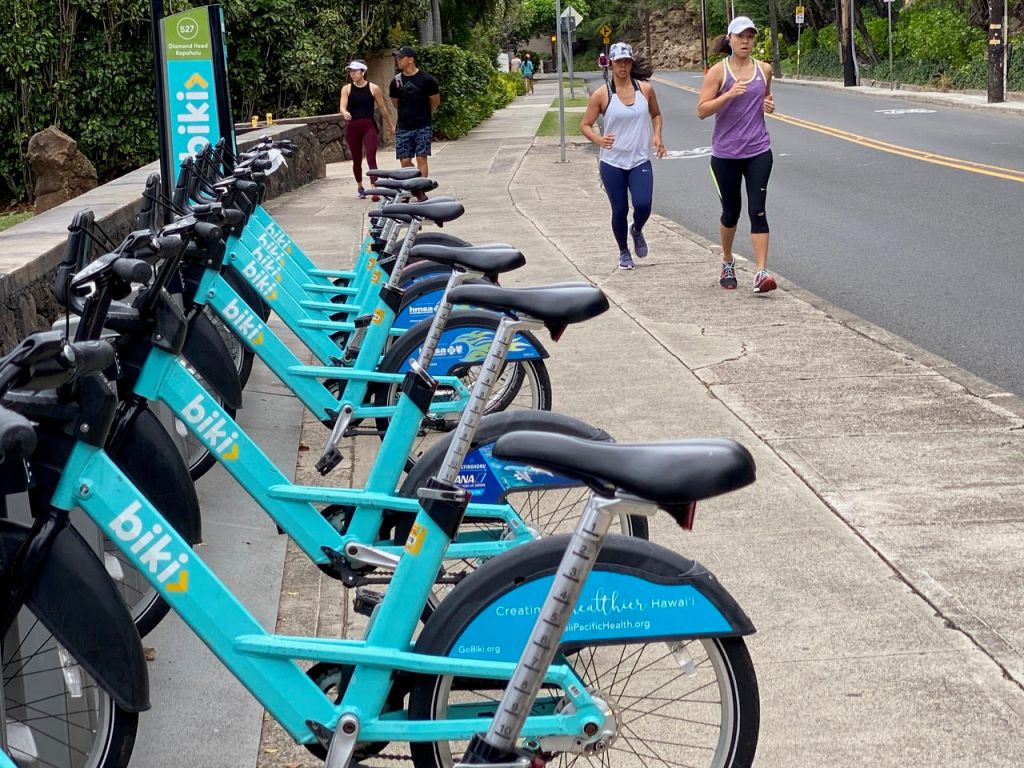
Hawaii Bicycling League supports Biki’s fare increase as it helps to ensure a robust bike share system for Oahu. Two-hundred eighty-eight new bicycles will soon be on the way to Honolulu.
For nearly 50 years, HBL has championed a vision that a bicycle is a viable and accessible solution to many challenges facing individuals, families and communities across the islands.
A bicycle offers affordable transportation as well as numerous mental and physical health benefits. In times of emergency, it can speed evacuation away from danger and operate more nimbly in cases when a road may be blocked by debris.
When adopted at scale, cycling is proven to create jobs and increase spending in local communities while also creating more affordable transportation networks and options.
Oahu voters have repeatedly asked their government for solutions that help us to walk, ride and roll safely on local roads, while also building capacity for sustainability and resiliency in the face of a global climate crisis.

In 2006, 72% of voters adopted an amendment to the Revised Charter to make the island more pedestrian- and bicycle-friendly (codified as Section 6-1706). In 2016, nearly 55% of voters adopted a Charter Amendment to create the Office of Climate Change, Sustainability and Resiliency (codified as Section 6-107 and today known as the Resilience Office).
These voter demands for improved bicycling infrastructure and programs that measurably reduce carbon emissions locally, were a driving force behind the conception and launch of Biki, beginning in 2014.
Over the last 10 years HBL has been a strong supporter and ally for Biki and we have hosted approximately 50 “Biki Basics” workshops, as well as regularly reporting about Biki in our e-newsletter, linking thousands of riders to bike-sharing skills and resources during this time.
Biki quickly and deservedly earned international recognition as one of the most popular bike share systems in the U.S. and Canada based on factors such as ridership, system size and user satisfaction. In 2022, Honolulu ranked eighth across the U.S. and Canada for the total number of trips taken, ahead of Vancouver, British Columbia, and Philadelphia.
In 2023, there were nearly 800,000 Biki trips taken in Honolulu, representing 1.6 million miles traveled, 1.9 million pounds of carbon use avoided and 65 million calories burned. Most impressively, Honolulu demonstrated higher average utilization/rides per vehicle per day (2.6 r/v/d) as compared to all station-based bike systems across North America (1.9 r/v/d), including those that offer e-bikes (2.2 r/v/d).
Biki is a shining example of a public-private partnership that is delivering beneficial transportation and sustainability impacts to Honolulu’s urban core. It is also a key transportation option for low-income residents.
Last year, Biki pioneered “Everybody Rides,” an expanded access membership program for qualified low-income participants. This program offers unlimited 30-minute rides for $10 per month and helps address social determinants of health that disproportionately impact Native Hawaiian and Pacific Island populations.
Bike share services are sometimes mistakenly perceived as niche services primarily utilized by tourists or delegated for recreational use. The reality in Honolulu and around the world is quite the opposite; bike share represents a vital, affordable transportation option providing equitable connections to places of work, education and essential services including healthcare, businesses and government services.
Everyone deserves safe places to walk, ride and roll.
While ridership numbers for Biki have declined since 2021 as noted in the Civil Beat article, we remain convinced that bike share is an essential part of Oahu’s overall transportation network and future. This is because it offers one of the most affordable transportation methods on the island, even factoring in new higher rates that begin in June.
Moreover, there needs to be more options beside fossil-fuel-powered personal vehicles, which make up about 90% of the ground transportation GHG emissions, according to the city’s Climate Action Plan.
As HBL looks ahead to our 50th anniversary, we are continuing to advocate for a continuum of active transportation options, as well as cornerstone strategies like Complete Streets and the goal of Vision Zero.
Everyone deserves safe places to walk, ride and roll. A robust bike share system supports these concepts while building multimodal capacity that strengthens and leverages all other components of our current and future transportation network.
This is a value proposition that benefits everyone, whether you use Biki today or will tomorrow.
 Sign up for our FREE morning newsletter and face each day more informed.
Community Voices aims to encourage broad discussion on many topics of community interest. It’s kind of a cross between Letters to the Editor and op-eds. This is your space to talk about important issues or interesting people who are making a difference in our world. Column lengths should be no more than 800 words and we need a photo of the author and a bio. We welcome video commentary and other multimedia formats. Send to news@civilbeat.org. The opinions and information expressed in Community Voices are solely those of the authors and not Civil Beat.
Read this next:

Local reporting when you need it most
Support timely, accurate, independent journalism.
Honolulu Civil Beat is a nonprofit organization, and your donation helps us produce local reporting that serves all of Hawaii.
ContributeAbout the Author