Court Ruling Could Have Major Impact On State Oversight Of The Office Of Hawaiian Affairs
Lawyers for OHA say the state does not have the authority to fine trustees for ethics violations. The Attorney General’s Office disagrees.
July 21, 2024 · 6 min read

About the Author

What began as a $23,000 fine for dozens of violations of the state ethics code five years ago has evolved into a constitutional argument over the independence of an agency mandated to better the lives of Native Hawaiians.
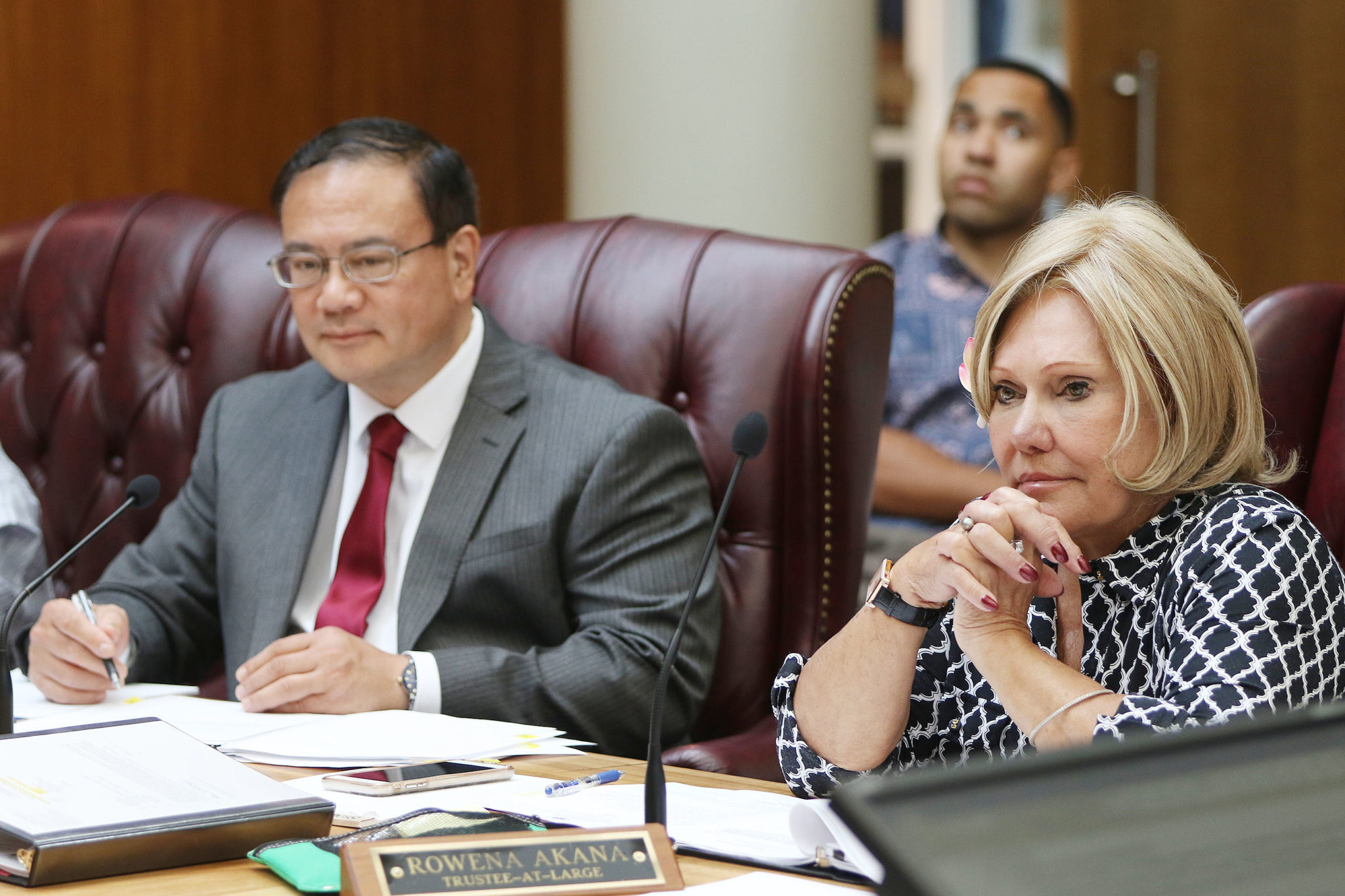
The lawsuit, Rowena Akana vs. Hawaii State Ethics Commission, was heard by the Hawaii Supreme Court Tuesday. While a decision is not expected until later this year, the ruling could significantly affect how the commission as well as the Office of Hawaiian Affairs operates.
Attorneys for Akana, a former longtime OHA trustee, argue that the ethics commission did not have the authority to fine Akana for 47 violations of the state ethics code, as it did in 2019.
The commission determined that the trustee had accepted illegal gifts valued at over $21,000, failed to report gifts valued at over $50,000 in a timely manner and used her annual trustee allowance for personal benefit or political contributions.
The violations included claiming reimbursement for home cable television service, buying food for her and OHA staff, an Apple iTunes gift card and Hawaiian Airlines Premier Club membership.
In its legal brief, attorneys for OHA urge the high court to reverse a decision by the Intermediate Court of Appeals in January of this year that affirmed the ethics commission’s actions. At the core of OHA’s argument is that, because OHA trustees use proceeds from ceded lands, OHA alone has discretion over how those resources are used.
“The outcome of this appeal will have ramifications well beyond Petitioner-Appellant’s rights, which may impact or impede OHA and its trustees from fulfilling their duties,” the brief states. Those duties include a trustee’s fiduciary obligations.
Created by the 1978 Constitutional Convention and legislative action the following year, OHA is a semi-autonomous state agency mandated to improve the well-being of all Native Hawaiians regardless of blood quantum. The work of the nine trustees and offices involves advocacy, research, community engagement, land management and funding community programs.
Ceded lands are 1.8 million acres of former government and crown lands from the Hawaiian Kingdom, which was overthrown in 1893. They were transferred to the U.S. after the overthrow and then to the state in 1959.
OHA argues that, under the Hawaii Constitution, the agency is its own political subdivision akin to the four counties in the state. The counties have separate ethics commissions and ethics codes “not administered or enforced” by the State Ethics Commission.
The brief acknowledges that OHA adopted the state ethics code as the guidelines for its trustees, as it has not set up its own separate ethics commission. It’s up to the Supreme Court, the brief concludes, to decide not only whether OHA is subject to the jurisdiction and authority of the state but also whether OHA is permitted to set up its own ethics commission to oversee itself.
In its response, the attorney general’s brief counters that the case is not about whether the ethics commission has the authority to shape how OHA trustees use ceded land proceeds. And the ICA’s ruling against OHA does not threaten its semi-autonomy nor impinge on fiduciary duties.
Rather, it’s about whether the ethics commission has the authority to deal with violations of the state ethics code by OHA trustees as it does for other state employees.
“It unquestionably does,” the AG’s brief posits. “As state employees, OHA trustees are plainly subject to the State Ethics Code and, by extension, the Commission’s authority to enforce the code.”

The AG points out, for example, that OHA has held workshops and presentations with trustees regarding compliance with the state ethics code — known as Hawaii Revised Statutes Chapter 84 — and it regularly reminds them of their obligations. And OHA in its own executive policy manual says trustees “shall abide” by Chapter 84.
“And OHA trustees have certainly acted as if they are bound by the State Ethics Code (as they undoubtedly are),” the brief says. “Public records indicate, for example, that OHA trustees have long filed financial disclosure statements with the Commission, the Commission has responded to written requests for exemptions from OHA trustees, and OHA employees have completed the Commission’s mandatory ethics training.”
In oral arguments lasting over an hour on Tuesday, attorney Jim Bickerton, representing Akana, emphasized that OHA is not like other state agencies because of historical and legal circumstances, and that trustees have wide latitude in how they can use their allowances. He noted that OHA itself settled the dispute over Akana’s spending internally, as is its right. The policy manual, meanwhile, should not be interpreted as law.
Bickerton also argued that his client was targeted by her political opponents, including by some on the OHA board, noting that the allegations of ethics violations were made public just weeks before the 2018 November elections. Akana lost reelection, placing fifth out of six candidates in an at-large contest where the top three finishers were elected or reelected to the board.
But Deputy Attorney General Ewan Rayner said OHA is not a political subdivision like a county government, which has the power to police, zone and tax. And, while it owns land and property, OHA is not a geographical entity with sovereign powers.
In their questioning of the attorneys, Associate Justice Todd Eddins and Chief Justice Mark Recktenwald appeared skeptical of the political subdivision argument. But Associate Justices Sabrina McKenna and Vlad Devens seemed open to the contention that OHA is a unique agency, given its trust obligations, and so has some degree of independence from the state.
The five-member court did not indicate when it would rule, but decisions are typically made within six months or less.
 Sign up for our FREE morning newsletter and face each day more informed.
Read this next:
Local reporting when you need it most
Support timely, accurate, independent journalism.
Honolulu Civil Beat is a nonprofit organization, and your donation helps us produce local reporting that serves all of Hawaii.
ContributeAbout the Author