When Hawaii’s Local Elections Went Nonpartisan
The City and County of Honolulu was the first to abandon partisan races for mayor, council and prosecutor. Why? To take party politics out of elections.
July 28, 2024 · 8 min read

About the Author

On Nov. 3, 1992, Honolulu Mayor Frank Fasi managed to barely squeak by his opponent, Dennis O’Connor, to win reelection. His margin of victory was a mere 1.1 percentage points, or 3,220 votes out of more than 263,000 cast.
It would turn out to be Fasi’s last term in office, as he resigned two years later in an unsuccessful run for governor. Fasi was Honolulu’s longest-serving mayor, 22 years in all.
Less remembered today is that Fasi was also the last Republican mayor of the City and County of Honolulu. In that same election, Oahu voters approved a charter amendment making the county’s elections for mayor and City Council nonpartisan. (The city’s elected prosecuting attorney was made nonpartisan in 1978.)
Just four years later Kauai County followed suit, as did Maui County in 1996 (that county’s prosecutor is an appointed position) and Hawaii County in 2000.
Why the counties switched from partisan to nonpartisan races varies from county to county. But a major reason was the consensus view that party platforms have no real relevance to county responsibilities such as dealing with sewers, water, roads and the like.

“Partisan politics has little to do with local government,” states a report from Honolulu’s charter commission in 1992. “For the most part, city government is involved with providing basic public services to its inhabitants, and not with setting broad public policies. As such, partisan politics is superfluous to the operations of city government.”
Another report from the commission said that partisan election campaigns “may distract the attention of voters from the essential issues of the election.” The charter proposal was intended to “remove the issue of party politics” from city elections.
But the shift to nonpartisanship also demonstrates significant ways in which the counties have managed their governments differently as compared to the state. In that same 1992 election for Honolulu mayor, voters easily passed term limits for mayor and council.

In this manner county voters are able to directly alter their governmental structure.
The Hawaii Legislature and races for governor and lieutenant governor remain partisan and have historically been dominated by the Democratic Party of Hawaii. The Legislature has rejected several times putting a constitutional amendment before voters regarding term limits for senators and representatives.
Interestingly, it was party politics that almost cut short Fasi’s time in office. His opponent, O’Connor, was chair of the state Democratic Party who argued that it was time to throw Fasi out of office once and for all.
The reason: Fasi had previously run for mayor as a Democrat, serving from January 1969 until January 1981. But he lost to Democrat Eileen Anderson in 1980.

Four years later Fasi ran and won as a Republican and won again in 1988. That’s when Ronald Reagan was president — Reagan even won in Hawaii that year — and was succeeded by his vice president, George H.W. Bush.
Fasi, arguably Honolulu’s most popular, colorful, controversial and successful mayor, had angered many for changing his political stripes.
“He has committed probably the worst crime that we as a Democratic Party allow anyone to commit,” O’Connor, a former state senator and city councilman, told the party faithful at the 1992 state convention at the Sheraton Waikiki. “He, as a Democrat, switched to being a Republican purely for his own political gain.”
The Pros And Cons
Fasi himself supported the idea of nonpartisan elections. He told the charter commission that two out of three people who registered for the 1990 general election did not signify any party affiliation. Fasi thought that nonpartisan elections would encourage greater voter turnout.
But there was resistance. Councilwoman Donna Kim, who today is a Democrat in the state Senate, saw no benefit to eliminating partisan elections. She said that as a member of the council “she treats everyone equally and does not cast votes along party lines,” according to charter commission documents.
State Sen. Les Ihara, a Democrat, expressed concern that nonpartisan elections “may have a negative political impact on future elections” — for example, if a nonpartisan council member runs for the Democratic nomination for lieutenant governor against a Democratic senator. The council member, he argued, could be placed at “a distinct disadvantage” because the senator could be viewed as the more experienced party leader.

The Hawaii Government Employees Association also opposed going nonpartisan, as did the editorial page of the Honolulu Star-Bulletin.
“The idea has some superficial appeal; there’s no partisan way to collect rubbish, etc.,” the paper opined that October. “But Democratic, Republican and other political philosophy should have meaning in local government where candidates for higher office are often trained. Furthermore, it’s naive to think that partisan politicians wouldn’t be involved in city elections.”
Councilman Steve Holmes, however, “had no qualms” with holding nonpartisan elections, noting that he had no party affiliation when he ran for office.
“His position is to represent the people and not to be concerned with party affiliation,” according to a charter commission report.
The charter amendment passed 48% to 42%.
Principle Vs. Harmony
It was a closer election on Kauai in 1996, where voters approved nonpartisan elections 41% to 40%. That same election saw Republicans Bryan Baptiste and James “Jimmy” Tokioka elected to the county council (Tokioka later served as a Democrat in the Legislature) as well as Democrat Ron Kouchi, who today is the state Senate president.
After the election Kauai Mayor Maryanne Kusaka predicted that candidates themselves rather than party label would be the most important issue at election time.
Kusaka, a Republican, said Kauai was “a very Democratic island,” The Honolulu Advertiser reported. “There is an opportunity here for young people to work hard in the community and really make a difference.”
Maui came next.
“In essence, your committee noted that advocates for nonpartisan elections believe that the elimination of party-based elections would foster greater harmony and efficiency among elected officials,” according to a 1998 report from a county committee that included notable Maui politicians Alan Arakawa, Alice Lee, James “Kimo” Apana, Sol Kahoohalahala, Charmaine Tavares and J. Kalani English.
Apana, a Democrat, was elected mayor that same year, beating Arakawa, a Republican.

Kahoohalahala, who was then the County Council chair, told The Honolulu Advertiser before the election that it was voters themselves who wanted the ballot question because they were frustrated by the primary election system that limited them to choosing from among candidates of only one party.
Maui Democratic Party Chair Ryther Barbun, though, said nonpartisan elections would damage parties and increase the cost of running. It would also make it easier for incumbents to win, he added, because most voters given a list of names with no party affiliation would simply vote for the name they recognize.
In 1998 Maui County voters approved nonpartisan contests 48% to 39%.
Then, in 2000, Hawaii County went nonpartisan, too, making it a clean sweep. The vote was 51% to 40% and was held in the same general election that chose Republican Harry Kim to be mayor and Democrat Bobby Jean Leithead-Todd and the Green Party’s Julie Jacobson to serve on the County Council.
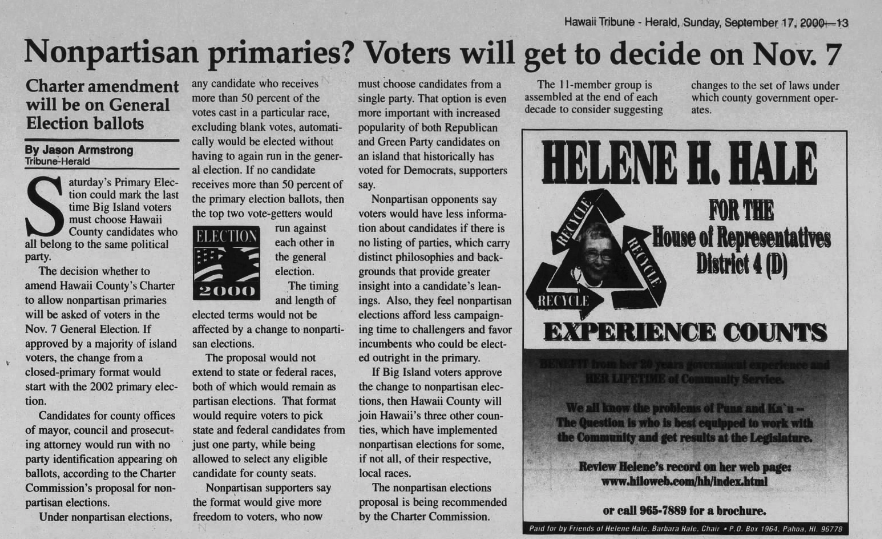
A few days before the election, Big Island political scientist Jim Wang said passage of the amendment would hurt the island’s political process by reducing the role of the party.
“The party’s role is to provide principles,” he told the Hawaii Tribune-Herald, which links voters with the demands of citizens to their elected officials.
But John Ray, charter commission chair, said, “I’m in favor of it personally, and if I had to bet a nickel, I’d bet that it would pass.”
Fasi, who died in 2010, ran his last race for mayor in 2004, finishing third in the primary.
In addition to running as a Democrat, Republican and independent, he also ran under his own creation, the Best Party. In 1994, he finished behind Democrat Ben Cayetano in the race for governor but ahead of Pat Saiki, the GOP nominee.
Today, it’s also obvious that politics had not entirely disappeared from local government. On the Honolulu City Council, for example, members include a former Democratic House speaker, a former Democratic chair of the state House Judiciary Committee, a former staffer for Hawaii Democrats in Washington, D.C., a former chair of the Democratic Party of Hawaii, a former Republican nominee for governor and a former minority leader in the Hawaii House of Representatives.
But they all got to the council in nonpartisan elections that did not limit primary voters to a single party.
 Sign up for our FREE morning newsletter and face each day more informed.
Read this next:

Local reporting when you need it most
Support timely, accurate, independent journalism.
Honolulu Civil Beat is a nonprofit organization, and your donation helps us produce local reporting that serves all of Hawaii.
ContributeAbout the Author