Kirstin Downey: A Fire That Echoes More Than A Century Later
Honolulu officials thought fire could stop the bubonic plague from spreading through the growing city. But high winds thwarted that plan.
January 24, 2025 · 10 min read

About the Author

On Jan. 20, 1900 — 125 years ago this week — an out-of-control, government-ordered fire in Chinatown destroyed the lives of thousands of people.
Local officials, terrified by a frightening pandemic emerging from China, had taken extraordinary measures to block the spread of a plague but their controversial efforts backfired and increased the trauma. It remains a mystery whether the final conflagration that burned down Chinatown was intentionally allowed to spread in an effort to wipe out the disease.

It was the “worst civic disaster in Hawaiian history,” wrote medical historian James C. Mohr, in his 2005 book, “Plague and Fire: Battling Black Death and the 1900 Burning of Honolulu’s Chinatown.”
“At its core lies the enduring dilemma of making public health policy in times of crisis on the basis of limited medical knowledge.”
Now, since the coronavirus pandemic and its restrictions, a battery of destructive fires has decimated communities across the West in recent years — including last year’s Maui fire and the blazes that are still burning in Southern California.
The events of Jan. 20, 1900, seem strangely familiar.
“There was an echo and a resonance that was hard to miss,” says Honolulu businessman and poet Wing Tek Lum, who has spent the last eight years, including during the pandemic years, writing a collection of poems, “The Oldtimers,” about life in Chinatown at the turn of the century.
His book, including a poem called simply “The Fire,” was published earlier this year.
He found himself reliving some of the anxiety that his immigrant grandfather, Lum Kip Yee, had suffered in 1899 and 1900, first living in fear of disease, then under a health quarantine, and then suffering a terrible economic loss when his retail store in Chinatown burned to the ground in the fire.
The same eerie deja vu affected Charles Richter, a historian with the American Association of Immunologists, who, in early 2020, was researching the Chinatown fire for an exhibit in Hawaiʻi on medical quarantines of an earlier era. Instead of a public exhibit, his work appeared only as a published article on the group’s website in July 2020 because of public health restrictions imposed during the pandemic.
The exhibit has been rescheduled for May.
In both cases — the Covid-19 pandemic shutdown and during the bubonic plague outbreak — government officials used the best available information at the time in crafting a response, Richter said.
“The government was doing whatever they believed was necessary to take care of a health problem,” he said.
In 1860, bubonic plague, a medieval terror known as the Black Death, made a reappearance in Asia.
It was reported to be spreading from rural villages in China to big cities, producing symptoms that Richter described as “painful and gruesome,” according to the article he co-wrote. A killer of tens of millions of people in previous centuries, bubonic plague is a bacterial infection that starts with a high fever, headache, chills and nausea and progresses to intense physical pain, overwhelming fatigue, swollen lymph nodes and the collapse of internal organs. Contracting it was believed to be a death sentence.
Now bubonic plague is easily treated with antibiotics but in the 19th century there was no known cure.
Scientists didn’t even figure out the cause of the disease until 1895, when a researcher in Bombay, India, provided evidence that flea-infested rats were the source of the infection. Doctors weren’t sure how to prevent or treat it. The disease inexorably made its way along busy trade routes at a time that new steam-powered ocean-going vessels made it easier to transmit infectious disease over long distances. Wherever it landed, it provoked panic.
In 1899, Honolulu was a commercial hub in the Pacific, but also a city rife with racial conflicts and political instability. A group of white businessmen had overthrown the Hawaiian monarchy and seized control of the kingdom, provoking anxiety and suspicion among the other ethnic groups in the islands. The United States annexed Hawaiʻi as a U.S. territory but many questions of governance had not yet been resolved. Cultural differences in Hawaiʻi about health and sanitation practices exacerbated these tensions.
In June, bubonic plague showed up in Honolulu. A Chinese passenger died on a ship, the Nippon Maru, which had stopped in Honolulu on route to San Francisco, according to Mohr. The captain asked for permission to take the man’s body ashore to arrange for shipment home to China, triggering a government health inspection. A local doctor determined the man had died of bubonic plague, and the territorial government ordered the ship quarantined. No one else got sick. After a week the ship was allowed to proceed to California.
Plague-carrying rats probably came on shore in Hawaiʻi during that interlude. The disease exploded in the island’s rat population, particularly near the harbor.
The closest neighborhood was a bustling business district called Chinatown. It was home to a growing and diverse population of perhaps 5,000 to 7,000 people — Chinese, Japanese and Hawaiian. They worked and lived in tight quarters, many homes little more than shacks and sheds, with irregular garbage disposal and a substandard sewage system.
Some Chinatown businessmen were wealthy and lived elsewhere. But many residents operated small, marginal shops, bars and restaurants, living a hand-to-mouth existence in borderline poverty, gambling their futures on their entrepreneurial ventures.
In the fall of 1899, rumors of bubonic plague spread through Chinatown, according to Mohr, but residents kept the information to themselves. Local people distrusted American doctors because the territory had handled a recent cholera epidemic in a heavy-handed way, injuring local businesses and intruding on people’s privacy. But in December, a young bookkeeper named You Chong died, and it became clear that the cause was the Black Death.
Hawaiʻiʻs Board of Health, comprised of white doctors knowledgeable about the new and emerging field of bacteriology, declared a public emergency. Trying to prevent spread of the disease, the government imposed a halt on all interisland commerce. Officials banned indoor gatherings. They limited travel in and out of Honolulu. Chinatown was placed under quarantine, forcing residents to remain in place in locations where the plague was present and threatening. Local police officers were deployed to make sure that people stayed in the areas where they were confined.
Most residents cooperated with authorities, eager to help banish the Black Death from their midst. But even those unaffected by disease were damaged. Business in Chinatown withered and residents suffered financially while white-owned businesses elsewhere in the city prospered because they were allowed to continue to operate, Mohr reports. Privately the residents felt they were being singled out for persecution by white people.
There were more deaths. In late December, Ah Pow, age 24, Quong You Quan, age 25, and Kou Wai, age 40, all died of bubonic plague, according to the Honolulu Advertiser on Jan. 1, 1900. A few days later, a 17-year-old Japanese boy was taken to the hospital and a woman was reported ill. The neighbors were said to have “promptly cleared out at the first sign of trouble,” according to the Hawaiian Gazette on Jan. 5.
More deaths followed. Hoping to curb the spread of disease, the Board of Health ordered more extreme measures. Thinking they could purify and sanitize the area, officials began burning the properties where victims had lived or worked, believing it would destroy the germs as well. Among the businesses identified for destruction on Nuʻuanu Street, for example, were those of Wing Koi Seong, a tailor; Wing Tai & Co., a shoe store; Young Wo, a dressmaker and Chun Hoy, a watchmaker, according to the Advertiser.
In addition, 85 Chinese and Japanese people lived in and behind these stores. Residents learned their homes were being burned with “a cry of dismay and a look of consternation” before they were ushered away with the few possessions they were allowed to take, the newspaper reported.
More government-mandated fires followed. On Jan. 4, Hawaii officials set ablaze an area bounded by King, Kekaulike, Queen and Maunakea streets. On Jan. 11, the government burned down all the buildings between the Commercial Saloon and Kukui Lane, all occupied by Japanese residents.
Some people protested the steps officials were taking. On Jan. 13, a group of Chinese merchants said Hawaii authorities were overstepping and that “the situation does not warrant such drastic measures,” according to an article in the Pacific Commercial Advertiser.
Chinese Counsel Yang Wei Pin acknowledged the fearsome disease but said that the Board of Health’s approach to solving the problem was “unnecessary and ruinous to the merchants.” He said the Board of Health was operating out of racial animus to Chinese people.
Others, however, fearful of contracting the disease themselves, applauded the targeted fires in news editorials.
“The good work of destroying Chinatown was proceeded with this morning when the balance of the shacks in the block on Pauahi, Nuʻuanu and Smith streets was burned down,” blared a newspaper, The Independent, on Jan. 19, 1900.
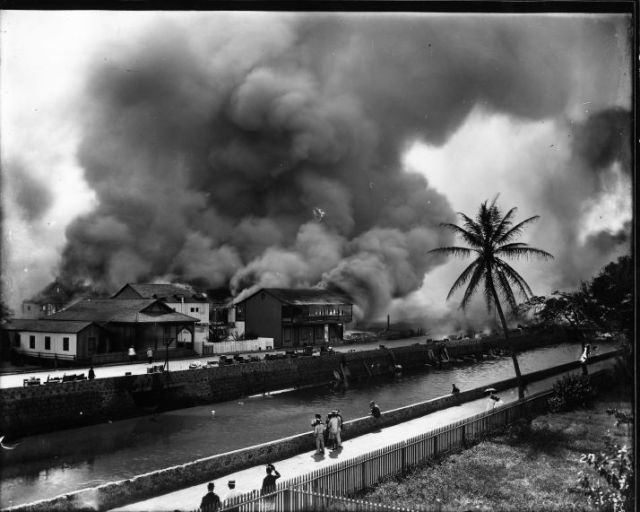
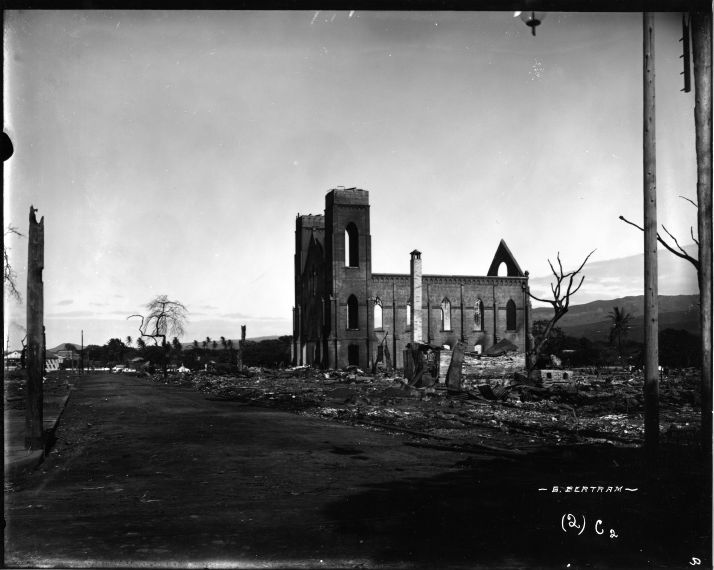
The next day, a fire that was supposed to have been carefully managed burst out of control in high winds and leveled the densely packed neighborhood. Some 38 acres of Chinatown, representing almost a fifth of the city’s buildings, were turned to ash, according to Mohr.
“Chinatown is wiped out,” the Hawaiian Star declared on Jan. 20.
About 5,000 people lost their homes, jobs, businesses and possessions. They were forced to live in detention camps until the threat of disease had passed. Many received financial compensation for their losses but it was hard to make up for what had been destroyed.
Soon afterward, the epidemic disappeared. According to Richter, 71 people had been diagnosed with bubonic plague, and 61 had died.
Was the big fire truly an accident? Some news articles suggest some people thought it would be best if Chinatown was leveled. On Jan. 16, for example, the Hawaiian Gazette had urged officials to “remodel Chinatown” and to allow “the greater part of the Asiatic quarter” to be cleared for the building of a “model Chinatown” similar to Singapore.
“It’s entirely possible that the people setting the fires were not as careful as they should have been,” said Richter, something that occurred to him after reviewing news articles from the time about the outbreak and fire. “I’d not be surprised if some of the people involved took actions to assure that all Chinatown burned down, not just some sections.”
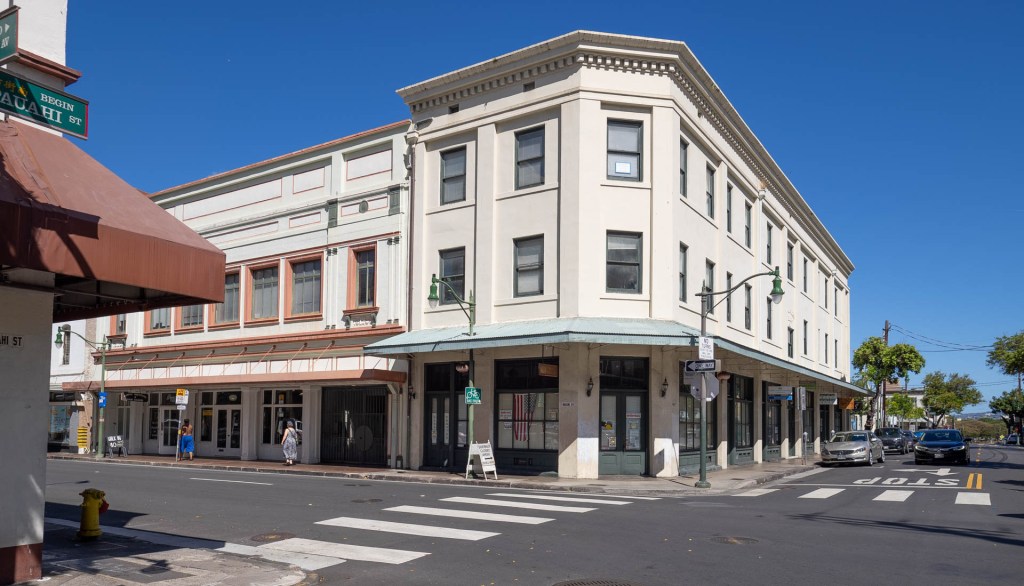
Chinatown was subsequently rebuilt in an iconic manner in the 1920s and 1930s and repopulated with dozens of small, independently owned shops. It was known as the primary business center for Chinese-owned businesses. Chinatown was listed as a national historic landmark district in 1973.
 Sign up for our FREE morning newsletter and face each day more informed.
Read this next:

Local reporting when you need it most
Support timely, accurate, independent journalism.
Honolulu Civil Beat is a nonprofit organization, and your donation helps us produce local reporting that serves all of Hawaii.
ContributeAbout the Author