Will Hawaiʻi Approve Warning Labels On Gas Pumps?
A bill calls for mandating a display regarding public health and climate change.
January 30, 2025 · 4 min read


About the Author

State Sen. Chris Lee just reintroduced a bill that will require all gas pumps to display a public health and climate change warning label. It follows the city of Cambridge, Massachusetts, which passed the very first “warming label” law in the nation in 2020. The country of Sweden on its own, mandated similar labels in 2021.

The Hawaiʻi Circuit Court ruled in Navahine v. Hawaiʻi Department of Transportation last year that burning transportation fuels violates the state Constitution’s public trust doctrine and right to a clean and healthful environment. The U.S. Supreme Court recently allowed Honolulu to proceed with its lawsuit against oil and gas companies for promoting their main product “without warning” of their climate change effects.
Most people are dependent on burning gasoline and diesel fuels for daily life and the fossil fuel industry knows this. Delivering something indispensable even in a climate emergency, say scholars, the industry operates in a comparatively lax regulatory environment.
Working in the background of our economy, the fossil fuel industry is powerful. It usually doesn’t have to say much to stay that way but, noted these scholars, gets plenty vocal when its business interests are threatened. Which is what Driving Force Sweden, a fossil fuel industry trade group, did when Sweden mandated warming labels. It claims that a recent study of the country’s gas pump label program by the Swedish Energy Agency shows they are ineffective.
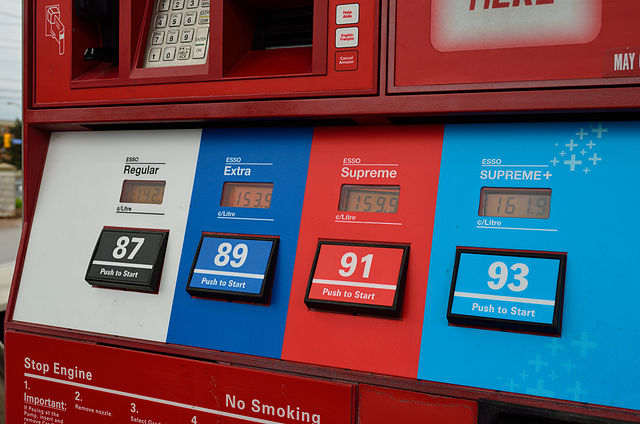
Most concerning, Driving Force Sweden’s self-interested interpretation of the study has, fortunately for them, raised some doubt about the Swedish “eco-label” program. SEA for instance could have referred to Stylianos Syropoulos and colleagues studying warming labels at Boston College.
While research is ongoing, their preliminary findings show they increase drivers feeling “personally responsible for” or “obligated to do their part ‘to help out’ in the broader societal transition away from fossil fuel.”
But the trade group’s influence was no different from the Western States Petroleum Association back in 2014, which effectively stalled legislation for warming labels all along the West Coast of the United States. In 2016, a Canadian fossil fuel conglomerate turned the very first warming label law in the world, into greenwash.
When a labeling bill in Hawaiʻi passed the Senate back in 2023, the Hawaii Energy Marketing Association’s flawed but vocal testimony was seemingly convincing enough to dispatch it in 2023 and 2024.
The Navahine ruling perhaps for the first time, naming transportation fuels the largest threat to a clean and healthy environment in Hawaiʻi, presents a real challenge to HEMA’s power. The settlement revealed however, a disconnect between the lawsuit’s intent, with its call for greater investments in low carbon transportation infrastructure, and ongoing consumer ignorance about the negative effects from fossil fuel burning.
Embedded in Hawaiʻi’s goal to reach a zero emissions transportation system by 2045 is an assumption that the driving public will freely choose, and accept, some of the behavioral changes associated with such a system. Alas, for most consumers of gasoline — the ones Hawaiʻi depends on to execute its emissions target — choosing low-carbon alternatives and investing in clean transportation infrastructure remains a low priority.
A point-of-sale warning at the gas pump would be a direct intervention. Cigarette smoking rates declined — the behavioral mechanics associated with reducing exposure to tobacco smoke in society — when the government raised the salience of its harms by educating the public using the direct intervention of the Surgeon General warnings. Similar, we need to increase the driving public knowledge of the hidden, detrimental, effects of burning petroleum fuels.
A point-of-sale warning at the gas pump would be a direct intervention.
What the two lawsuits in Hawaiʻi reveal is the absence of any basic public education. In other words, any serious-minded effort to reduce emissions in transportation will need to focus on the people who will ultimately effectuate a low-carbon transportation system.
As cleaner alternatives exist, a repeated warning at the pump about the public health effects of fossil fuel burning in particular would be especially influential in mobilizing the driving public in their critical mitigating role. Warming labels would address the incongruence between the intent of the lawsuits and ongoing public apathy on climate.
And the good news is they are likely to telegraph dominant public opinion about fossil fuel-driven climate change. Indeed, this is their key marshaling effect, where markets for fossil fuels are failing a commensurate response to climate change and where people must agree upfront, together, and in a permanent way that choosing clean energy transportation is the only way forward.
But it also appears the labels would openly defy the political power of the fossil fuel industry.
 Sign up for our FREE morning newsletter and face each day more informed.
Community Voices aims to encourage broad discussion on many topics of community interest. It’s kind of a cross between Letters to the Editor and op-eds. This is your space to talk about important issues or interesting people who are making a difference in our world. Column lengths should be no more than 800 words and we need a photo of the author and a bio. We welcome video commentary and other multimedia formats. Send to news@civilbeat.org. The opinions and information expressed in Community Voices are solely those of the authors and not Civil Beat.
Read this next:

Local reporting when you need it most
Support timely, accurate, independent journalism.
Honolulu Civil Beat is a nonprofit organization, and your donation helps us produce local reporting that serves all of Hawaii.
ContributeAbout the Author