Loving Trees, Loving Parks: An Rx For Our Urban Areas
Measuring tree canopy helps identify gaps in coverage and prioritize areas for growth.
February 19, 2025 · 4 min read

About the Authors

In the second month celebrating the Year of Our Community Forests in Hawaiʻi, our organizations highlight parks as essential spaces where urban greening efforts can have the greatest impact in response to the loss of tree canopy throughout urban Honolulu.

As you sit underneath the shade of a tree, you are experiencing its canopy firsthand. In technical terms, a tree’s canopy refers to the leaves and branches that cover the ground when viewed from above.
Measuring tree canopy helps identify gaps in coverage and prioritize areas for growth. Tree canopy averages 22% in Honolulu, with some neighborhoods having much less, resulting in limited access to nature and increased exposure to extreme heat.
Why does this matter?
- For people: a community’s quality of life and health is in large part determined by the built and natural environment where we live.
- For the environment: while trees aren’t the only way to combat climate change, they play a significant role in increasing resilience and combating rising temperatures.
Our community forests provide shade for people to talk story under, flowers for lei, food for nourishment, and connection to cultural practices. Beyond these benefits, trees also absorb stormwater, filter air, reduce heat, capture carbon, and boost local economies by increasing property values.
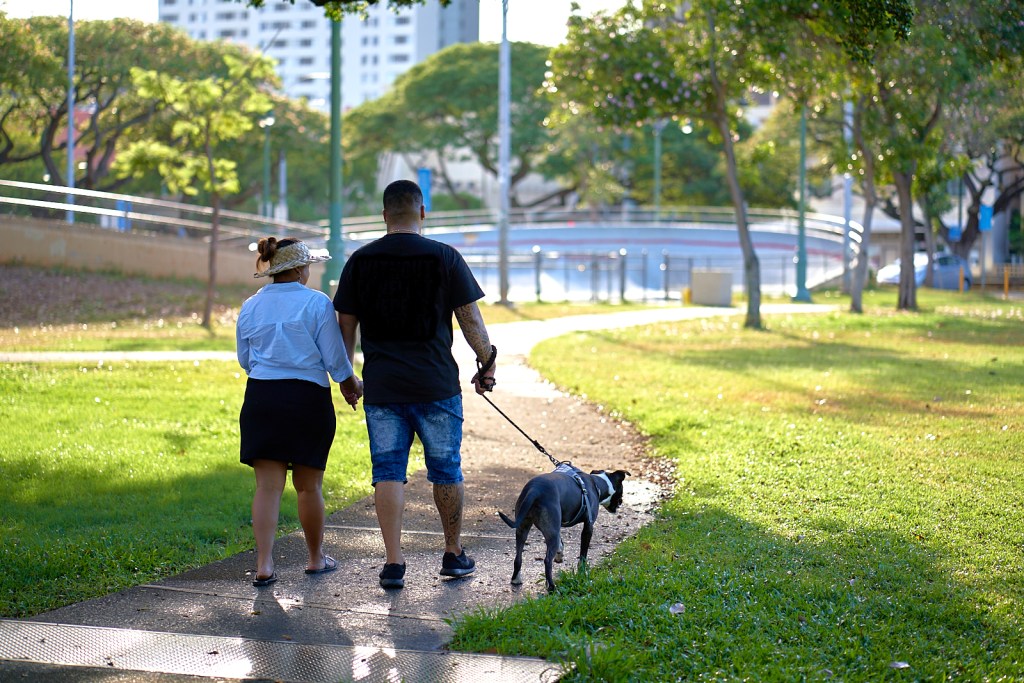
In the wao kanaka, where people live, learn and gather, tree canopy is essential. It provides cooling relief in towns and cities, reduces climate impacts and improves overall well-being. One way to expand tree canopy is through parks — accessible public spaces that foster improved health, social connection, economic vitality, and myriad environmental benefits.
An example is ʻAʻala Park, which provides critical greenery and gathering space in a densely populated area with limited recreational facilities. Trust for Public Land is working with stakeholders to implement a community vision that will transform the park into a vibrant, multifunctional space.
Historically, the area was abundant with Hawaiian fishponds and wetlands. In the early 1900s, ʻAʻala Park was established as a thriving hub for political rallies, cultural festivals, and sports leagues. From 1990-1993, Honolulu used the park as a “tent city” for the unhoused.
While historical and social challenges have shaped the park over time, ʻAʻala Park represents an opportunity for community-led revitalization.
The tide is turning. In 2020, TPL employed a collaborative grass-roots, community-based participatory design process, bringing together residents, park users, businesses, and organizations to create a shared vision for the future of the park, honoring its rich history.
Partnering with the University of Hawaiʻi Community Design Center to create a conceptual plan for ʻAʻala Park. Community aspirations included native plantings, agroforestry, a community garden, and other green infrastructure.
These ideas were refined in a final proof of concept that is being used to implement initial park improvements in partnership with the City Department of Parks and Recreation.
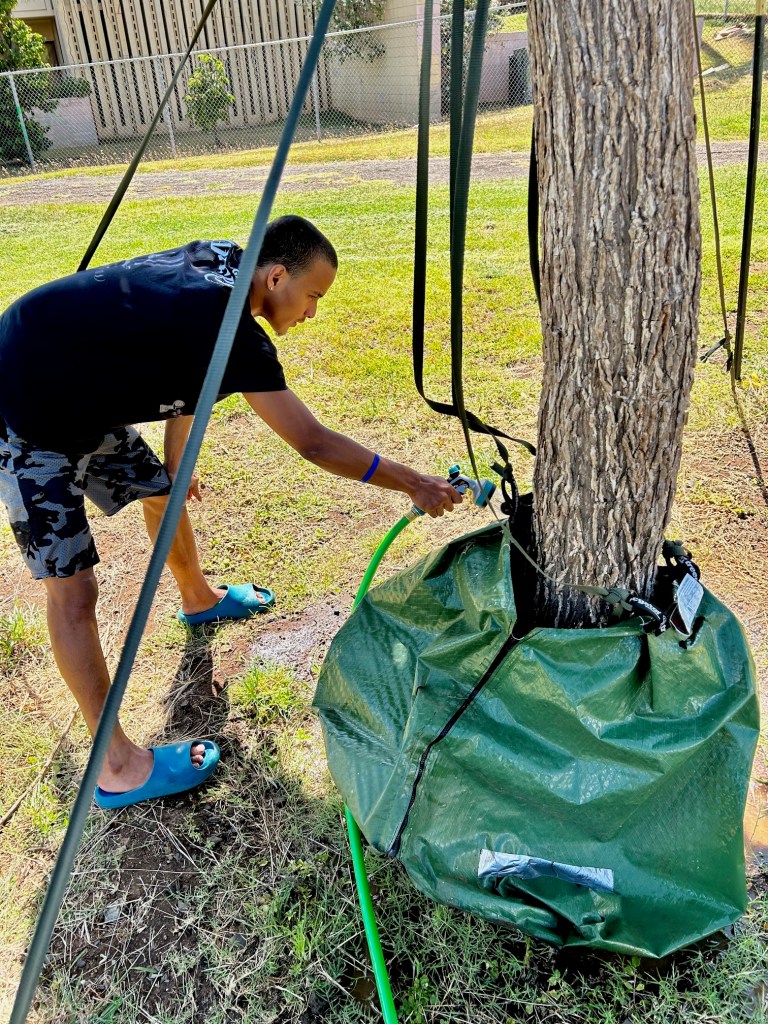
Another example of a vital piece of our community forest is Makalapa Neighborhood Park. There, youth residents of Pu‘uwai Momi public housing measured heat, came up with a plan, testified at the City Council, and positive results have ensued. The City turned the lights on so residents could use the play court after dark and continue to work with the community to plant trees, which are being watered by volunteers.
Indeed, “The times are a-changin’” — thankfully in a positive way. We applaud the city’s Department of Parks and Recreation in their efforts to accelerate tree planting in parks around Oʻahu along with the many other groups and organizations making a positive difference in our parks, public green spaces for all.

Trees grow thriving cities, towns, and communities. In the Year of Our Community Forests, we celebrate ʻAʻala Park and Makalapa Neighborhood Park as parts of our shared community forest. We invite you as readers to reflect on your relationship with trees in the places where we live, learn, and play.
This is how we will reverse the decline in urban tree canopy for Honolulu — with action. One tree. One park. One person at a time. You can keep up to date with TPL’s work at ʻAʻala Park on TPL’s website and on broader community forestry work at Trees For Honolulu’s Future website.
The year 2025 is officially the Year of Our Community Forests. Community partners are celebrating the importance of trees in the wao kanaka: the trees and forests where we live, learn, and play. To learn more or find classroom activities, volunteer opportunities, tree giveaways and more, visit dlnr.hawaii.gov/trees.
 Sign up for our FREE morning newsletter and face each day more informed.
Community Voices aims to encourage broad discussion on many topics of community interest. It’s kind of a cross between Letters to the Editor and op-eds. This is your space to talk about important issues or interesting people who are making a difference in our world. Column lengths should be no more than 800 words and we need a photo of the author and a bio. We welcome video commentary and other multimedia formats. Send to news@civilbeat.org. The opinions and information expressed in Community Voices are solely those of the authors and not Civil Beat.
Local reporting when you need it most
Support timely, accurate, independent journalism.
Honolulu Civil Beat is a nonprofit organization, and your donation helps us produce local reporting that serves all of Hawaii.
ContributeAbout the Authors