10 Things You Might Not Know About Hawaiʻi’s 2024 Election
Who raised the most money? Who spent the most per vote? The Campaign Spending Commission has answers.
March 23, 2025 · 10 min read


About the Author

I always look forward to the summaries that the Hawaiʻi Campaign Spending Commission puts together after elections.
The commission’s extensive analysis of the 2024 election was recently posted, and it puts the bigger picture in context: In most races, money is indeed the mother’s milk of politics, and it flows most heavily to the powerful.
But the data also reveals how having a lot of cash does not ensure victory, giving hope to voters who would like to see a more level electoral playing field.
Here are my Top 10 takeaways from the 2024 election based on the commission’s work.

Blangiardi Raised And Spent The Most
He faced no serious primary challenger in the nonpartisan contest and easily won it outright, meaning he did not have to campaign in the general election.
But Honolulu Mayor Rick Blangiardi raised far more money than any other candidate for office in 2024. Indeed, he raised more than the nine other candidates who followed him in contributions received, other receipts and loans:
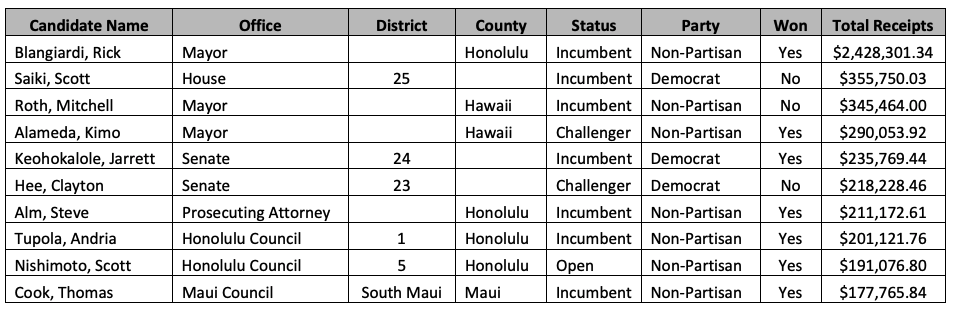
Of note: Blangiardi’s wife, Karen Chang, loaned her husband $50,000 during the campaign. The loan has since been forgiven.
Saiki Spent The Most Per Primary Vote
While the mayor raised the most money, former House Speaker Scott Saiki, a Democrat, paid the most per vote in the primary: about $129. He still lost to Kim Coco Iwamoto, who spent about $62 per vote.
In the general election, meantime, Democratic Rep. Cedric Gates spent $29 per vote but still lost his bid for a state Senate seat.
Some Candidates Are In The Red
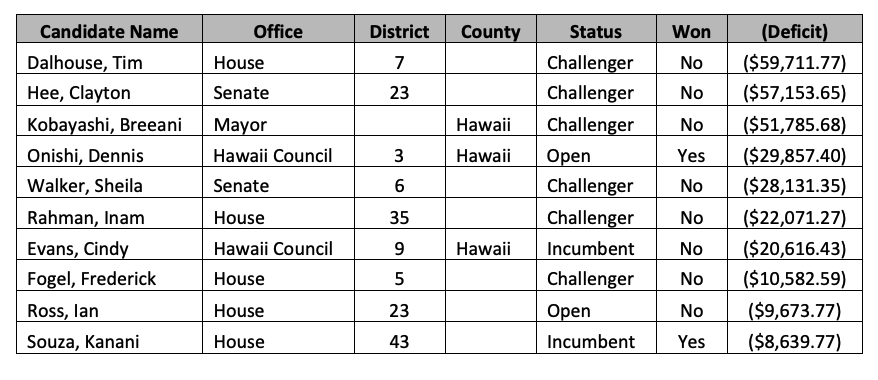
Civil Beat reported several times how former state Sen. Clayton Hee spent a lot of money to try to win back his former North Shore seat. By the end of the election year he had loaned himself $119,000 for a gig that pays less than $80,000 a year.
He remained in debt by the year’s end, as did two other unsuccessful candidates: Tim Dalhouse, a Republican challenger for a House seat, and Breeani Kobayashi, a challenger in the nonpartisan Hawaiʻi County mayoral contest. Both loaned tens of thousands of dollars to their respective campaigns.
Here are the Top 10 candidates who reported campaign finance deficits by the end of the election:
OHA Races Attract Little Money
Trustees for the nine-member Office of Hawaiian Affairs are statewide officials, and OHA elections are open to all registered voters, not just Native Hawaiians. You also don’t have to be Native Hawaiian to serve on the OHA board.
But voters consistently tune out voting for OHA candidates.
In the 2024 general election, more people left their ballots blank than voted for winning OHA incumbents Luana Alapa and Dan Ahuna. Another incumbent, Keliʻi Akina, barely edged blank votes in his win.
Not surprisingly, the new finance data from the CSC reveals that many OHA candidates don’t even bother to raise and spend campaign funds, apparently recognizing the futility.
Ahuna, the Kauaʻi board member, reported zero receipts, while Alapa, the Molokaʻi board member, raised just $4,000 — a fraction of what a winning state House or Senate candidate typically brings in.
There is one major exception to financing of OHA campaigns, however: Akina, who raised about $85,000 for his at-large position. But Akina faced a crowded primary with several well-known contestants and in the general election opposed Lei Ahu Isa, who was trying to get back on the OHA board and who herself raised and spent nothing.
Akina spent his money on radio, TV and social media ads and posters, signs and banners — even baseball caps — to plaster his name statewide. I saw several of his large banners in prime locations.
Still, little campaign kala flowed to other OHA races. All told, the 17 candidates for OHA seats last year raised less than $140,000.
Prosecutor Races Drew No Challengers
OHA races may attract little voter or donor love, but the nonpartisan county prosecutor races in Honolulu, Kauaʻi and Hawaiʻi counties were completely uncompetitive.
Unencumbered by challengers, Big Island prosecutor Kelden Waltjen spent less than $6,000 on his guaranteed reelection. Kauaʻi prosecutor Rebecca Like spent just $2,800.
Honolulu prosecutor Steve Alm, though, took no chances. He raised $210,000 and spent over one-third of it, helped by generous donors like developer Bert Kobayashi and the Hawaiʻi Regional Council of Carpenters. That left Alm with a $121,000 campaign war chest surplus, even though he can’t run for prosecutor again.
You Can Win With Public Financing
A House committee recently killed a bill to set up a comprehensive public financing program for Hawaiʻi candidates. It’s the third year in a row the proposal has died.
But there are still measures to increase state matching support for Hawaiʻi’s partial public funding system, which has been anemically funded for years, including House Bill 370.
In spite of the power of well-funded incumbents, seven plucky candidates last year who used public funds managed to win their races. One of them even returned unspent money to the fund.
A total of $52,000 went to 10 candidates, which works out to just 4% of all 259 candidates in 2024:
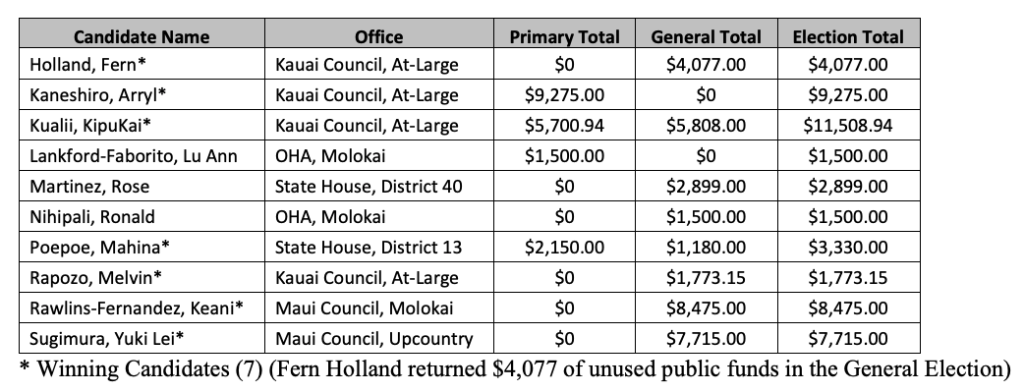
Of note: The Hawaiʻi Election Campaign Fund’s current balance is a paltry $2 million. Hence the proposed legislation to feed the fund.
Incumbency Does Not Guarantee Victory
The upsets of Speaker Saiki and Hawaiʻi County Mayor Mitch Roth were major news in 2024. But there were other notable losses for incumbents, giving hope to challengers.
The losers also included Cindy Evans of the Hawaiʻi County Council and Ross Kagawa of the Kauaʻi County Council. Besides Saiki, four other House Democrats were sent packing: Sonny Ganaden, Natalia Hussey-Burdick, May Mizuno and Rose Martinez.
There were also four candidates who won open seats in the Legislature: Samantha DeCorte in the Senate and Tina Grandinetti, Ikaika Olds and Chris Muraoka in the House.
Still, incumbency remains a strong indicator of electoral success. Eighty-nine percent of the 95 incumbents who ran last year won compared with the mere 8% of 131 challengers who prevailed.
A Lot Of Cash Left Over
Mayor Blangiardi had around $330,000 in cash on hand by the end of the 2024 election, the most of any Hawaiʻi politician. He’s term limited, too. Like Alm, Blangiardi could maybe donate to other candidates or escheat the dough to the Campaign Spending Commission, which would no doubt appreciate the money.
Legislators who are not term-limited and still have surpluses in the six-figure range are Sens. Jarrett Keohokalole, Troy Hashimoto, Lynn DeCoite, Henry Aquino, Sharon Moriwaki and Michelle Kidani. Also on that list are Reps. Scot Matayoshi, Kyle Yamashita, Nadine Nakamura and Lisa Kitagawa.
None of these legislators had competitive races in 2024.
About Those Hawaiʻi Super PACS
Super PACs are allowed to raise unlimited amounts of money from corporations, unions, associations and individuals, “then spend unlimited sums to overtly advocate for or against political candidates,” according to the nonprofit OpenSecrets that tracks campaign finance data nationally.
The PACs are not allowed to coordinate with or donate directly to campaigns. But they can support candidates and oppose their opponents.
Of the 23 independent expenditure committees — that is, super political action committees — that raised and spent money in Hawaiʻi’s 2024 elections, two rose well above the PAC pack. And both are in the service of the powerful carpenters union:
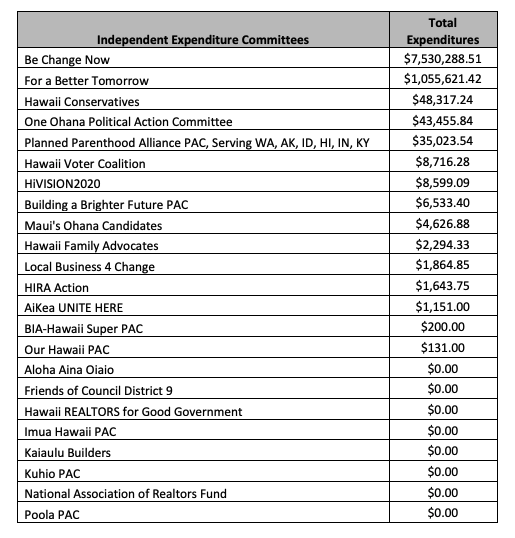
Be Change Now’s contributions came from the Hawaiʻi Carpenters Market Recovery Program Fund, which gave the super PAC $4.9 million in the recent election cycle.
For a Better Tomorrow’s contributions came from the Hawaiʻi Carpenters Market Recovery Program Fund ($8.6 million) and the Hawaiʻi Regional Council of Carpenters PAC Account ($7,500).
Most Hawaiʻi super PACs spent on average about two-thirds of their money on advertising, media and related materials, according to the commission’s analysis. The rest mostly went to pay for printing, postage, mailing and freight.
For a Better Tomorrow focused much of its attention on county races. It supported Addison Bulosan, Bernard Carvalho and Aryl Kaneshiro in the wins for Kauaʻi County Council seats, as well as losing candidate Billy DeCosta.
Matthew Kanealii-Kleinfelder and James Hustace were supported for their successful bids to serve on the Hawaiʻi County Council. And for the Maui County Council, For a Better Tomorrow backed winners Tom Cook, Nohelani U‘u-Hodgins and Tasha Kama.
As Civil Beat reported in August, Hawaiʻi Carpenters Union PACs have been actively training candidates to run for a variety of offices. Maui County Council races have been of particular interest to the union in recent years, where it has put its weight behind pro-development candidates.
Money Always Finds A Way
The 2024 election was the first in which elected officials were prohibited from holding fundraising events during any regular or special session and any legislative recess days, holidays and weekends.
Some state legislators have griped that the new law makes it difficult to raise money, but the commission’s analysis shows that many of them had little problem at all getting donations. And, while not always, those with the most money generally did best at election time.
In the 2022 elections for the House of Representatives, for example, a total of $3.3 million was raised for the 51 seats. Two years later, after the law was in effect, the total climbed to $3.5 million. On average, incumbents easily raised far more than challengers.
The races for the state Senate in 2022 and 2024 cannot be compared mangoes to mangoes, as all 25 seats were up in 2022 due to reapportionment compared to 13 two years later. But the data show that incumbents did not have much trouble raising cash in the 2024 Senate elections.
Jarrett Keohokalole, for instance, ran both years and raised $40,000 more in 2024 than he did in 2022. His two challengers in 2022 raised barely $7,000 combined, and the incumbent ran unopposed in 2024.
In the 2022 election cycle, Keohokalole held one fundraiser each in the middle of the 2019 and 2020 legislative sessions and one just after the 2022 session concluded — three in all. That compares to his six fundraisers in the 2024 election cycle, none held during session but one held just prior to the 2023 session and another just prior to the 2024 session.
Legislators can still accept donations during session, by the way. The Campaign Spending Commission’s legislative package this year included a bill to stop that practice. But Sen. Karl Rhoads, chair of the Senate Judiciary Committee, did not schedule it for a hearing before deadline, so it’s dead for this year.
Fostering Transparency
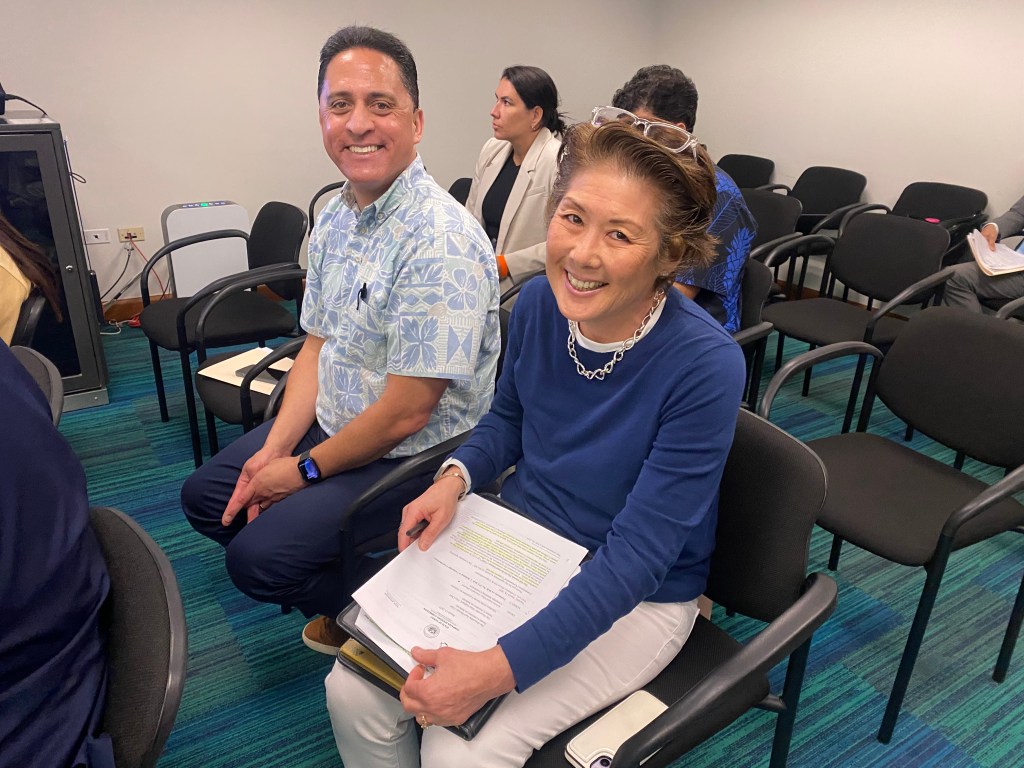
The election summaries, which go back to 2008, are done by Tony Baldomero, the Campaign Spending Commission’s associate director. The commission considers the work a way to further its mission of fostering transparency for the campaign finance process in Hawaiʻi elections.
“Because all candidate and noncandidate committees must file their reports electronically with the commission, we wanted to optimize on the technology by sorting and synthesizing the aggregate data inputted by the committees so that everyone can see the total contributions received and expenditures made in an election year for a birds-eye view of following the money, which you can then compare with prior elections,” said Kristin Izumi-Nitao, the commission’s executive director.
 Sign up for our FREE morning newsletter and face each day more informed.
Read this next:

Local reporting when you need it most
Support timely, accurate, independent journalism.
Honolulu Civil Beat is a nonprofit organization, and your donation helps us produce local reporting that serves all of Hawaii.
ContributeAbout the Author