Long Story Cut Short: The Interesting History Of Hawaiʻi's Federal Czar
Hawaiʻi once had an office in the nation’s capital to watch out for the state’s interests. Gov. Josh Green is hoping to resurrect the idea.
March 30, 2025 · 7 min read

About the Author

Gov. Josh Green’s recent call for a federal affairs team in Washington, D.C., marks a critical juncture in the long fight to coordinate the State of Hawai‘i’s interests at the national level.
However, the story does not begin with President Donald Trump’s second term or the legislative odyssey of House Bill 300. Instead, it goes back 60 years.
Through HB 300, Hawai‘i may finally establish a long vacant presence at the national level. In state law, a forgotten statute establishes an Office of Federal Programs, along with a federal programs coordinator.
Neither exists in the present day.
Back To The Beginning
Even with a strong, bipartisan congressional delegation in Washington, D.C., throughout the 1960s, then-Gov. John Burns still knew that Hawai‘i needed to identify federal funding opportunities. As Burns explained to the press, “we’re missing out on getting all the funds that are available from the Federal government through various programs.”
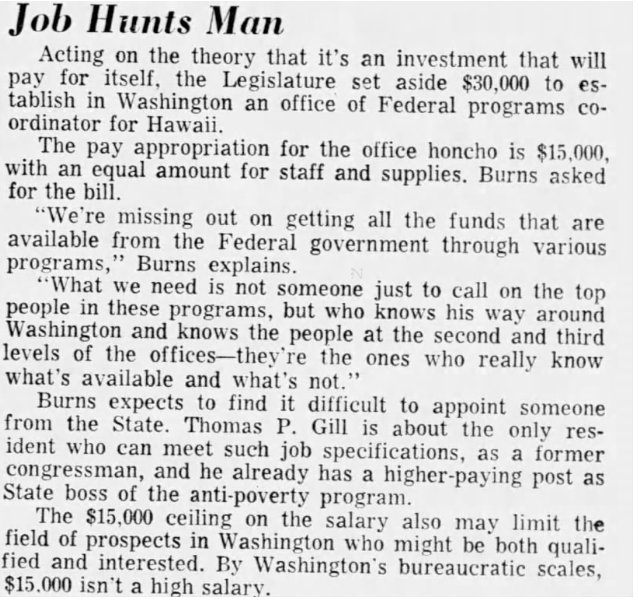
On July 8, 1965, Governor Burns signed Senate Bill 389 into law as Act 237[1] . The legislation created an Office of Federal Programs, with a federal programs coordinator to be charged with coordinating “all state and county Federal aid programs in Hawaii.”
A figure like then-former Rep. Tom Gill, who had already been tapped by Burns to lead the State of Hawai’i’s Office of Economic Opportunity, was the position’s ideal candidate.
“What we need is not someone just to call on the top people in these programs,” Burns concluded, “but who knows his way around Washington and knows the people at the second and third levels of the offices — they’re the ones who really know what’s available and what’s not.”
No viable candidates could be found. For the next 10 years, no one was appointed to fill the position.
A Renewed Call
According to one 1975 report, it is likely that members of Hawai‘i’s congressional delegation opposed the office’s existence because it “would encroach on their own duties and responsibilities.” Instead, members of Hawai‘i’s congressional delegation were expected to uneasily coordinate a single front of advocacy for state and county federal aid programs.
The next Hawaiʻi governor, George Ariyoshi, did not find this approach adequate. The inauguration of a Democrat as president, Jimmy Carter, suggested that 1977 was the time to aggressively pursue new opportunities for federal funding.
In his 1977 State of the State address, Ariyoshi indicated a readiness to fill the position over a decade after it had been created. “In these days of tight finances,” Ariyoshi explained, “we must make sure we receive all we are entitled to in the way of Federal funding for construction projects and other programs of benefit to our citizens.”
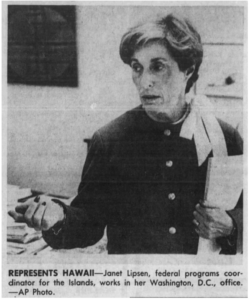
The first – and only – person to formally hold the position of federal programs coordinator was Janice Lipsen, a one-time aide to former U.S. House Speaker Carl Albert (D-Oklahoma). Lipsen’s appointment was reported as having been made in July 1977.
For her services, Lipsen would be paid $37,400 in 1985 dollars, or approximately $109,000 in 2024 dollars. On a monthly basis, approximately $3,750 ($11,000 in 2024 dollars) was also steered into her firm. These expenses were folded into the governor’s operating budget.
According to the Honolulu Star-Bulletin’s then reporter, Gregg Takayama, her first task was to reckon with pressing sugar legislation in Washington, D.C. A late 1978 report by the newspaper’s David Shapiro, said areas of interest for Lipsen included sugar, an aquaculture bill and the Housing and Community Development Act.
Meanwhile, there was another renewed push to strengthen the State of Hawai‘i’s federal position with the election of the Reagan Administration in 1981.
In speaking in favor of the proposal to build-out the position of a federal programs coordinator, then-state Rep. John D. Waihe‘e outlined the proposal’s rationale in simple terms: “We are entering a period of uncertainty as to federal funding.”
Lipsen was a lobbyist in Washington, D.C., with several clients, so the State of Hawai‘i was only one among many of her priorities. Beyond profiles on her position, few newspaper reports on her work were ever published.
By 1985, however, Lipsen came under severe scrutiny as a result of her extraordinarily high salary, as well as the utility of her position given her seeming silence. In response to the report, then-state Rep. Michael Liu criticized “her unclear accomplishments and apparent reluctance to specify verbally or in written report any major contributions in the past few years.”
The lack of transparency – not her failure to deliver for Hawai‘i – opened Lipsen up to extensive scrutiny. Legislators did not understand her function; her reports to Governor Ariyoshi were not made public until media pressure in March 1985.
Press and legislative scrutiny hastened the effective de-funding of the position toward the end of the Ariyoshi administration. As part of the 1986 budget, the governor and cabinet officers received raises, while the federal programs coordinator’s position and office were effectively abolished after receiving no money.
By this time, Lipsen’s salary was already being drawn from the governor’s operating budget, which meant that her position was not set to be adversely affected by the legislation in the short-term. According to Carolyn Tanaka in January 1987, Lipsen was retained by the Waihe‘e administration under a similar arrangement.
Lipsen effectively ceased to be the federal programs coordinator. Instead, she was regarded in one press report as “Gov. Waihe‘e’s lobbyist to Congress.” Lipsen was reported as having made efforts to brief members of the Legislature in 1988. As late as 1990, she was called “a lobbyist for Gov. John Waihe‘e.”
It is not apparent when Lipsen ceased to be the governor’s paid lobbyist in Washington, D.C. However, the position’s reliance on the governor’s operating budget played a role in its tenuous, discretionary evolution into de facto abolition.
The calls for an established Office of Federal Programs looked to be moot.
The Present Day
Decades later, the attitudes of Burns, Ariyoshi and Waihe‘e are returning. Green’s budget request for five federal affairs positions through House Bill 300 could culminate as a contemporary pseudo-realization of Governor Burns’ aims in 1965.
“As the State continues to navigate these uncertain times, these federal affairs positions will provide a crucial lifeline through which to facilitate quick responses to and advocacy around federal funding and resources,” according to testimony submitted by the governor’s office on March 18.
While some may question the necessity of these positions, state law may already influence the expectations of Hawai‘i’s federal affairs team. Furthermore, a federal affairs team will supplement the state’s Office of Federal Awards Management, which is charged with planning, organizing, directing, coordinating and conducting all federal award activities across state agencies and departments.
Hawai‘i will not be alone in organizing and coordinating its federal interests in Washington, D.C. Navigating the complex minutiae of federal politics requires several states (such as Alaska, Texas and Washington state) to maintain similar positions.
In the meantime, the State of Hawai‘i needs a mechanism for coordinating federal funding opportunities, communications among federal agencies and even the efforts of our federal delegation.
With a federal affairs team, the State of Hawai‘i can weather federal confusion, find opportunities to secure federal funding with the assistance of our members of Congress and supplement our State’s needs.
 Sign up for our FREE morning newsletter and face each day more informed.
Read this next:

Local reporting when you need it most
Support timely, accurate, independent journalism.
Honolulu Civil Beat is a nonprofit organization, and your donation helps us produce local reporting that serves all of Hawaii.
ContributeAbout the Author