Neal Milner: Sorting Out Honolulu's Stadium Aspirations And Fantasies
If we could get this project right, it could be a model for Hawaiʻi actually doing big things successfully again.
March 6, 2025 · 7 min read

About the Author

“Aspirational.”
That’s the word Brennon Morioka, head of Hawaiʻi’s Stadium Authority, used last week to describe developer Stanford Carr’s stadium plan.

Good word choice. Building a stadium is not about girders and turf. It’s about fantasies and aspirations — really powerful fantasies, because sports is such a fantasy incubator.
It’s not just about sports, though. The aspirations are about innovation, nostalgia and distrust. Sound familiar? It should because those three kinds of aspirations affect every major political decision in Hawaiʻi.
Stadium construction is Hawaiʻi in a nutshell, and could become a model of the way to get things done. Or yet another way to fail.
There are three sets of aspirations in the stadium-building mix: Stanford Carr Stadium, McCully Chop Suey Stadium and Jerry Orbach Stadium.
Stanford Carr Stadium
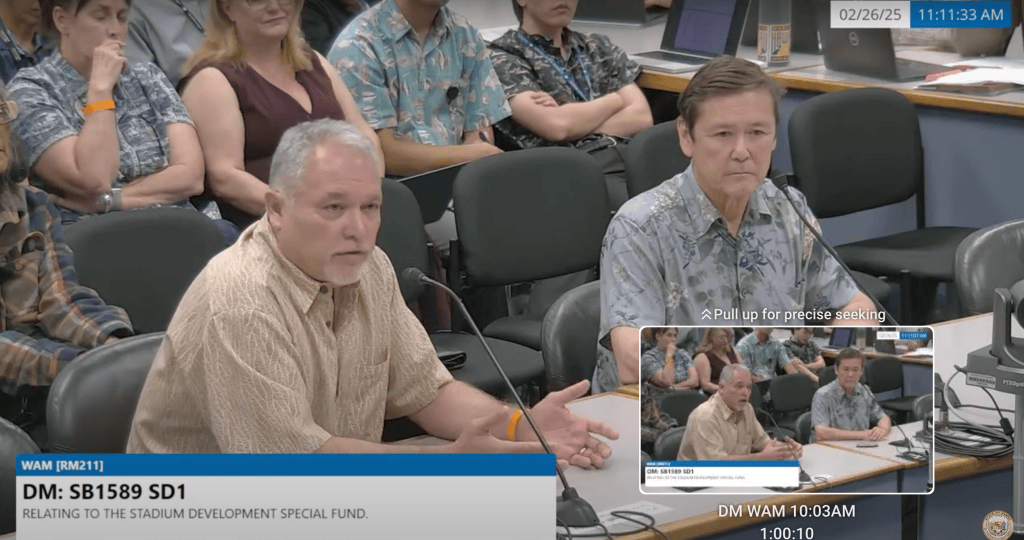
When Morioka described the stadium plan as “aspirational,” he was acting as good cop to bad cop Carr, who was presenting in yet another dream-deadening hearing about Hawaiʻi’s should-have-been-built-by-now stadium.
Carr announced that the new cost would be a tad higher than the state had put aside, like over $300 million higher, almost double the amount of money the state had set aside. He dismissed the former estimate as a “stale number from years ago.”

Carr’s plan comes right out of the modern stadium builders’ playbook where the stadium is just the start of something big.
In Carr’s as well as the state’s proposed “entertainment district,” the stadium is just a part of a complicated mosaic.
The stadium by itself is, in Carr’s hardboiled words, just a “black hole.” While the entertainment district is the Holy Grail.
The McCully Chop Suey Stadium
This week, the House passed a bill that would stop Carr Stadium and instead enlarge the football stadium on the University of Hawaiʻi campus. That’s a full-force McCully Chop Suey aspiration.
MCS was an old-school Chinese restaurant for years located on the corner of McCully and King.
It was right out of central casting as a site of local Chinese restaurants at the time. Chop suey on the menu, surly waitresses, self-serve fountain drinks from a coin-operated dining room Coke machine. Bathroom out back if you dared to use it.
If that’s not old-school local enough, it was just two blocks from the old Honolulu Stadium, the icon of sports facilities in Hawaii. “The Termite Palace,” but a place with great memories and stories that still circulate.
UH played its football games there, as did minor league baseball. Many spectators lived in the neighborhood and walked or took a short bus ride to the games.
UH is only a few blocks from both the restaurant and that old stadium site.
McCully advocates just want a stadium. All the rest is extraneous. The stadium should be in a place that triggers important memories and honors the past.
Simplicity, intimacy and memory.
Jerry Orbach Stadium
If you think that the state doesn’t have the capacity to build anything, then the Jerry Orbach Stadium is for you.
This aspiration memorializes actor Jerry Orbach, not because he played Lennie Briscoe, best sidekick detective ever on “Law and Order,” but because he won a Tony Award for his role in the Broadway musical “Promises, Promises.”
“Why should we believe your grandiose stadium plan, considering the miserable track record Hawaii has for building any big public projects. Promises promises.”
The Jerry Orbach aspiration is kind of a counter-aspiration. It’s not as much about the construction process as it is about the accountability process.
Advocates of the Jerry Orbach view see Stanford Carr’s recent presentation as Rail Redux.
Jerry Orbach Stadium wouldn’t be loaded with bells and whistles. It would be loaded with guarantees, accountability measures and oversight mechanisms.
Finding The Right Combination
Taken individually, each aspiration has crippling flaws, but taken together in the right combination, they could really make the stadium project work.
If that happened, the aspiration combination could be a model for the way things should work around here.
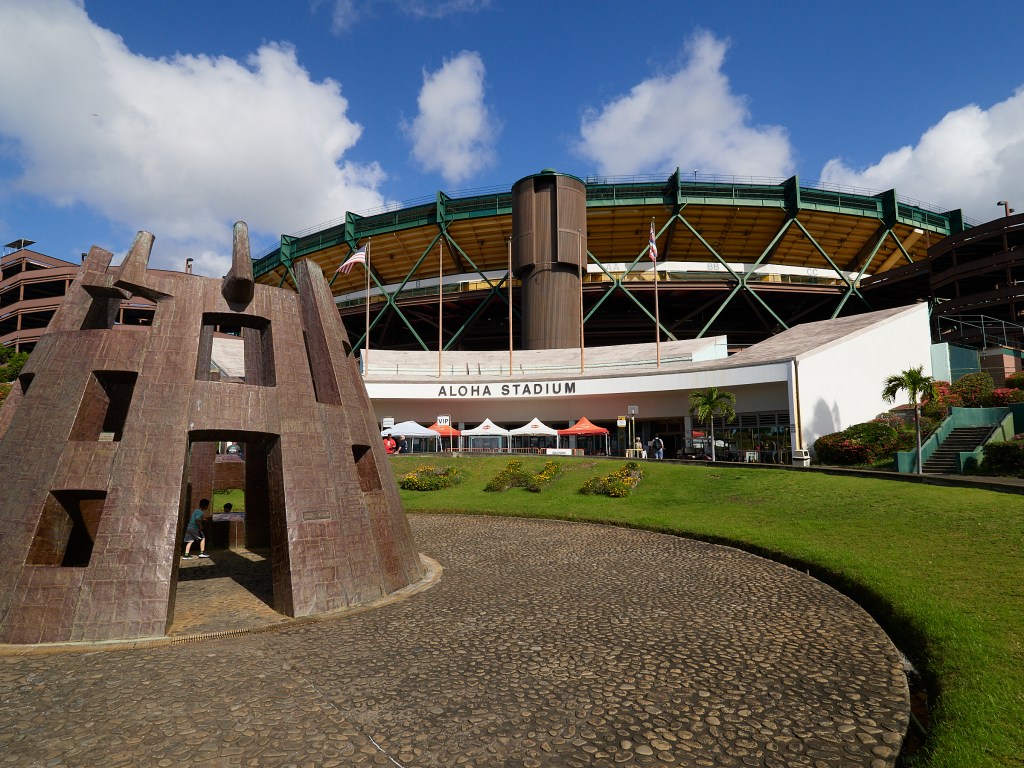
Stanford Carr Stadium’s success depends on making multiple timelines for multiple purposes. It’s about creating and coordinating a complicated plan all in a space that’s not even a big hole yet because the shell of Aloha Stadium still hasn’t been knocked down.
Think that’ll happen here? Are you kidding? Despite all of the governor’s enthusiastic happy talk about making a 2028 deadline and funding the stadium with no additional coasts, Carr’s bombshell instead indicates monkey business as usual.
Meanwhile, McCully Chop Suey wants a stadium that is “just like the old days.” Not a black hole but a black diamond — a crown jewel, not an ancillary or an afterthought.
Big changes make this impractical, like changes in college football whose big-time revenue streams and conference consolidations have left UH football in the dust and much more vulnerable than in the Aloha Stadium days.
The fan base has changed. Attendance dropped big time even before Aloha Stadium went kaput. Loyal older fans have died off. Even with the football stadium now on campus, students don’t go to the games. They never have.
Thanks to new technologies, there are plenty more ways to “experience” the game than there used to be. And people are now more likely to keep to themselves.
The result is likely to be far fewer people walking to the stadium, far fewer spectators watching the game there, and far fewer dedicated sports fanatics who depend on a stadium seat.
Does that mean that Jerry Orbach Stadium wins by default? Definitely not. The problem with skepticism is that it becomes a habit.
When “There’s no way that the state can …” becomes a mantra, it’s tempting to move from imagining the worse to hoping for the worse because it vindicates your view.
Or you simply quit having a view at all and become a passive supplicant of mediocrity and incompetence.
Try dealing with, say, Oʻahu’s landfill that way.
It’s bad enough that rail has been such a construction disaster. It’s even worse because rail misadventures color so much of the way people think about change.
Failure stories have become the go-to joke book that drives our political culture.
Individually, in their pure form, each set of aspirations has serious drawbacks. What’s needed is a hybrid. Taken together with the right balance, the hybrid can move us forward.
The aspirations around the stadium are the same ones that drive Hawaii — that complicated combination of the need for innovations and risk (Carr), maintaining old values (McCully Chop Suey), along with a watchful skepticism about getting things done efficiently and fairly (Jerry Orbach).
Building a stadium is important because the process could be a model. It’s a test of whether Hawaii can get big jobs done.
Where would you like to start?
 Sign up for our FREE morning newsletter and face each day more informed.
Read this next:

Local reporting when you need it most
Support timely, accurate, independent journalism.
Honolulu Civil Beat is a nonprofit organization, and your donation helps us produce local reporting that serves all of Hawaii.
ContributeAbout the Author