Promote Safety, Sound Budgeting And Equity Through Jaywalking Reform
Senate Bill 106 presents an opportunity to modernize our pedestrian laws.
March 17, 2025 · 4 min read

About the Authors


Millions of taxpayer dollars have been spent in Hawaiʻi over the years enforcing jaywalking laws, yet we have little to show for it in terms of improved pedestrian safety.

A bill currently before the Hawai‘i State Legislature, Senate Bill 106, offers a commonsense solution: Reduce jaywalking enforcement by allowing pedestrians to “act contrary to the statewide traffic code when a reasonably careful pedestrian would determine that there is no immediate danger of a collision with a moving vehicle if the pedestrian is more than 200 feet from a crosswalk.”
SB 106 recognizes that pedestrians often cross outside of designated crosswalks due to infrastructure challenges, such as long distances between crosswalks or poorly designed intersections. It would reform Hawaiʻi’s outdated and punitive jaywalking laws by limiting enforcement to situations where pedestrian crossings present an immediate safety hazard.
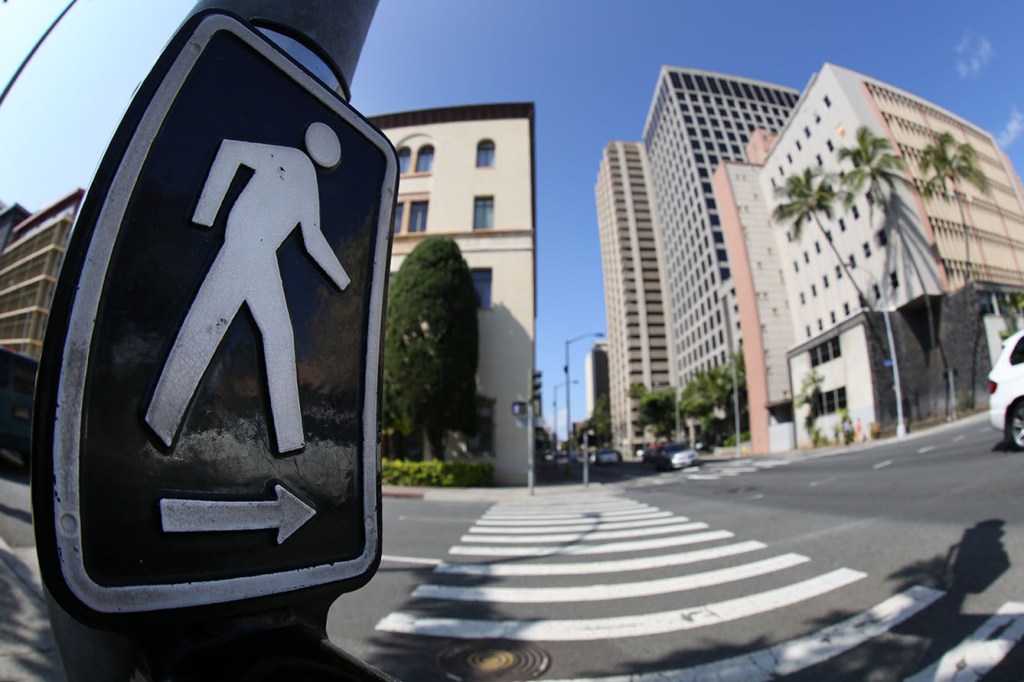
A recent analysis of judiciary data by the Hawai‘i Appleseed Center for Law and Economic Justice found that from 2018 to 2023, Hawaiʻi had one of of the highest per capita rates of issuing jaywalking citations, levying more than $3.8 million in jaywalking fines and fees.
Nevertheless, despite the state’s heavy-handed enforcement of jaywalking laws, Hawaiʻi ranks as the second-most dangerous state in the nation for pedestrians.
According to a study by the World Health Organization cited by Bloomberg, the UK has about half as many pedestrian deaths per capita as the U.S., despite allowing pedestrians to cross where they please. And in Norway, the world leader in eliminating [pedestrian] traffic deaths, again “there is no rule against jaywalking.”
In terms of generating revenues, the Hawai‘i Appleseed report found that Hawaiʻi’s jaywalking laws are actually a money-losing proposition — with arguably no positive results to show for it.
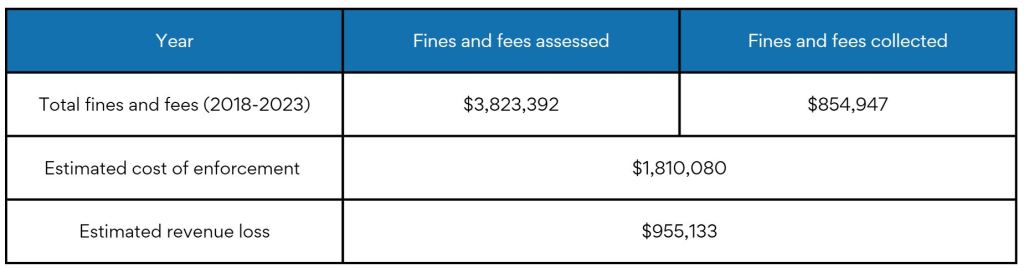
Of the $3.8 million in fines and fees levied from 2018 to 2023, only $854,947 — about 22.4% — was collected. In addition, the cost of jaywalking enforcement during that period was more than $1.8 million, leaving the net cost of jaywalking enforcement at approximately $955,000 — almost $1 million.
Jaywalking fines and fees assessed versus collected, 2018-2023:
In terms of equity, enforcement of jaywalking laws disproportionately affects low-income residents. Since jaywalking tickets in Hawaiʻi range from $130 to $180, receiving such a ticket can be a significant burden for those living paycheck to paycheck.
By reducing unnecessary fines, the bill would prevent financial hardships for low-income residents while allowing law enforcement to focus on more pressing public safety issues.
Compounding the issue is that fines and fees associated with jaywalking are completely out of proportion to other traffic citations. For example, a jaywalking ticket is more expensive than a speeding ticket, starting at $62, or a red-light violation, starting at $97. This misalignment suggests that jaywalking enforcement is driven more by grant incentives than by genuine safety concerns.
Indeed, some ZIP codes in Hawaiʻi saw thousands of tickets issued during the 2018-2023 period, while others had few or none. One key reason for this disparity is the Honolulu Police Department’s reliance on federal grants from the National Highway Traffic Safety Administration, which incentivize pedestrian enforcement efforts. In 2020 alone, HPD issued 5,436 pedestrian citations, with 2,050 funded through NHTSA grants.
Hawaiʻi residents already face mounting financial pressures due to the high cost of living. Burdening them with excessive jaywalking fines and fees only exacerbates economic hardship without clear safety benefits.
SB 106 presents an opportunity to modernize Hawaiʻi’s pedestrian laws, reduce unnecessary financial strain on residents and refocus resources on measures that truly enhance public safety.
Instead of wasting taxpayer dollars on ineffective enforcement, let’s pass SB 106 and invest in policies that will genuinely make our streets safer for everyone.
 Sign up for our FREE morning newsletter and face each day more informed.
Community Voices aims to encourage broad discussion on many topics of community interest. It’s kind of a cross between Letters to the Editor and op-eds. This is your space to talk about important issues or interesting people who are making a difference in our world. Column lengths should be no more than 800 words and we need a photo of the author and a bio. We welcome video commentary and other multimedia formats. Send to news@civilbeat.org. The opinions and information expressed in Community Voices are solely those of the authors and not Civil Beat.
Read this next:

Local reporting when you need it most
Support timely, accurate, independent journalism.
Honolulu Civil Beat is a nonprofit organization, and your donation helps us produce local reporting that serves all of Hawaii.
ContributeAbout the Authors