The Civil Beat Interview: US Rep. Jill Tokuda
The congresswoman talks about the need to protect the social safety net, the importance of the Pacific to America, and why Democrats must get better in their fight against the new administration in Washington, D.C.
March 23, 2025 · 24 min read

About the Author

Editor’s note: Civil Beat reporters and editors met Wednesday with U.S. Rep. Jill Tokuda, who represents the 2nd Congressional District. It covers the part of Oʻahu primarily outside of the Honolulu urban core as well as the neighbor islands.
The interview was edited for length and clarity and an eye towards future reporting. The congresswoman began by talking about what was most on her mind during the first few months of the new Trump administration.
If I had to pick just one broad thing that I worry about, because there’s many, as you can imagine, it is our social safety net. It’s hard enough to live in Hawaiʻi. I don’t have to tell you folks that — you run stories about it. Before all of this and this administration, the ability to keep a roof over your head and food on the table, to know that your kids are okay and income was coming in so that you can stay and live here, was hard enough. That was a struggle.
Now you tack on complete attacks on whether you have a job because you’re a federal employee or a federal contractor, whether you’re going to still have your Medicaid, whether you’re going to have SNAP food money to feed your keiki, whether grandma or grandpa is going to get that Social Security check still coming in — all of these different things we are seeing decimated left and right. It’s leading to fear and panic and anxiety, and it’s well deserved and it’s felt. And so for me, it is, How do we protect that Social Security net that they’re trying to rip apart?

How do we protect those entitlements they’re trying to rip up? I’ve heard various estimates what that impact is in Hawaii, but it’s at least several hundred million dollars annually, is it not?
It depends what they do. So what we know is the very least, they’ve put a target of at least $880 billion in cuts to the committee that oversees Medicaid. The vast amount of spending in that committee is Medicaid. It’s one of the top things we spend our money on, and so the estimates at the end of the day of how much they might have to cut from Medicaid is upwards of $880 billion to $1.5 or $2 trillion.
If you’re trying to hit a marker, and that’s what the Republicans are trying to do, of cutting X trillion dollars so that they can afford this billion-dollar tax cut that they want, then they can only do it by attacking the big buckets. You could literally take away complete departments, small ones, and you still won’t make up the amount of money necessary to hit that cut line that they’re talking about in order to pay for the billionaire tax credit, even while they’re going to be raising the debt ceiling.
But they have to cut. To meet the requirements of a lot of these very conservative Republicans, they’ve got to cut, which means they’re going to have to dig into Medicaid. They’re going to have to cut SNAP. They were looking at a $230 billion minimum of cutting into that particular program. All of these things are not without impact.
And one of the top things that the federal government spends money on is Social Security. And these last few weeks, we have been seeing them trying to make the case that there’s this rampant fraud and abuse going on in the Social Security system — that we have been spending billions or trillions of dollars to folks that are supposed to be 150-plus-years old.
People are scared that everything that they’ve worked hard for in their life is being ripped away, that the values that they believe in are being decimated.
We know that this is, in fact, not the case. Yes, there are different kinds of accounting mechanisms in the past, because we have a legacy system for Social Security. That does not mean that a 200-year-old has been getting a Social Security check all of this time, and somehow there has been fraud and someone is cashing those checks.
It’s really a paper error, if you will, on how many people are above a certain age. It is not a fraud issue and error. So where are you going to find those cuts in Social Security? You’re going to take it from real people, and I think that is the real big, big fear.
Republican voters are on Medicaid, take food stamps, will take Medicare, have already qualified for Social Security and have been paying into it for years. Do you hear among your Republican colleagues any resistance, even if it’s been quiet? What are you hearing when you’re there in D.C. from your GOP colleagues?
I remember our federally qualified health centers came to visit us. They do a Hill day They all come from all over the country. They visit with their members of Congress. They talk about how they’re basically providing frontline care for rural and remote communities across the country. If you don’t have that health center, you don’t have a doctor, you’re not able to give birth — in some cases, you’re not going to have the care that you need for hours. You have to drive hours. Sometimes you won’t even get there in time.
And I remember they flew in very concerned that if you cut out Medicaid, you will end up closing these health centers, because they largely rely on Medicaid dollars. That’s what they serve. You cut them, you cut the reimbursements, they can’t pay for a doctor or a nurse or an APRN or OB-GYN. They were talking to me about how here in Hawaiʻi, they had to rescind offers for OB-GYN, which breaks my heart. We don’t have enough OB-GYN on our neighbor islands — that means sisters and mothers and aunties and cousins can’t give birth on island, in some particular cases. They have to come to Oʻahu, where the specialists might be.
And I remember a Republican coming up to me and telling me, “I’m on your bipartisan rural health caucus.” I said, “Yes, you absolutely are.” I knew exactly who he was. He’s actually a very right-wing Republican, but he cares about health care, and he goes, “We have to help those health centers.” I said, “Yeah, we do.” And you know, if we cut Medicaid, they’re going to go out of business, you’re going to lose them. He goes, “We cannot have that happen.” I said, “Well, then you’re going to have to fight with me. You’re going to have to make sure that this doesn’t happen.”
At the same time they vote for the (continuing) budget resolutions. They know it. And yet, to your point, the fear of Musk coming in and funding an opponent against them is so pervasive that in spite of hurting their constituencies and the most basic human needs, they will actually go against what they know to be right.
You’ve been having this series of town halls. What are you hearing from your constituents? And you’re the 2nd Congressional District, which is basically much of the entire state.
Anger, lots of anger. Anger, fear, frustration. We had a town hall last night on Maui, and we had well over 400 people. We had to change the venue because we outgrew the venue.
They’re scared. They’re scared that everything that they’ve worked hard for in their life is being ripped away, that the values that they believe in are being decimated. You have a lot of people standing up angry about the fact that this administration is completely bypassing the separations of power, ignoring court decisions, stealing the power of the purse from Congress. They see democracy at risk right now, and they don’t see a path forward to how we protect it.
I definitely believe that here in Hawaiʻi we grossly underestimate our dependence on federal dollars.
And while democracy is the big theme, at the end of the day, when I sit and I talk with union groups and I talk with different individual groups that are coming to me, the fear is very basic. “I don’t think I can live here anymore, because if I lose my job, there’s no income. I can’t pay my mortgage. I can’t pay my my rent.”
I’ve had students write in saying, “My mom works with the federal government. I think she’s going to lose our job. If she does, we can’t pay for college. And we’re going to have to leave.”
What’s your primary message to them?
That’s a hard one. It’s hard to give them comfort, and it’s frustrating. Anger, frustration, fear — that’s no different than what any of us in Congress are feeling right now. Definitely the anger. This should never be happening, even if you have Republicans in Congress and Republicans controlling the White House, and you’re a Democrat — the way that we are seeing this just absolute destruction of democracy should never be happening. That anger we feel, I would say, we feel double the frustration, because we should be able to fix this. And people are asking us and looking to us to fix this situation.
And so all you can really do, which doesn’t sound like much, is listen. All you can do is tell them we’re fighting like hell. We’re going to litigate, we’re gonna put legislation, we’re going to communicate. I’ll stand in front of buildings and do whatever I have to do to try to get our message across. We will stand shoulder to shoulder. Then we will fight.
We have to give them hope, and that is the hardest thing that we’re finding right now. But I think that is one of the most important things that we can do, is let people know that their voice matters. We hear it. We’re sharing it. We’re amplifying it. But right now, we can’t lose hope or they win.
Can Hawaiʻi as a state weather this storm, even that Medicaid cut that we’re looking to take on, or a cut to education?
I thought I was familiar with the kind of vulnerabilities that we were in in terms of federal money in relation to our state budget when I was Ways and Means chair. Now being on the other side of the table, on the federal side, I definitely believe that here in Hawaiʻi, we grossly underestimate our dependence on federal dollars. The way that they are looking to change different methods of funding, for Medicaid, for SNAP, for education, it would have a catastrophic impact on our financial situation.
We have done a great job, yes, contributing to the rainy day fund, to really being smart with our books, really banking that money. But the kind of impact we could have depending on which scenario comes down the pipe to try to sustain everyone, keep everyone whole would, to me, be impossible. The message I relayed to the House caucus was, “You are going to, sadly, have to really start from this moment, start to think about prioritization, because you cannot make everyone whole.”
And how long can it actually last? It seems like we have a lot of money in the kitty, billions of dollars, but the kinds of impacts that we’re talking about are billions of dollars too, and can you last more than a few months? Can you last more than a year? Have you talked to every institution like the University of Hawaiʻi? How long, if you lose those indirect costs, can you actually keep that medical school and UH Cancer Center running? We’re not talking years, at best, a singular year, possibly even less.
If you think of all of the ripple effects that cutting funds, freezing funds, changing formulas mean for the state … I want to be an optimist and say, “We can weather the storm.” You’ll weather the storm, but not everyone will be whole, and that is a very difficult political calculus to put to any legislator or any lawmaker, that you might have to cut, that you might have to let some go, especially when the public doesn’t care what color the money is. They don’t care if it’s federal money or state money or county money. They just want the service the way they’ve been getting it.
Everything about the Dept. of Ed made my life possible. I wouldn't be in Congress without the opportunities provided by public schools & teachers who believed in me.
— U.S. Rep. Jill Tokuda (@RepJillTokuda) March 18, 2025
I'm fighting against all attacks on public education. Books over bombs. Teachers over tax breaks for… pic.twitter.com/t2on9yHFhR
Trump is now planning to sign the executive order to gut the Department of Education. I was wondering if you could share what this means for funding for Hawaiʻi?
It’s horrific to think. What more can you gut? You’ve already culled half the staff, whether it was by bullying them into resignations, whether it was getting rid of probationary employees, or whether it was straight up firing them, like we saw just recently. I don’t know how much more you can do before you are running into what has to be preserved as congressional territory.
If you are going to dismantle the Department of Education, it cannot be without an act of Congress. But what they’re trying to do is whittle it down until there’s so little left that they basically proposition Congress to say, “Well, what more?”
At the end of the day, when you add all of those things up, do not equal a free and appropriate public education. As a public school product, as the mother of two kids In our public schools, as someone who’s both been an education chair and a WAM chair, the money the federal government has ever given any state has never been enough. When you look at free, appropriate public education, when you look at supporting students where they are, the federal dollars, it’s always been an unfunded mandate.
Farmers are pissed. That scares Republicans, because farmers have been consistently the bread and butter base for Republicans. They’re mad right now.
Now imagine if it was all up to the state. You just got that check, minus all of the technical assistance and support that a Department of Education at the federal level gives you. States will have to recreate it on (their) own. Hawaiʻi is, yes, the 10th largest school district in the country because we are single. We are an oddity. We are the only one in the country. So we seem big, but we are the whole state at the end of the day. Our ability to have that capacity, to be able to get what is less dollars than we need, really down to the student level, to the school level, to the teacher level, is impossible.
If we lose all of this quote, unquote, bureaucracy, can it be trimmed? Absolutely — everyone can be trimmed down, made efficient. This is not about trimming and making efficient. This is complete destruction of public education as you know it, so that the end of the day, they’re going to be able to look at vouchers and privatization and so many other cuts that ultimately will not be better for our kids. This hits close to home, because this is our kids’ future that they’re messing with. I went to public schools. I could not have gone to college as a first-generation college kid without Pell, Perkins and Stafford (loans), and remember, they’re all included in this kitty right here.
Is there more that Hawaiʻi in particular should be doing to be involved with some of the court action that’s happening? Do you think we’re doing enough as a state? And does it matter?
I honestly think, and I’m not an attorney, I think the power that we have now (is) the fact that we’ve got attorney generals taking everything they can to court. I would ramp that up on steroids. I would tell the bar associations, groups that care about things like democracy, the rule of law, the integrity of the court system — I will tell them get in there to help with the fight right now, because the only place that I’ve seen where we’ve actually made some meaningful ground, is through the courts.

Now, again, he’s going to defy the courts, but for once, we even have a Supreme Court justice, a conservative one standing up and going, “No, no, no, wait, it’s not about being punitive because you don’t agree with the decision of that particular judge. You don’t seek impeachment because you disagree.”
I think even for many at the top levels of the benches, even the conservative courts, they understand what they took an oath to do, and that it’s a complete violation that’s happening right now in terms of the Constitution, the rule of law. It requires us to be absolutely aggressive and diligent.
So I would say, instead of backing off, lean in. Even if we lose and we lose or he defies, lean in. They are counting on us giving up. You only flood the field if your hope is that at some point your opponent drowns and they just resign themselves to the situation. That’s my humble non-attorney position, but I think that is where we have seen actual progress.
Talk a little about the Farm Bill, which of course was due for reauthorization by the end of last year. Now it has got a new September deadline with these priorities. How confident you are that maybe this is going to be the can they actually kick down the road.
I’m on the agriculture committee. I’m the ranking member for the Conservation, Research and Biotech Committee. So everything to deal with invasive species and conservation all falls under the committee that I basically lead with the chair of the committee. I like to be an optimist where we’re able to, but sometimes it is difficult to be optimistic. The Farm Bill used to be and could be the place that we come together and see common ground and we find agreement on things. It was always a bipartisan Farm Bill, we prided ourselves on that, but what came out of the House last year was not a bipartisan Farm Bill, which is why I was sad when Democrats had to vote against it.
I do think there’s still hope, especially now with Republicans running scared that farmers are mad at them because farmers are saying, “I no longer can stay in business, you’re going to literally make it impossible for me to put food on the table, whether it’s your cuts to the USDA that you’re making or the trade wars that you’re instigating, and making it so difficult for me to actually grow a crop into higher labor.”
Farmers are pissed. That scares Republicans, because farmers were, and have been consistently, a lot of times the bread and butter base for Republicans. So they’re mad right now. They’re fuming, and they should be, and they should be letting the Republican members know that this is absolutely not right.
At the same time, they’re barreling down with $230 billion in cuts that they want to take off the backs of our committee. And 75% of the Farm Bill is SNAP. It’s the ability to feed people. Yes, it’s the farmers too, but it is food money, plain and simple. We’ve got a lot of SNAP beneficiaries in red states, and you’re going to tell those guys, “Well, you need to be responsible for cutting food, taking food off of people’s tables, from kids to seniors, from keiki to kūpuna.” It’s going to be a really hard thing for those Republicans to do.
My hope is the farm bill is where they will find their heart, their conscience and courage and a spine, perhaps, and say we can’t cut SNAP the way that we are being forced to do by our own party. We can’t cut conservation funding. We can’t cut USDA staffing, because our farmers will no longer be able to farm. I’m hoping the Farm Bill is that one opportunity that we will have not to kick the can down the road.
Chuck Schumer and Brian Schatz voted in favor of the Republicans’ budget resolution, and you voted against it. And Brian Schatz’s reasoning and Chuck Schumer’s was a shutdown would be worse than passing this resolution. What was your own thinking?
At no point in time did I think I would vote for the not clean, absolutely horrible continuing resolution. Just looking at the cuts in there, I could not agree to it. You can’t hurt veterans. You can’t take away housing and opportunities through HUD — homelessness service projects. You can’t cut Army Corps projects that will provide much-needed infrastructure, safety improvements for communities across this country. You can’t do that. You can’t give away our power of the purse. You can’t stop our ability to actually end these horrible tariffs that the Trump administration is launching. So there was no question in my mind I would be voting no, absolutely hell no on this resolution.
I will say as a whole, there was no win situation in the House or the Senate. This was a lose-lose situation, an impossible set of votes that were presented to many House members and to Senate members as well. I think we just have to look forward. The votes have happened. The continuing resolution has passed. Let that be the anchor we tie around the GOP’s neck. They have to own every harm and hurt that comes out of that continuing resolution.
The continuing resolution has passed. Let that be the anchor we tie around the GOP’s neck. They have to own every harm and hurt that comes out of that continuing resolution.
I don’t care how the votes went. We need to make them own it. We need to paint them solidly. Now it’s time to make sure Americans across this country know exactly who to blame, and that is the GOP. There were better options. They opted for this.
One of the first moves that the new administration made was dismantling the USAID. The U.S. was kind of clawing back some influence in the Pacific but without the USAID that hurts. What’s the conversation going on there? China’s influence actually is increasing now.
We’ve given it to China. We’ve literally abdicated all of our soft power diplomacy to China. We were already lagging behind them. They invest in the Belt Road, the Pacific, all of these things. We were always trailing them. In many particular cases, when we decide intentionally to walk off the world stage, whether it’s USAID, whether it’s the World Health Organization, all we’re saying to our adversaries is, “The door is open. We’re opening the door.” Hell, we’re pushing them in, we’re guiding them in.
Now, this is a strategic national security mistake. That seems like an understatement. I just recently have been appointed to a select committee on the strategic competition with China. It’s called the China committee. It’s a small group, and it’s bipartisan, and we are looking closely at where the U.S. is trailing. Where can we have the opportunity to dominate in these particular fields? What decisions actually hurt us? How can we improve our situation in relation to China? Because they are leaps and bounds, in many cases, ahead of us.
Right now, whether it’s the tariff, whether it is USAID, whether it’s withdrawing funding from critical organizations, this is going to actually really help, not hurt, help our adversaries, in particular China.
This has always been a sore point for me too, that a lot of times we take our Pacific ‘ohana for granted. We do. And yet, when you think of the island chain, the lines of defense here, why is China spending so much time on them? If we lose that critical link in the chain, we’re screwed when it comes to any kind of war with the PRC.
We really should be not taking away aid, we should actually be tripling, quadrupling down right now, if you ask me. Oddly, it’s something that even Republicans understand, yet they are not finding the courage to stand up to the cuts. They’re calling USAID bloated, abuse, waste and fraud. We’re talking less than 1% of the budget that makes it so that our boys and girls aren’t on the front lines of a war instead. Pay that less than 1% on the federal budget to ensure peace and stability around the world, or you can send your kids to war. That’s literally the proposition that we have been given by the Trump administration. They’d rather send our kids to war to save a few bucks.
You and some of your female colleagues wore pink to President Trump’s address to Congress. You wore pink with some lettering on it.
I did. I turned it into an arts and crafts project. I was thinking what would be said in the room that day, and what wouldn’t. And I really felt that what should be lifted up in that room was the Constitution and the word of law. And so I literally put the Constitution on my jacket, the 14th Amendment on just the dignity of people to be recognized as for who they are.
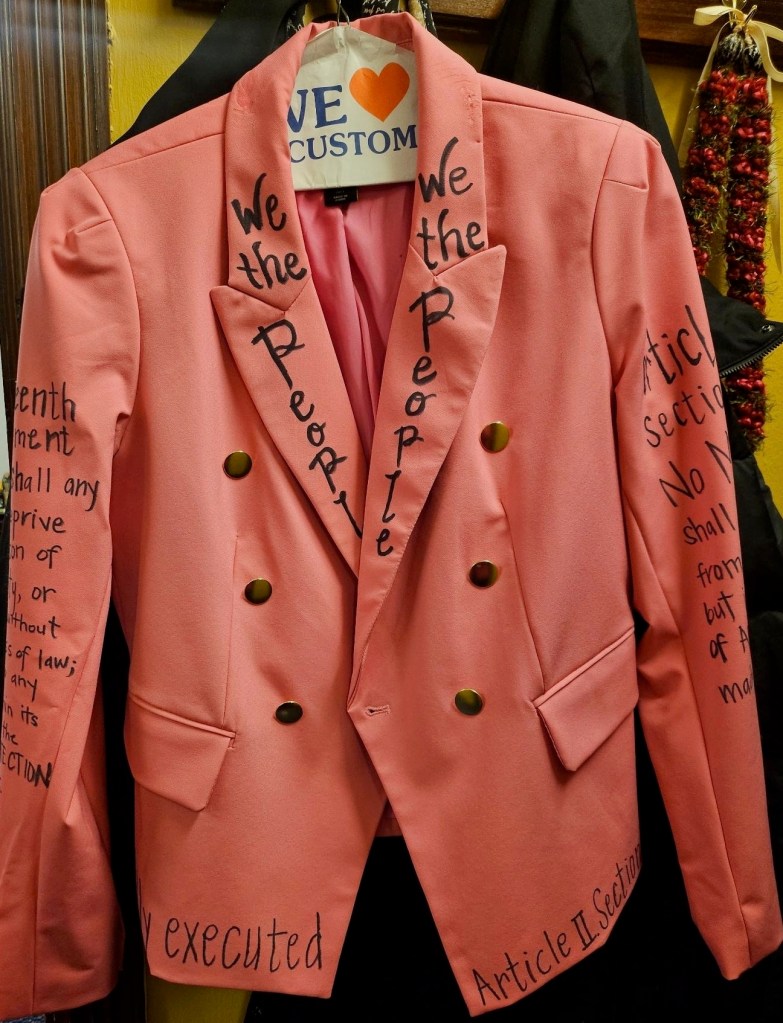
I had on my other sleeve the power of the purse, specifically for Congress. And along the edges, which people can see when I was sitting down, was the fact that the president shall uphold the law. I put that right along the edges. And I had a resist fist on my back, which I was very proud of having etched onto my jacket. It was a statement that, above all, we have to protect and uphold, fight for the Constitution and the law.
We took that oath, and I wanted to make sure that he saw that, that the Republicans and anyone watching saw that, that while there is a blatant disregard of the Constitution, of individual rights, of the law by this administration and those who support him, the GOP majority, that there are those of us who will fight, and that’s really what it was.
What kind of blowback has your office received? We see what is happening with people who dare take on Trump and Musk.
You get a lot of responses on both sides. You have those who really appreciated the fact that the Constitution, the word of law, was represented loudly in the chamber that night. So they really appreciate that kind of action. They didn’t want us just sitting there being solemn and silent. They wanted us to really be making a statement. And people did in different ways.
I will say that we did see a significant uptick in trolling on our social media, from Facebook to the X accounts to phone calls in our office. Unfortunately, as you can imagine, when you go against that person that they absolutely believe in, it draws out their followers who will make those ugly calls, that will write nasty things on our social media accounts and comments. I tell my family and my kids, as I have from day one, “Don’t read the comments, even the articles. Don’t read what they have to say, blog posts and social accounts. Don’t go for that. Don’t engage.”
But I think the hardest part for me is the fact that your family, your friends, your staff, especially, they bear the brunt of that. They didn’t sign up for this. But at the same time, all of us sign up knowing we will have to take hits. We will have to take that risk in order to do what we feel is absolutely 100% right.
 Sign up for our FREE morning newsletter and face each day more informed.

Local reporting when you need it most
Support timely, accurate, independent journalism.
Honolulu Civil Beat is a nonprofit organization, and your donation helps us produce local reporting that serves all of Hawaii.
ContributeAbout the Author