The Sunshine Blog: It's Tough Being A Legislator These Days
Short takes, outtakes, our takes and other stuff you should know about public information, government accountability and ethical leadership in Hawai‘i.
March 9, 2025 · 12 min read


About the Author

Not so easy money: The Sunshine Blog is one of those eagerly waiting to see what the Legislature does about pay raises for itself, the governor, lieutenant governor, state executives and judges. Lawmakers have until the end of session to accept large raises being recommended by the state salary commission, reject them or let them take effect by remaining silent.
It’s an all-or-nothing deal. They can’t just approve higher pay for judges, for instance, even though everyone seems to think judges need to be better paid or soon no one will want to be a judge. Lawmakers have to sign off on what the commission has handed them. Or not.
And by large raises, The Blog means it’s enough that citizens are largely aghast. Even the governor asked the commission to reduce the amount of money it was contemplating for that position. Legislators, who already make $74,000 a year for what’s supposed to be part-time work, would see their paychecks rise to about $99,000 in just two years and then to $114,000 at the end of six years.

It’s all very dicey politically. All the House and half the Senate will be up for reelection next year and legislators couldn’t receive their first pay bump till after the 2026 elections.
Some House lawmakers are already speaking up against the raises despite the impact rejecting them will have on hundreds of state officials. And last week at Civil Beat’s panel discussion with a couple House leaders, there seemed to be a willingness to link more money to more work — as in possibly making the Legislature year-round.
House Minority Leader Lauren Matsumoto (that means she’s a Republican) acknowledged that most people don’t think the raises, particularly for legislators, are acceptable. “That’s a huge jump from what we’re currently making,” she said.
But is the Legislature really a full-time job? CB politics editor Chad Blair asked. “Are you being compensated for the work that you do?”
House Majority Leader Sean Quinlan (Democrat), who proved to be absolutely charming and even pretty funny, noted being a politician comes with sacrifices.
“I’ve made two really bad financial decisions in my life,” he told the crowd at the State Capitol. “One was marrying my wife, God bless her, and the other one was becoming a politician.”
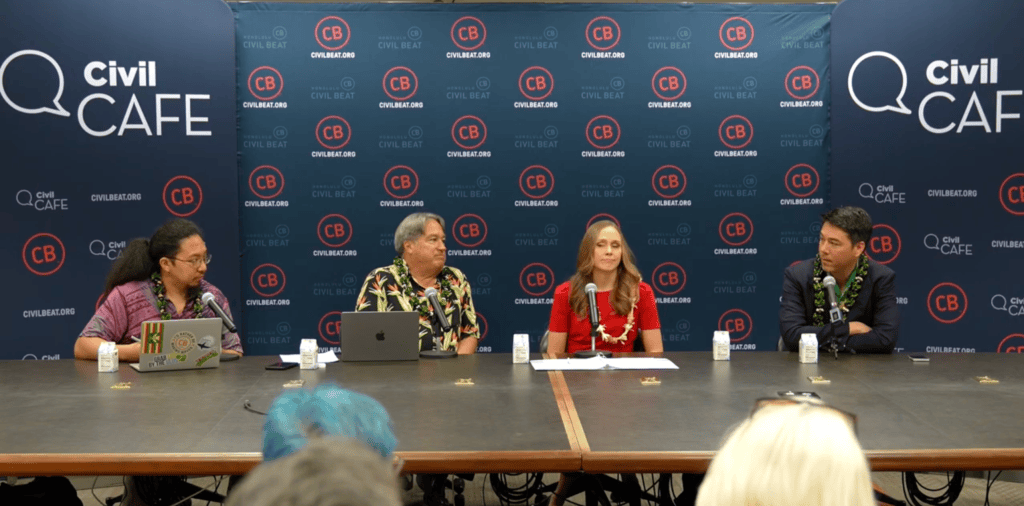
Quinlan pointed out he has been working many hours a day, seven days a week since joining House leadership last summer. The long hours not only make it hard to hold a second job but he conceded it was difficult to imagine something he could do that wouldn’t be a conflict.
“What second job could I get that wouldn’t be tainted in some way by the position of power that I hold?” Quinlan said.
“The other day I was thinking maybe I could get a job as a valet parker. I’m a pretty good driver, I’ll make good tip money. And then I realized, oh my gosh, I’m the tourism chair. If I go to a hotel and ask them for a valet parking job, they’re going to give it to me because I’m the chair of tourism. Even at that level of job can I be assured that they’re not just hiring me because they want some quid pro quo?”
It’s hard to carve out any time for themselves and their families, they both agreed. Not like the old days when lawmakers went back to their districts, had regular personal lives, and came back to the Capitol in January to do the public’s business.
Now, Quinlan pointed out, with new technology and social media lawmakers are getting called or messaged by constituents constantly.
“Now everybody in my district has my cell phone ’cause my mom gives it out at Foodland,” he said. “It’s never ending.”
Matsumoto recalled making $46,000 a year when she first was elected 13 years ago. The pay has gone up, but it’s still not enough to convince good, qualified people to give up their jobs and become lawmakers.
Matusmoto isn’t saying she’ll back a year-round Legislature. She wants to see how it would look and what changes to the currently cumbersome legislative process would be in order. Campaign finance rules would need to be re-thought, she said, particularly since lawmakers recently passed a ban on fundraising during session.
A bill backed by House Speaker Nadine Nakamura to study a full-time Legislature died. But the legislative staff is continuing a study that was already in the works.
Will it all come together in time for lawmakers to decide the Big Question on pay raises? The Blog is on the edge of our seat.
Job security: And speaking of lawmakers who have other jobs that could pose a conflict except for when the House speaker says it doesn’t (which as Matsumoto pointed out during the Civil Beat event is virtually all of the time), during Tuesday’s marathon House floor session members approved a bill that would officially prohibit “excited delirium” from being used as a factor in legal cases. That’s a state of extreme agitation and aggressiveness that can sometimes lead to a person’s death.
Perhaps the most well-known and most recent case here in the islands involved Sheldon Haleck, who died after scuffling with police in 2015. Officers were found not be at fault and in a later civil suit the city contended it was excited delirium that caused Haleck’s death.
Rep. Della Au Belatti’s law firm was the one who brought the case against the city and she rose from her seat on the House floor to declare she was one of the key attorneys who worked on the case. That lawsuit, by the way, sought to do the very thing this legislation would do — outlaw the use of excited delirium as a defense in Hawaiʻi, something many other states had already done.
And yet? “No conflict,” House Speaker Nadine Nakamura ruled on the advice of House legal counsel.
The Blog is scratching our head at that one. Here’s the House’s definition of conflict of interest: “A ‘conflict of interest’ arises when the standards herein are impacted and includes, but is not limited to, situations when the measure affects the member’s direct personal, familial, or financial interest; provided that a conflict does not arise where the measure applies to a broader class.”
Teach your children well: And one more item involving Lauren Matsumoto, speaking of lawmakers who are charming and funny.

For the past six years or so, Matsumoto has been distributing copies of a 30-page booklet titled the “Hawai‘i State Government Activity Book.” (It’s also available online.)
Activities include a crossword puzzle and a connect-the-dots exercise, all with the aim of educating youth on the lingo, history and purpose of our government. There’s even a section on how to submit testimony for a bill.
Matsumoto tells The Blog that some students who received the book in her home district of Mililani later approached her for help writing legislation and resolutions.
“It’s aimed at a third-grade curriculum, but it works for kindergarten through fifth grade,” she said. “But actually the whole goal was also to have the kids do it with their parents so they learned about the process, too.”
Help wanted: Both the Hawaiʻi State Ethics Commission and Campaign Spending Commission are looking to fill upcoming vacancies.
The ethics commission tackles issues involving legislators, registered lobbyists and state employees, with the exception of judges, who are governed by the Commission on Judicial Conduct. Campaign spending commissioners are responsible for enforcing the law, educating the public, administering public financing and training campaign committees.
It’s a volunteer gig, but some expenses such as travel are reimbursed. Vacancies are appointed by the governor from a list of nominees submitted by the Judicial Council Click here to apply or call the Judicial Council at (808) 539-4702.
Crossing over: And now that the dust has settled on what bills are still being considered this session, here’s The Blog’s list of Sunshine bills that have survived. Loyal readers will recall that in January we laid out a list of about 200 bills dealing with accountability, transparency, ethics, elections, public records and a bunch of other things that helped the public scrutiny of the people’s business.

So there are about 50 left on our list. And while that may seem like they got whacked pretty good, many on the original list were duplicative between the House and Senate or even within the same chamber. The Blog still can’t understand why lawmakers don’t just get together before session and collaborate on an issue, thus sparing the public from having to figure out minor twists on the same issue in multiple bills.
Here are the survivors, by category: (with our shorthand summary of the bill. Click the link for the details.)
Constitutional Amendments
SB 311 – Provides that the right of free speech does not include spending money to influence elections.
SB 1225 – Majority of votes means all yes votes and doesn’t include spoiled, blank or over votes.
SB 124 – Making reapportionment based on the resident population rather than the permanent resident population.
SB 121 – Giving the Senate more time to consider and confirm judges.
SB 350 – Right to contraceptives and contraception.
Elections
HB 408 – Office of Elections package: extends time to register for voting by mail to 10 days before primary rather than 30 days.
SB 176 – Changes the criteria for mandatory recounts.
SB 780 – Requirements for disqualifying candidates from the ballot and challenging them.
HB 134 – Requires elections officials to provide an electronic system for filing nominating papers.
SB 1030 – Specifies that voter fraud and intimidation includes carrying a gun at a voter center or polling place.

SB 5 – Legislative vacancies. If someone can’t finish term and deadline to file for the seat has passed, governor can fill a vacancy for the rest of the term and the next one.
HB 141 – Elections Commission members need to be confirmed by Senate.
SB 1515 – Replaces the boards of registration with on-call circuit judges to hear elections disputes.
Campaign Finance
HB 371 – Campaign Spending Commission package: Restrictions on donations from contractors and grantees, company and organization officials and their family members.
HB 372 – Campaign Spending Commission package: Prohibits campaign contributions to elected officials during session.
HB 369 – Campaign Spending Commission package: Return excess campaign funds or they go to the state
SB 1202 – Allows candidates to spend campaign funds for child and family care.
HB 370 – Campaign Spending Commission package: Revises partial public financing with increased amounts for each office.
SB 345 – Campaign Spending Commission package: Partial public financing increases cap on matching funds and amount that can be spent.
SB 51 – Establishes a comprehensive system of public financing for all candidates seeking election to state and county public offices in the state of Hawaiʻi, to begin with the 2026 general election year.
SB 1032 – Requires business entities contributing or spending money in an election to disclose their foreign influence and requires independent expenditure committee donors to disclose their interests.
Ethics
HB 411 – Ethics Commission package: Uniform provisions for penalties under lobbying law.
SB 289 – Ethics Commission package: Uniform provisions for penalties under lobbying law.
HB 412 – Ethics Commission package: Expands definition of lobbying to include high government officials when involving procurement.
HB 413 – Ethics Commission package: Clarifies restriction on lobbyist contributions.
SB 1545 – Repeals language in the state’s Code of Ethics that exempts the Legislative Branch from prohibitions against nepotism in public employment.
SB 283 – Increases penalties for bribery, under certain circumstances.
Public Records
SB 353 – Prohibits governor from suspending requests for public records during an emergency and allows Legislature and county councils to terminate governor or mayor’s state of emergency.
HB 131 – Allows access to government records for research purposes.
Sunshine Law
SB 405 – Allows neighborhood boards to discuss items not on the agenda if brought up by a government official.
SB 869 – Defines community outreach boards and brings them under the Sunshine Law similar to neighborhood boards.
SB 1651 – Requires that board packets for public meetings be posted at least two full days in advance of meeting.
Accountability & Transparency
HB 792 – Clarifies the office of the legislative analyst.
HB 1320 – Requires the University of Hawaiʻi system to collect, analyze, and publicly report certain graduate outcome data.
SB 741 – Establishes an external audit committee within the University of Hawaiʻi to audit the UH System and the Board of Regents and report annually to the Legislature.
SB 747 – Establishes an audit office within the Department of Education to audit the DOE and report to the Legislature. Creates six positions for the audit committee and provides funding.
HB 126 – Hawaiʻi Omnibus Criminal Forfeiture Act: Increases transparency and accountability around asset forfeiture. Clarifies what property can be forfeited.
SB 307 – Establishes right to record law enforcement.
SB 1149 – Requires law enforcement to report all possible hate crimes.
HB 763 – Promotes civic education in public schools including two full-time positions.
HB 1343 – Requires the Board of Education to adopt a policy that bans the use of phones and related devices by students during school hours.
HB 546 – Establishes the Aloha Intelligence Institute within UH to develop, support and advance AI initiatives.
SB 1622 – Establishes the Aloha Intelligence Institute within UH to develop, support and advance AI initiatives.
 Sign up for our FREE morning newsletter and face each day more informed.

Local reporting when you need it most
Support timely, accurate, independent journalism.
Honolulu Civil Beat is a nonprofit organization, and your donation helps us produce local reporting that serves all of Hawaii.
ContributeAbout the Author