What Social Science Tells Us About Violent Crime On O‘ahu
Aggravated assaults, robberies and sexual offenses are significantly lower than they used to be.
March 14, 2025 · 6 min read


About the Authors



Crime is a big problem. At least, that’s what people are thinking these days.

A recent survey of Hawai‘i residents shows crime is a significant concern — “the 4th most pressing issue, surpassing fixing local government, economy and jobs, and inflation.” Considering the state of the economy and inflation, that is telling.
Indeed, despite the growing salience of other problems facing the state, crime is more concerning to residents than it had been. According to a Hawaii News Now article, in 2023, crime was only ranked the seventh highest concern; “[t]his time, 63% of respondents believe violent crime in Hawaii is getting worse.”
But is it actually? Are we less safe now than we used to be?
As members of the Hawai‘i Crime Lab, a research group for public-minded criminologists at UH Mānoa, we can answer this question!
The Hawai‘i Crime Lab seeks to help residents, visitors, and policymakers understand crime and punishment. Since political rhetoric and media coverage of select crimes can shape public perceptions of the crime problem, our Crime Observatory of O‘ahu analyzes publicly available crime data to figure out what’s going on with crime on O‘ahu. In this way, we provide context for the headlines about crime.
To put current crime counts in long-term perspective, research assistants Emma Burnkrant and Jesus Romero recently collected data on violent crime going back to January 2019 from the Honolulu Police Department’s crime dashboard.
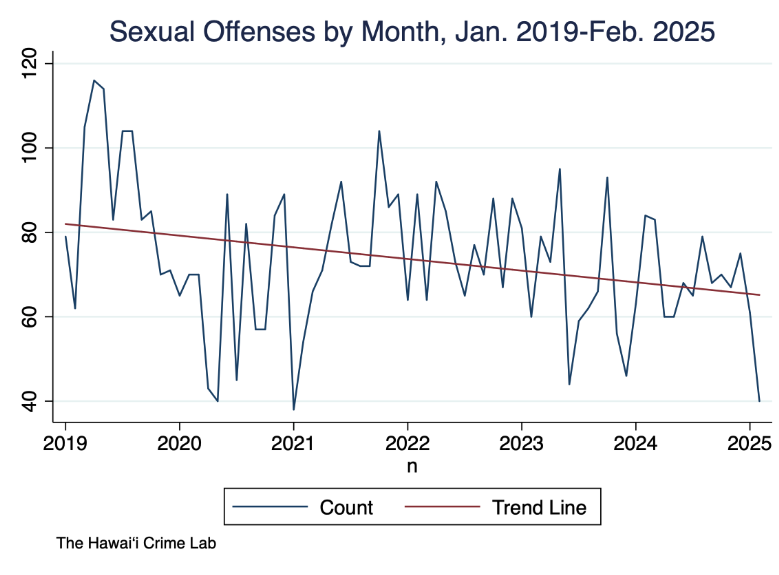
Since crime rates across the country were interrupted by the pandemic and subsequent lockdowns in March 2020 onwards, and then rebounded with a vengeance in late 2020 and 2021, simply comparing recent years’ crime counts to 2020 or 2021 could be very misleading.
If 2020 was a low-crime year (as it was in many places), comparing current (2025) or 2024 data to 2020 would make our recent counts look artificially high. If 2021 was a high-crime year (as it was in many places), comparing current (2025) or 2024 data to 2020 would make our recent counts look artificially low.
However, with data going back to 2019, we can track crime rates even before the pandemic, providing a more accurate baseline with which to compare the 2024 and (early) 2025 data.
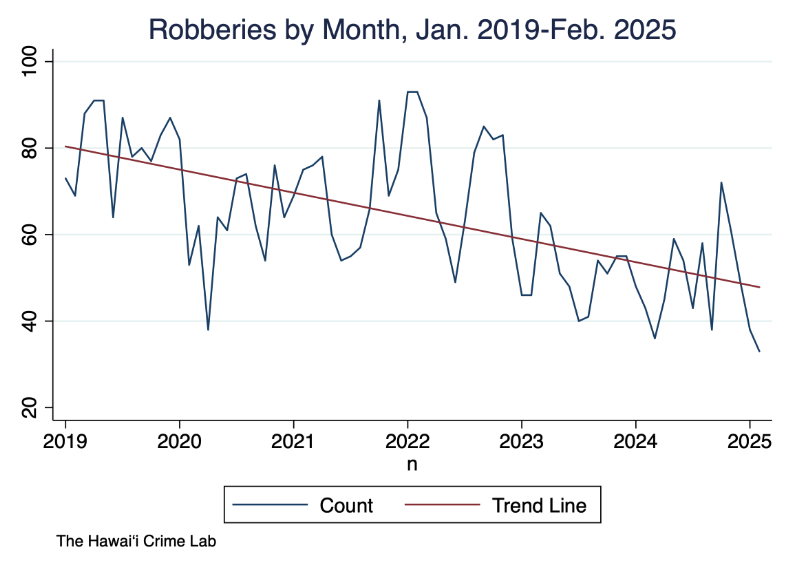
Next, we use statistical techniques to help us make sense of the data. Since crime counts fluctuate substantially from month to month — they can be down by 60% one month and up 80% the next — statistical analyses help us take out the “noise” and see the larger trend. Our statistical techniques reduce the trend to one number — the average change over time. They also tell us whether that number is statistically significant or not — is it a real trend or not.
After analyzing the data, we found that aggravated assaults, robberies, and sexual offenses are significantly lower than they used to be. When we say significantly, we mean the long-term trend of downward changes is not part of the standard, expected fluctuations around some stable number but a clear downward trend. That is, the monthly counts of these crimes aren’t just lower over time: they are meaningfully lower.
On average, we’ve been seeing 0.28 fewer aggravated assaults each month since January 2019. That means that some months, we see more aggravated assaults and sometimes we see fewer, but over time, those ups and downs are averaging out to a significant downward trend.
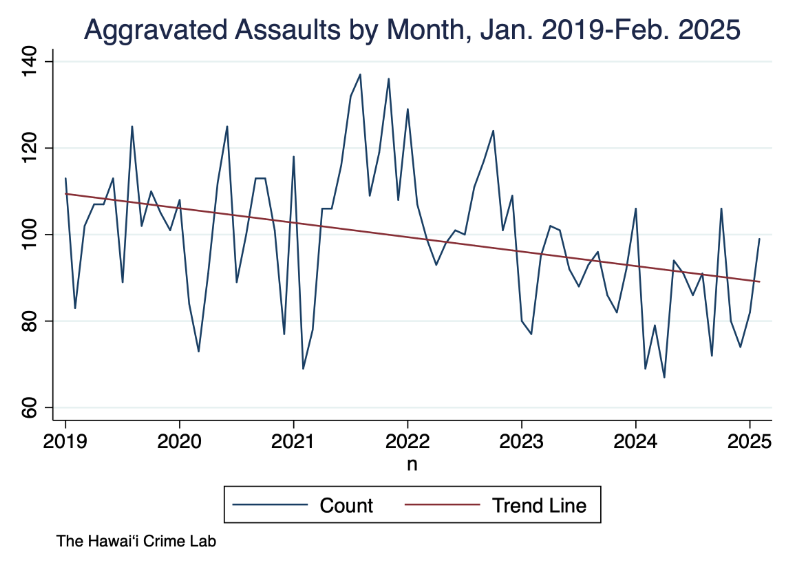
Even though 0.28 fewer monthly assaults is not a lot, it does add up. For example, in 2019, we averaged almost 105 aggravated assaults each month and in 2024 we averaged 84.6 aggravated assaults. That’s an incredible difference.
Likewise, we’re seeing 0.45 fewer robberies on average in a given month. In 2019, we averaged 80.7 robberies a month, but in 2024, we averaged 50.5. Again, a sizable (and significant) decrease.
We’re also seeing an average of 0.23 fewer forcible sex offenses in the monthly counts. In 2019, we averaged 89.7 sexual offenses each month and 70.2 in 2024, another significant decrease.
We cannot share similarly happy news about the monthly homicide counts. Homicides have been rising at very small amounts, although the increase is not quite statistically significant.

On average, we’ve been seeing 0.02 more homicides each month over time. This number is too close to zero, so we cannot rule out a flat trend, but it adds up over time. In 2019, we averaged 1.4 murders and manslaughters each month, but in 2024, we averaged 2.7. Statistically speaking, this is not a large amount, but in practice, it means more lives lost. In 2019, there were 17 recorded homicides and but there were 32 in 2024, a fairly stark increase.
Our analysis is consistent with an earlier analysis we published on our website analyzing crime trends from January 2022 to December 2024. In that analysis, we also found downward trends in aggravated assaults, robberies, and sexual offenses, but a flat trend for homicide offenses.
In that case, however, only the aggravated assault and robbery trends were significant. The decline of sexual offenses was just barely not statistically significant, meaning we can’t be sure from those data that there is actually a flat trend. In the case of sexual offenses and homicide, this means that our counts have been fairly stable from 2022 to 2024 despite the monthly fluctuations, including some months with really high (for us) counts of sexual assault, murder, or manslaughter.
Taken together, we are seeing a general decrease over time in aggravated assaults, robbery, and sexual offenses, but the decrease in sexual offenses has been flattening out in recent years. Likewise, we’re seeing a general increase over time in homicides, but that increase is also flattening out in recent years.
So, is the public right to be worried about crime? Are we less safe now than we used to be? Island-wide, there are fewer aggravated assaults and robberies than there were in prior years, and generally there are fewer sexual offenses. But what is probably most contributing to public fear is the slow but steady rise in homicide offenses, particularly as these cases get disproportionate news coverage.
There is no such thing as an optimal amount of crime — all crime is unfortunate and scary, even when there is less of it than there used to be. But how we perceive crime varies based on our experiences, beliefs, and access to information. That’s where the Hawai‘i Crime Lab comes in.
We break down the numbers, track trends over time, and put crime data into context. Our monthly updates and in-depth analyses help everyone understand not just the headlines, but the bigger picture. Ultimately, our goal is to help residents, visitors, and policymakers separate fact from fear by staying informed.
 Sign up for our FREE morning newsletter and face each day more informed.
Community Voices aims to encourage broad discussion on many topics of community interest. It’s kind of a cross between Letters to the Editor and op-eds. This is your space to talk about important issues or interesting people who are making a difference in our world. Column lengths should be no more than 800 words and we need a photo of the author and a bio. We welcome video commentary and other multimedia formats. Send to news@civilbeat.org. The opinions and information expressed in Community Voices are solely those of the authors and not Civil Beat.

Local reporting when you need it most
Support timely, accurate, independent journalism.
Honolulu Civil Beat is a nonprofit organization, and your donation helps us produce local reporting that serves all of Hawaii.
ContributeAbout the Authors