Beth Fukumoto: Legislature Might Just Deliver On Some Opening Day Promises
Taking a calculator to the bills — and overriding issues — that are still at play this session.
April 22, 2025 · 6 min read

About the Author

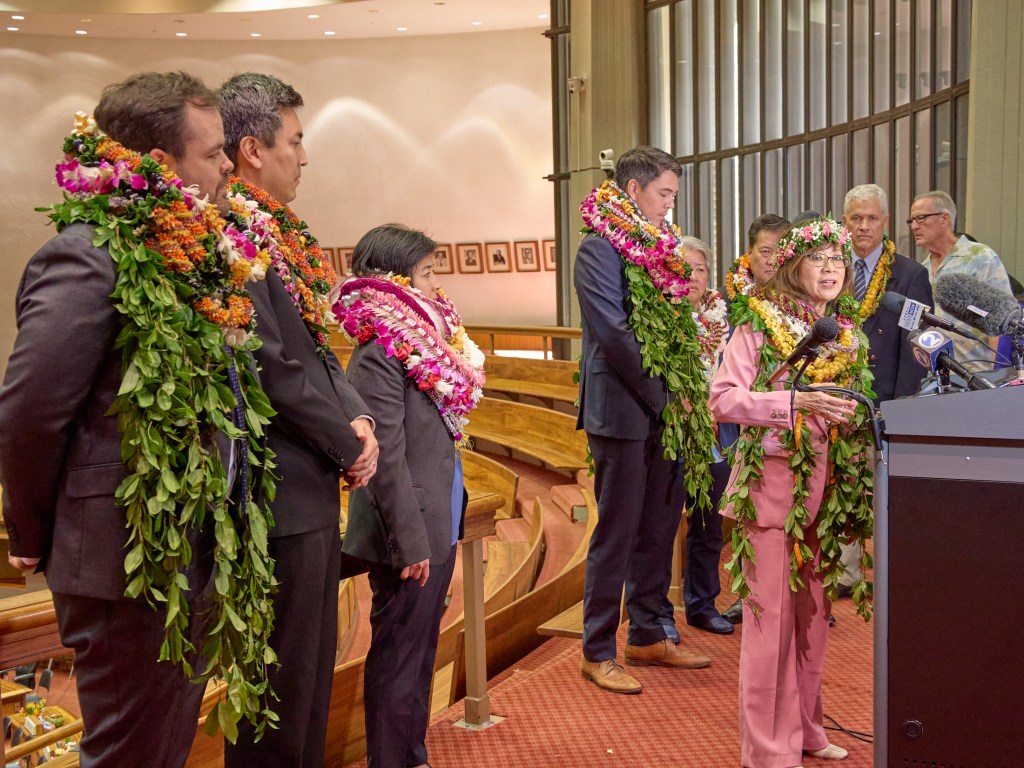
Every legislative session in Hawaiʻi opens with lofty promises. This year was no exception.

On opening day, state leaders painted visions of a healthier, safer and more affordable Hawaiʻi — where more locals are housed, more students thrive from pre-K to higher education, and agricultural innovation helps feed our families.
Senate President Ron Kouchi called for expanding vocational education, addressing disaster insurance and improving rural health care. House Speaker Nadine Nakamura outlined a 20-year vision anchored in workforce housing, pre-K access, economic diversification and environmental stewardship.
Republican minority leaders Sen. Brenton Awa and Rep. Lauren Matsumoto echoed the urgency around housing and cost of living while also focusing on parental rights, tax reform and government transparency.
The parties may differ in how they hope to achieve these goals, but their priorities — housing, education, health and affordability — were strikingly aligned.
So, how did their actions match their words?
That depends on how we measure success.
By The Numbers
This session, lawmakers introduced 3,172 bills. As of last week, only 451 remained alive — less than 15%. Of those, just 44 had passed both chambers and been sent to the governor — barely 1%. While the legislative process naturally narrows the field, the numbers reveal something about the friction between ideals and implementation.
As an initial metric to track how well legislators followed through, I tallied the number of bills referred to each subject matter committee in the House and Senate — excluding catch-all committees like Finance, Ways and Means, Judiciary, and Commerce and Consumer Protection.
Health and Human Services led the way, with more than 600 bills referred to those committees. Agriculture, Energy, and Environment followed with at least 550, and Water and Land received over 360. These areas touch on local food production, services for the homeless, and climate resilience — all key topics in opening day speeches from Democratic leaders.

However, housing, education and economic development — frequently mentioned as top priorities — saw fewer bill introductions. Housing committees received fewer than 225 bills, while Education and Economic Development each came in under 300. Government Operations and Legislative Management — which handle transparency and election reform — saw fewer than 140.
So, by volume alone, lawmakers didn’t exactly flood the system with ideas on their highest-profile issues. Still, quality matters more than quantity. As the session nears its May 2 end, it’s worth asking: Which of these priorities were still on the table?
Health and Human Services still led, accounting for nearly one-fifth of all surviving bills. Agriculture, Energy, and Environment followed with about 15%, and Water and Land rounded out the top three. Housing, which got off to a modest start, had 37 bills still in play.
And crucially, many of those bills align with Democratic leaders’ original promises.
Platforms Still Standing
The House Majority Caucus has made steady progress on its platform. All seven bills in the caucus’s legislative package — focused on housing, early education, sustainability and workforce development—were still alive and moving. That said, even if they all become law, it’s just the first step in the sweeping vision Speaker Nakamura laid out on opening day.
In the Senate, a closer look at the surviving bills showed progress on several of Kouchi’s stated goals. Notably, the Senate budget included $39 million to purchase more than 1,000 acres of agricultural land on Kauaʻi, a move that supports his focus on food security and land banking for local agriculture.
Meanwhile, the Republican caucuses can claim credit for surfacing ideas to tackle the issues they prioritized — even if few of their bills advanced. Both the House and Senate minority caucuses introduced packages reflecting their values and priorities, such as eliminating the state individual income tax, setting a time limit for counties to grant building permits and restrictions on foreign ownership of land.
While some mismatch between vision and reality is inevitable, lawmakers are better positioned than usual to make good on their promises.
Still, not everything currently moving through the Legislature matches January’s soaring rhetoric.
Some of the most consequential bills now center on issues barely mentioned on opening day. Still pending were decisions on how to handle the legal and financial fallout from the Maui wildfires, whether to legalize online sports gambling and how to tighten rules around police chases.
There was also a cluster of tax proposals in the mix: raising the transient accommodations tax to address climate impacts, taxing cruise ships, increasing the cigarette tax, and adding a new vehicle weight tax on large trucks and SUVs to fund the Safe Routes to Schools program. These are the kinds of policies that don’t always make for great stump speeches, but they matter just as much in the everyday lives of residents.

Streamlining Permits: A Pleasant Surprise
Of the 44 bills already sent to the governor, most passed through Judiciary or Finance. That’s not unusual. But looking at bills referred through topical committees, Health and Human Services and Public Safety had the strongest showing so far. Four of the passed Public Safety bills were related to firearms — an issue largely absent from opening day speeches. Only one housing bill had made it through so far, and it doesn’t address affordability or permitting delays.
But there’s a pleasant surprise in the mix: Despite early doubts, several bills aimed at streamlining the building permit process are still alive. That’s no small thing. Improving permitting has been a bipartisan talking point for years, but rarely has it translated into viable legislation. This time, the groundwork lawmakers laid early in the session may actually yield results — if they can shepherd those bills through the final stretch.
So, while some mismatch between vision and reality is inevitable, lawmakers are better positioned than usual to make good on their promises. Several of the most high-profile issues, including the House majority’s and key Senate legislative priorities, are still on track. And if permitting reform passes alongside broader housing, education and agriculture measures, the session could still deliver meaningful steps toward an affordable, sustainable future.
Opening day speeches show us what lawmakers hope to achieve. The final days of session show us what they’re actually willing — and able — to do. And this year, if they follow through, we might end up a little closer to the vision they set out to build.
 Sign up for our FREE morning newsletter and face each day more informed.

Local reporting when you need it most
Support timely, accurate, independent journalism.
Honolulu Civil Beat is a nonprofit organization, and your donation helps us produce local reporting that serves all of Hawaii.
ContributeAbout the Author