The Sunshine Interview: Honolulu Prosecutor Steve Alm
The wide-ranging discussion addressed sports betting, fireworks, relations with HPD, staffing challenges and priority legislation.
April 13, 2025 · 24 min read


About the Author

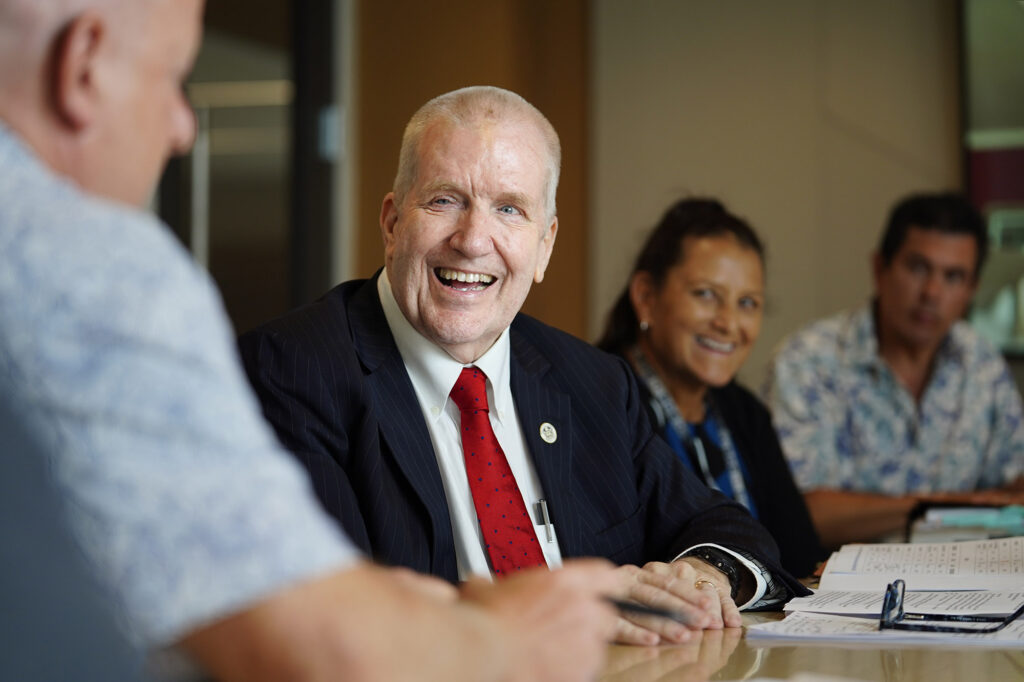
Editor’s note: Honolulu Civil Beat editors and reporters met with Steve Alm, prosecuting attorney for the City and County of Honolulu, on Friday. This interview has been edited for length and clarity. Alm began by talking about his opposition to a bill that would legalize online sports wagering.
I’m really concerned about legalized sports gambling. It reminds me of legalization of marijuana. I didn’t look into until recently, and it’s probably two or three months ago that I started looking into this. And you know, it wasn’t until a Supreme Court case in 2018 that said every place besides Nevada can do this. And so states have rushed headlong into this, and 38 states now allow it, but it’s a casino in somebody’s hand in their living room.
I think in a few years we are going to have, regardless of what Hawaiʻi does, a generation of problem gamblers. They’re going to get in so much trouble. And we look at other states, that’s what’s happening. I mean, it’s unbelievable. The bankruptcies are up in states that have legalized sports booking. There are other problems. They’ve had casinos and stuff, which I don’t like either, but from sports bookmaking they have credit card debt.
They’re four big companies that do this, FanDuel, DraftKings, BetMGM and Fanatics. And they have hosts. So if someone starts betting and you reach a certain number, a host will start texting, “Hey, how’s it going? I’m so and so, let’s develop a personal relationship.” And then if you start easing off, “Hey, I haven’t heard from you for a while, here’s some tickets to the next wahine volleyball game. Here’s a trip to Vegas.” It’s like Pareto’s law: A small percentage of the consumers are going to consume the bulk of it. So 5% of the betters spend 50% of the money. It’s the problem gamblers.

And one of my beefs with the Legislature legalizing it is we’re making money off addiction. I mean, that is absolutely what it is.
I think it could destroy sports. People will be going to UH football games, but they’re not going to be watching. They’re going to be on their phones betting. “Is he going to make the field goal or not? Is the quarterback going to pass? Are they going to run?” They bet on the most minuscule things, and the NCAA is scared to death
This bill is slated to go to conference committee. The primary rationale for its passage is the revenue. I believe the estimates currently are $10 million to $15 million a year if the state gets 10% of the gross revenues.
That’s industry numbers. The Department of Taxation testified once, in February, never to return. They estimated $5.3 million in fiscal year 2026, $5.5 million the next year, $5.7 million the next year. And they took out the 10% and the other stuff. So I don’t trust industry. And so in a budget of $10 billion, I really don’t think the Legislature is going to do this. And if they do, I sure hope the governor vetoes it.
Can I ask a philosophical question about this? Gambling is a crime against morality, not property, not against the person. And the rationale for prohibiting crimes against morality is that the community just says we don’t want this. But is society at a point where we’re saying gambling is OK?
I hope the Legislature doesn’t fall prey to them, and they’ve resisted gambling for decades. And typically, the governors would say, “I’m going to veto it,” so that ends it. You know, when I was U.S. attorney, I wrote an op-ed because (Gov.) Ben Cayetano comes and says, “I’m open to it,” which caused everybody to start putting stuff in there. And (Speaker Joe) Souki and I battled it. I brought experts in from the mainland. We had informational briefings. I sent out a press release saying this is really bad.
One of my beefs with the Legislature legalizing gambling is we’re making money off addiction.
And I think part of it is people realize with drugs, the individual person might get hurt. With gambling, the whole family’s destroyed. All the money goes. And you’re right, a lot of people want it, but I think that’s one of the challenges of the Legislature. There are a lot of new legislators, and they may think, “Wow, this is just easy money to pick up. People are doing it anyway. Let’s do it.”
I mean, this is a state that sends a lot of its people to Vegas every year. There clearly is an appetite for a gambling. Are you fighting against something that seems inevitable?
No, because we’ve never legalized casino gambling, and the statistics are worse on sports bookmaking. It’s this casino in your hand, especially for young men who don’t make good decisions anyway. Most of the problem gamblers are between 18 and 30, right? They make horrible decisions, and they’re getting in trouble. And the stats clearly show low-income people are going to do the worst at this. Rady School of Management at UC San Diego did a study — 96% of the people betting on sports bookmaking are losing, 4% are winning. And when they start winning too much, they cut them off or they limit them to $1 bets.
So our Legislature, I cannot believe, would want to legalize something where 96% of our residents are going to lose, for $5 million bucks. And once one type of gambling comes in here, I think it truly is self-fulfilling. We’re going to have casinos, we’re going to have everything
else.
I believe there is language in the latest draft regarding helping people with addiction.
That’s to make themselves look good on this. But there aren’t any other things, like how about banning these hosts? How about if somebody gets so far in debt that they can’t keep pressuring them to do this? Because gambling is everywhere in the mainland, I don’t think a lot of tourists are going to come here to gamble. They may do it when they’re here, but if they do it, then that means their disposable income instead of going to Gyotaku or Roy’s or the Polynesian Cultural Center, they’re going to spend some money on gambling.
There is this working group being formed to study the issue. Are you guys going to be included in that?
We are not so far. But what really bothers me is they’re talking about a working group at the state Department of Business, Economic Development and Tourism. It’s not an analysis of “is this a good thing or a bad thing.” It’s “How do we market this?” And they had seats at the table for FanDuels and DraftKings, and then I think that they got embarrassed about that, so they took that out. But they still are going to want people from the gaming industry.
They’re talking about allowing gambling by 2027, so if that passes, that’ll give us a couple of years to try to educate the legislators. Because I think something like 31 of the 51 (in the House) are either first year or second year and they may just see this as, “Hey, this is money. People like to gamble anyway. Why don’t we get a cut of it?”
Are you guys going to get a seat on that working group?
I don’t know. So far, we have not been asked. There’s nobody, I don’t think, from law enforcement on there. And I don’t know if they’d want us on there, because we’d be objecting to just the idea. Now, Nadine Ando from the state Department of Commerce and Consumer Affairs gave really good testimony. She said, “Since we’re supposed to protect the consumers, this goes against our charter” or whatever. But also it’s going to take a couple of years, a couple of million bucks, to set this up. It’s a complicated venture, because she said most states that have legalized sports gambling already have other gambling, so they have gambling commissions, they have that kind of stuff.

And so I don’t understand the latest bill where they’re supposed to start on July 1 of this year. So I don’t know if that’s done intentionally. And transferring it from DBEDT to the Department of Law Enforcement makes no sense either. I think people are putting so much on law enforcement, and they’re willing to try to help out, but they have no expertise in setting up this kind of regulatory structure.
Okay, let’s shift to fireworks. There are five bills currently still alive going into conference committee, including setting up a fireworks enforcement unit in DLE, extending the illegal fireworks task force, which sunsets this year. There’s one that allows drones and recordings as part of investigations, and then this omnibus bill on the various penalties. Where are you in terms of your feelings about fireworks and the Legislature this year?
I appreciate the focus it’s getting. It’s really helpful. And we’d support the setting up the task force and with DLE doing that. We appreciate Rep. (Scot) Matayoshi’s omnibus bill — I think it’s 88 pages long — but they changed the definition of aerials, which is great. We’ve all been talking about this because right now it’s incredibly complicated, and you get to talk about how much gunpowder is involved, and you need an expert witness. The way he’s written it is the way it should be, that if you observe somebody setting something off, it has to go 12 feet in the air and explode. That is an aerial and I think there’s a fine involved in it. And what would have to happen is HPD, because it’s got to be something a single police officer, can see. We can’t ask neighbors to testify against neighbors. It’s just not going to work and then publicize it when it happens.
But that is never going to stop this. I mean, look at New Year’s, it’s just everywhere. It’s going to have to be at the harbor. And when I Googled it, I think they have 320,000 containers a year coming in there. Whatever they can do at the docks to stop it there and use intelligence and figure out where stuff came from, I think is going to, in the long run, be the best argument.
With Matayoshi’s changes and definitions, would it help your office enforce some of these penalties?
Yeah, although that may end up with a person just going into their backyard and shooting it off rather than on the street. But something is better than nothing with that. And with the thing about drones — you know, there’s case law that a helicopter cannot be used to spot in somebody’s backyard and get probable cause. So it’s a little hard to think why a drone is going to be viewed by our appellate court any differently.

But I think we’ve seen that we may be taking all this seriously. I don’t necessarily know if the judiciary is, because the couple of fireworks cases that come up, I think they got deferral so they can keep their record clean. I don’t think they got a day in jail. This is not going to deter anyone.
The bribery bill that you guys introduced got shot down. What were you trying to do there?
The two differences to me between federal prosecution and state prosecution, one, you have to have a local prosecutor willing to prosecute these cases, which I am. I don’t know if my predecessors were. But you also need mandatory time in prison.
And so that’s what we’re trying to do with our bill at the Legislature. We want mandatory time because a police officer approaches a legislator and says, “You know, we’re looking into illegal stuff.” He’ll say, “Pound sand,” knowing even if he gets convicted he will get probation. And so that’s the big difference. We’re really disappointed, but unless the Legislature puts mandatory time on it, it’s going to be really hard to prosecute these cases. They’re really hard anyway.
So does that mean that you’re going to try and step up your prosecution of public corruption? Because there’s a sense that the feds do everything and the state and local folks just turn a blind eye.
We’ve been interested in it from the beginning, but I can’t emphasize how hard it is to make these cases. You have to get information about it, and we’re never going to be like the feds, because there you get prison time for most crimes. Back when I was U.S. attorney we prosecuted lots of people for political corruption, but it’s because somebody else got caught.
Mayor Blangiardi was in the other day and he’s very upset with the police chief because there’s a lot of crime, a lot of violence, and the mayor thinks that he’s the one who’s getting blamed for everything. So he would like to see some stronger oversight of the police. How is the police department operation affecting your ability to effectively prosecute crime, and what are you doing about it?
Police officers operate on a probable cause standard. We operate on a proof beyond a reasonable doubt standard. So there are a whole number of cases where they’ll bring it in and we can’t prove it beyond a reasonable doubt, or the witness doesn’t want to testify, which is often what it is. We try not to blame the victim, so when you or the Star-Advertiser calls us up and asks, “Why couldn’t you do this case?” We say, “Oh, there’s a wide variety of things.” It often is the victim doesn’t want to testify, or they’ve changed their mind, and we’re not trying to re-victimize them.

But what was top of mind for me is that crime is down in most categories. And if you ask the average person on the street, is it up or down, 99% will say it’s up. That is absolutely not true. It’s been down for 30 years in Hawaiʻi. Crime is half of what it is now as what it was in the 1990s. Overall, in Oʻahu, it’s down.
In most categories, it’s down. It’s up in murder. Usually they’re between 25 and 30 murder cases a year on this island, which compared to the mainland is tiny, but it still matters, and every murder gets a lot of press attention. That’s really good. And sex offenses were up. Every other category was down — aggravated assault, robberies, burglaries, motor vehicle theft.
From your perspective, is the police department being effective, or does there need to be some sort of change in leadership there?
I think they’re being effective. They need more people. When I talk to the police, like the major for the West Side, Major Gail Beckley, she said they see kids on Farrington Highway on their e-bikes, and a police officer is in a blue and white going to a 911 call where they’re passing the kids on the bikes. People see this and think, “Oh, they don’t care about that.” They don’t have enough people.
If you ask the average person on the street, 99% will say crime is up. That is not true.
So I know they have signing bonuses. I have a two-hour block that I talk to the police officers all the time about a variety of things, and they have a big incentive for people to join. But I’m hoping they can come up with money for retention bonuses so the experienced people don’t leave. So many problems will be able to be solved with more people. I think there that is just so important for HPD.
Where do you come down on the police chief himself? And the police commission?
I’m not going to criticize the police chief. I think we work well with them on virtually all these things. We’re trying to do more joint training with the police officers, with the detectives. It’s a challenge. I think the detectives, we hear anecdotally, they can make more money if they’re on patrol with overtime, and so because we want the detectives to stay there because they’re key to what we’re doing. But we have a very good relationship with them. I’ll do the independent investigations for the police shootings, and that’s always hanging out there in the background, but on a day to day basis, we work very well with them. I work well with the deputies, with the majors and the like.
I want to talk about staffing at your office as well. Looking at the budget you have a number of vacancies, particularly in the victim or witness counselor department. Can you talk a little bit about your biggest concerns when it comes to staffing in the prosecutor’s office, and how that impacts your ability to bring cases?
I think we, like many other organizations, have had trouble in the past attracting people to work. One thing we did that was really good: It used to be to hire a paralegal they had to have five years of legal experience, which means they’re going to go to the private sector and we’re never going to get them back. So we worked with the city and we set up a new path for a Paralegal 1. We’re hiring them from Kapiʻolani Community College when they’re in the paralegal program in the office, and we’ve hired several paralegals. We’d like to get one for each of the teams, because they can do so much. It’s cheaper than the lawyers we go to every job fair.
I don’t know if you’re aware, the federal agents have to retire at age 57. They take their guns away, and so we’ve hired some investigators from the feds when they hit 57. We’re getting a lot more interest for deputy prosecutors. The Maui prosecutor came up with a really interesting idea, and that’s can we hire people on a limited reciprocity basis, because right now you have to take the Hawaiʻi bar if you want to be a lawyer. But the proposal was for the government agencies, prosecutors, corporation counsel, attorneys general, can we hire somebody who has the bar in another state to work in our office?
They can’t go to private, they can’t go anywhere else, and the Supreme Court liked the idea. So we’re a four-month comment period that I think runs out in May, and I’m thinking that will come through. We’re already getting people who have a bar somewhere else, who are calling us wanting to come work.
So how is that impacting the cases?
It’s the clerical work. It’s really busy. The paperwork is overwhelming. And so that bill making a third offense for driving without a license a class C felony means we have to make sure we input all the information on every one of those cases. In a four-month period District Court got 14,000 cases of all kinds. So the case load is overwhelming. We had several people quit because they were doing overtime on a regular basis, and it was just too much. So we’ve got as part of our budget $120,000 to hire three more clerical folks, in large part because of that driving without a license law.
You mentioned earlier that one of the challenges in bringing cases was witnesses not wanting to testify. I noticed that you do have a decrease in the number of victim-witness counselor staff.
It’s a moving target. We’re trying to up the standards. We’re working closely with those folks, and they’re important. They’re not assigned to every case. A car theft case, they wouldn’t get a victim counselor. For an assault case, they would. We’re in an ongoing process for hiring folks. I think they’re able to cover the work that’s there. The deputy prosecutors are able to cover the work that they have. I’d like to get more because we can do more things, and we can have more training, and we do a lot of training, as it is. We have a week-long training at the end of May. It’s been at the convention center. And it’s really good because we can do a lot of skills training and watch people. But we’re trying to fill as many positions as we can.

Back to your Legislative agenda. You got a win with fentanyl — possession of it will join the same threshold for methamphetamine, heroin, morphine and cocaine. The governor recently signed that into law.
It’s a dangerous drug, so it’s part of the class C felony, but for Class B and Class A, for some reason, it wasn’t seen as a street drug. Nobody thought about it, and it wasn’t as big a deal in the past as it has been in the last few years. Most of our deaths are still meth, but fentanyl is increasing. So it’s a real problem. Nationally, fentanyl deaths are down. The overdose death from fentanyl are down.
Another potential win sitting on the governor’s desk is House Bill 392 prohibiting ghost guns. How significant is this legislation? How big of a problem are ghost guns?
It is a big problem. And a young man and a ghost gun is a really bad combination. And so what our bill does is change the definition. Essentially, if it doesn’t have a serial number on it, it’s a ghost gun. Now we will be arguing like heck to the Judiciary, “Send them at least to jail.” This is an area where deterrence can work. It normally doesn’t work. For violent crime, people don’t think about, “What could I get before I hit somebody with a 2 by 4,” right? But for white collar crime, it does. For political corruption, it does.
I’m curious if it’s a deterrent. There’s a number of cases where somebody’s been arrested with a ghost gun, not charged with a ghost gun, because, as you guys have talked about, there’s issues with the statute that you’re trying to fix, and then they’re usually charged with something else. But then they go on to commit a serious violent offense, domestic violence, serious assault cases. I believe there’s a murder. How do you think that changing the law is going to be a deterrent in those cases, and what went wrong there?
Well, because hopefully they’ll either get jail or prison time, and if people start getting that regularly, then they might not be trying to acquire or carry around a ghost gun. I mean, right now it’s probation. I’m a big believer in probation but not for certain kinds of crimes. And part of the problem too, is when there’s a shooting or something, HPD has a really hard time recovering the weapon, because somebody at the scene will grab it.
A young man and a ghost gun is a really bad combination.
We do try to get the message out there. “If you have guns at home, lock them up. Don’t give access to people. You cut down on suicides. You’ll also cut down on the 6-year-old killing the 3-year-old by playing with a gun, that type of stuff.
But part of this comes down to parents. You know, you’ve got a 14-year-old kid at 1 o’clock in the morning, where are the parents? In some cases they just can’t control them. They get picked up by HPD. And they call the parents, and the parents say, “You take them, I can’t control them.”
The bill to define and criminalize torture is going to conference committee. Watching that hearing, not only your folks are testifying for it, but particularly HPD officers saying, “I’ve seen these terrible scenes.” How commonplace is this?
We’re seeing more and more cases is the problem, some horrific ones, and that (Ariel Sellars case) in Waimanalo is a perfect example. That’s still pending trial. But we have other cases like that, a kid locked in a shed. And even the stuff about the starvation is apparently a thing around the country. And it’s about control. It’s horrific that we have people that do this kind of stuff, and that’s why we thought it was important that starvation put back into it. I think that’s the sticking point between the two houses.
On the torture bill for a second — there have been a lot of kids dying in Child Welfare Services custody, and many of them would fall under the torture bill. Do you think there needs to be some kind of stronger oversight of CWS? There have been a few bills this session to create some sort of oversight commission like other states.
We’ve had folks from our family division that deal with these cases, meeting with CWS, meeting with the Attorney General’s Office, and we’re trying to make the system work better. There’s no question that there are problems, and it’s such a hard area to deal with. They’re going to get criticized no matter what they do, but taking the kids out of school is a red flag to us. And I know there’s a talk about checking out the kids when they can, because if they go to school and they see the starvation or they see bruises, they’re under duty to report. But if they’re home-schooled, they’re not. And I don’t want to start a fight with all the legitimate home-school people, but if there’s some way there could be a welfare check, maybe we could catch some of these other ones.
Should the Legislature be doing better oversight of this state agency, or should the governor, frankly? Everyone seems to wash their hands of it, and kids keep dying.
Like I say, we’ve got some folks meeting with them, so I’m trying to let them work through the process to see where the failure really is. And maybe it’s something for the Legislature next time. They’re still having these meetings. We’ve got a really good team (in the prosecutor’s office) and they have these really horrendous cases. They’ve started with CWS and the Attorney General’s Office, and we hope to come up with some recommendations from that. I don’t have the answers to it right now, but hopefully something’s got to get better on this.
You and HPD Chief Joe Logan held a press conference last month on sexual assault cases on the internet. Talk a little bit more about that.
It’s young men trying to meet women. I think Instagram is a popular spot on it, but they’re meeting them, and then they’re sexually assaulting them. They’re raping them. There was one case in a drainage ditch next to Kahala Mall. There was another one they went to the girl’s house. They’re in her bedroom, and he took pictures of her. They had sex. He said, “If you tell anybody, I’m going to put this on the internet,” and we’re seeing a case a week of these. Kids love their phones, but parents need to be snoops and get into those phones and see who the kids are talking to. You know, they’re under 18, or in your house. We’re just seeing a lot of those cases.
Primarily younger people?
Yeah, but the guys are often over 21 and it’s teenage girls are on the other side of this. We had two bills in each house that tried to address the use of or the obtaining of pornographic images — Senate Bill 277 and House Bill 384. The House bill went a little far, but they both died. So we might try again next session. But that’s a growing problem.
 Sign up for our FREE morning newsletter and face each day more informed.
Read this next:

Local reporting when you need it most
Support timely, accurate, independent journalism.
Honolulu Civil Beat is a nonprofit organization, and your donation helps us produce local reporting that serves all of Hawaii.
ContributeAbout the Author