Benefits Of Early Learning Extend Far Beyond Classroom
Quality preschool has an invaluable impact on school readiness and a family’s income.
May 25, 2025 · 5 min read

About the Authors
Decades of research confirm what many parents and educators already know: Quality early learning experiences set children on a stronger path.

The Hechinger Report highlights that children who attend high-quality pre-K are more likely to graduate from high school, go to college, and earn higher incomes. The National Head Start Impact Study found that beyond cognitive development, quality, comprehensive early learning leads to better health outcomes, stronger family relationships, and even lower rates of criminal behavior later in life.
The first five years are the most critical window for developing early language and numbers skills and social and emotional skills like perseverance, self-control, motivation, self-care and working well with others. These skills are actually the foundation for long-term success.
The Harvard Center on the Developing Child reports that every dollar invested in early learning yields between $4 and $9 in economic benefits, thanks to lower crime rates, reduced public assistance needs, and increased tax revenues from higher earnings.
Universal Access
Hawaiʻi, with leadership from Lt. Gov. Sylvia Luke, has set the goal for universal access to early learning programs for all 3- and 4-year-olds by 2032. We are well on our way to achieving this goal through a mixed-delivery system, leveraging our public and community-based programs via combined investments in public pre-K classrooms and preschool subsidies.
Until 2014, Head Start was the only public preschool program in Hawaiʻi. Ninety-eight percent of keiki that attended preschool did so through long-standing community-based programs.
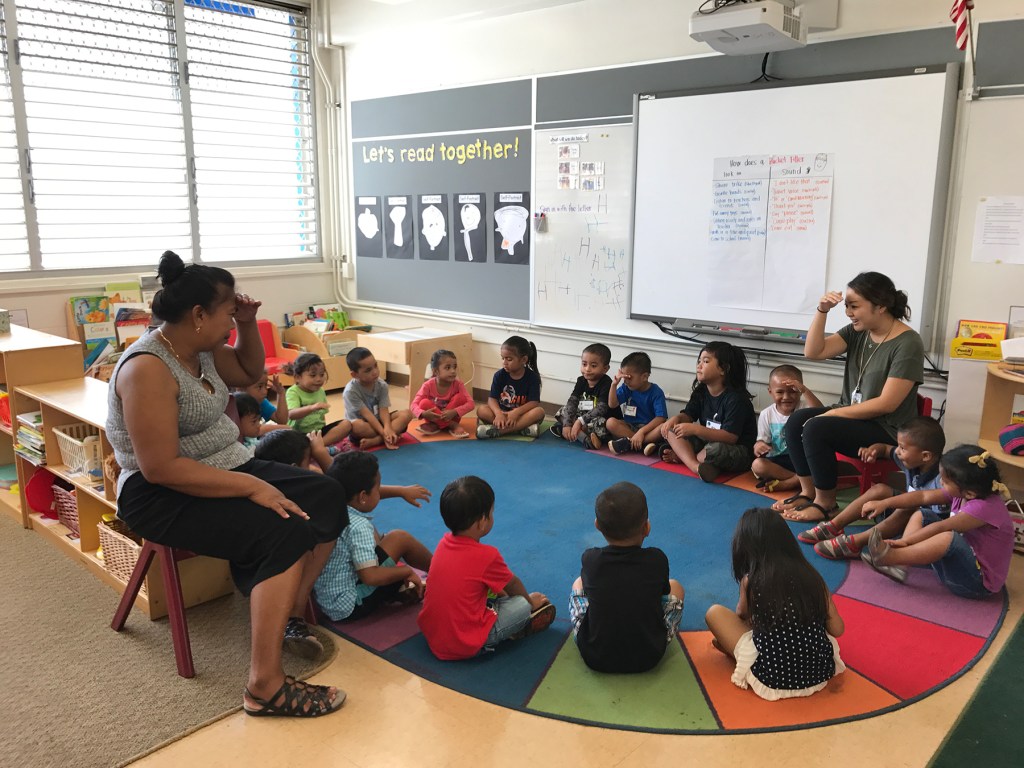
In 2014, Nānākuli Elementary School became the first school on O‘ahu’s Westside to pilot the Executive Office on Early Learning public pre-K program. Principal Lisa Ann Higa saw an urgent need to address the reality that many incoming kindergarteners were already behind — sometimes by two years or more.
The data spoke volumes. Among the school’s first cohort of pre-K students, 75% outperformed their peers in early math benchmarks compared to those who did not attend pre-K and the data has remained consistent with each new class. But the true impact wasn’t measured by numbers alone.
As a steadfast advocate for early learning, Principal Higa has witnessed firsthand how pre-K nurtures social-emotional growth, builds health and safety awareness, and teaches essential self-care skills. For her, the success of early learning is reflected in the confidence and resilience of every child who walks through the doors of Nānākuli Elementary School.
Now operating a second pre-K classroom, Principal Higa’s long-term vision is to create a comprehensive early learning hub that integrates multiple public and private early learning programs.
Researchers don’t debate the benefits of preschool for kindergarten readiness. Kindergarten readiness assessments have consistently demonstrated the benefits in states throughout the nation.
Some researchers have highlighted studies in select communities where kids who had access to preschool, “faded out” by third grade, meaning, they were more on par with their classmates.
This “fade-out” can be due to a variety of variables, including inconsistent and inadequately differentiated first through third grade instruction, loss of supports during early elementary school, attendance challenges and ongoing stressors in a child’s community and/or home.
In reality, the so-called “fade-out” effect underscores the need for strong, well-supported elementary education to build on the foundation that early learning provides. It is a reminder that investing in our keiki must be a continuous, comprehensive effort — one that starts with access to pre-K for all children and carries through every stage of their education.
Quality preschool has an invaluable impact on school readiness and a family’s income.
In a state like Hawai‘i, where the high cost of living makes it essential for many parents to work, access to quality preschool isn’t just a learning issue — it’s an economic one. When parents know their keiki are in safe, enriching environments, they can remain in the workforce, boosting household incomes and strengthening our economy.
Hawai‘i has made commendable strides in expanding early learning, recently meeting all 10 quality benchmarks set by the National Institute for Early Education Research for the state’s growing public prekindergarten program.
It has also significantly expanded access to preschool subsidies through the Preschool Open Doors program. With the recent passage of House Bill 692, the program will now serve keiki in the three years before kindergarten.
As a result, more families with 2-, 3-, and 4-year-old children will benefit from continuous enrollment during the most critical developmental years.
But there’s more work to do. The question isn’t whether pre-K is valuable — it is. The focus should be on how we ensure that all children have access to the best possible early learning experiences, followed by well-resourced elementary education.
Investing in early learning isn’t just about kindergarten readiness — it’s about building healthier families, stronger communities, and a thriving economy. The impact of these programs should be judged by the advances in early childhood development and the lifelong benefits they provide to our keiki, families and our communities.
 Sign up for our FREE morning newsletter and face each day more informed.
Community Voices aims to encourage broad discussion on many topics of community interest. It’s kind of a cross between Letters to the Editor and op-eds. This is your space to talk about important issues or interesting people who are making a difference in our world. Column lengths should be no more than 800 words and we need a photo of the author and a bio. We welcome video commentary and other multimedia formats. Send to news@civilbeat.org. The opinions and information expressed in Community Voices are solely those of the authors and not Civil Beat.
Read this next:

Local reporting when you need it most
Support timely, accurate, independent journalism.
Honolulu Civil Beat is a nonprofit organization, and your donation helps us produce local reporting that serves all of Hawaii.
ContributeAbout the Authors