Beth Fukumoto: Hawaiʻi's Pride Month Events Were More Important Than Ever
Don’t let other news developments distract you from the fact that rights are under attack across the nation.
June 30, 2025 · 6 min read

About the Author

Hawaiʻi marked June’s internationally recognized Pride Month with rallies, festivals and historic firsts. Yet these hard-won celebrations were easily lost in a month that saw Marines deployed on the streets of Los Angeles, U.S. bombs falling on Iran, and a barrage of crises demanding our attention.

In a world that presents us with a new apocalyptic headline every day, it’s too easy to lose sight of long-standing inequities and the successes of people who have spent decades fighting them. Now more than ever, we have to keep lifting up these stories so we don’t lose sight of them because in a time when so many rights are under attack across the country, staying engaged is essential, even in a place that prides itself on inclusion.
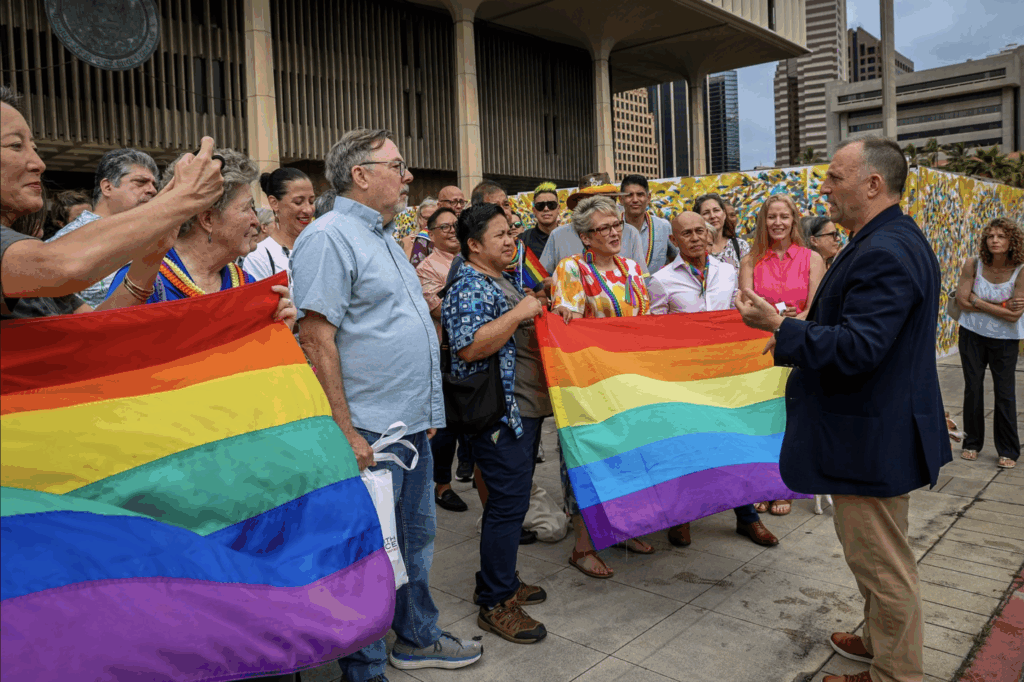
In Hawai‘i, Pride Month began with a rally at the State Capitol on June 1, where activists gathered under the banner “Act up! Speak out! Silence = Death!” honoring the legacy of queer and trans organizers while calling out the relentless wave of anti-LGBTQ+ action coming from the federal government. The urgency of that protest mirrored the stakes of Pride Month itself: a celebration born from resistance, now unfolding as old battles resurface.
That same weekend, Pride events stretched across the state, underscoring both the strength of Hawai‘i’s māhū, LGBTQ+ community and the challenge of keeping these moments in the spotlight. Aloha Maui Pride hosted events through June 14, the same day as the national No Kings protests — an overlap that showed how many urgent calls for justice are competing for our collective attention. Kaua‘i’s seventh annual Pride Parade and Festival was held June 7, while Hilo wrapped up the Pride festivities Saturday.
Amid these events, Hawai‘i achieved milestones that deserved far more attention than they received. On June 2, the Hawai‘i State Capitol raised eight Pride flags along South Beretania Street for the first time in state history, a powerful symbol of inclusion at a time when states like Utah, Idaho, and Montana have banned Pride flags from public buildings.
Two days later, a historic marker was unveiled at Queen’s Surf Beach in Waikīkī, honoring the site of Hawai‘i’s first organized LGBTQ+ māhū event, a parade held June 30, 1974, in tribute to the Stonewall riots.
On June 6, the Hawai‘i State LGBTQ+ Commission launched the nation’s first state-sponsored Inclusive LGBTQ+ Glossary. By highlighting Native Hawaiian and Pasifika identities alongside widely recognized queer terminology, the glossary offers a culturally grounded, affirming resource for anyone seeking to speak with respect and accuracy about Hawai‘i’s diverse communities.
‘Answering The Call Of The Times’
Even with these milestones, there was an undercurrent of unease.
Michael Golojuch Jr., president of Pride at Work Hawai‘i, described the month as “one of the busiest” he’d experienced, saying the community was “answering the call of the times.”
Reflecting on his experience at Kaua‘i Pride, he said, “Kaua‘i (Pride) is always going to have a soft spot in my heart because I’ve been going for decades, and so it was like going home. But you could tell that there was a different feeling in the air. There’s apprehension from people even participating because of the fears of what’s out there, what’s happening at the federal level, and the lack of demonstrated speaking out against the attacks on the trans community or gender non-binary from our elected leaders here in Hawai‘i.”
Symbolic gestures like raising Pride flags matter, but as Golojuch Jr. warned, they are not enough to protect rights.
“Everybody likes to party during Pride, but everybody needs to remember the first Pride was a riot because of the discrimination and bigotry that our community had faced for generations,” he said.
If you don’t have protections at the state level, you don’t have protections at all. People need to wake up to that reality.”
Michael Golojuch Jr.
Golojuch Jr. also pointed out that while Hawai‘i has a reputation for inclusion, it still lags behind on critical protections: “We didn’t even make the top 15 states of progressive states when it comes to queer issues,” he said. “Other states were behind us for decades, and now they’ve leapfrogged over us.”
“The Supreme Court has made it clear that if you don’t have protections at the state level, you don’t have protections at all. People need to wake up to that reality,” Golojuch Jr. said.
This reality underscores why Hawai‘i’s Pride Month events must be more than a celebration; they are reminders of the unfinished work ahead.
As Pride Month neared its end, the Honolulu Rainbow Film Festival offered a powerful coda. Centered on the theme of kīpuka, a native plant that is among the first signs of life to emerge after lava flow, the festival celebrated resilience in the face of ongoing struggles, bringing together diverse voices to remind us why these stories matter.
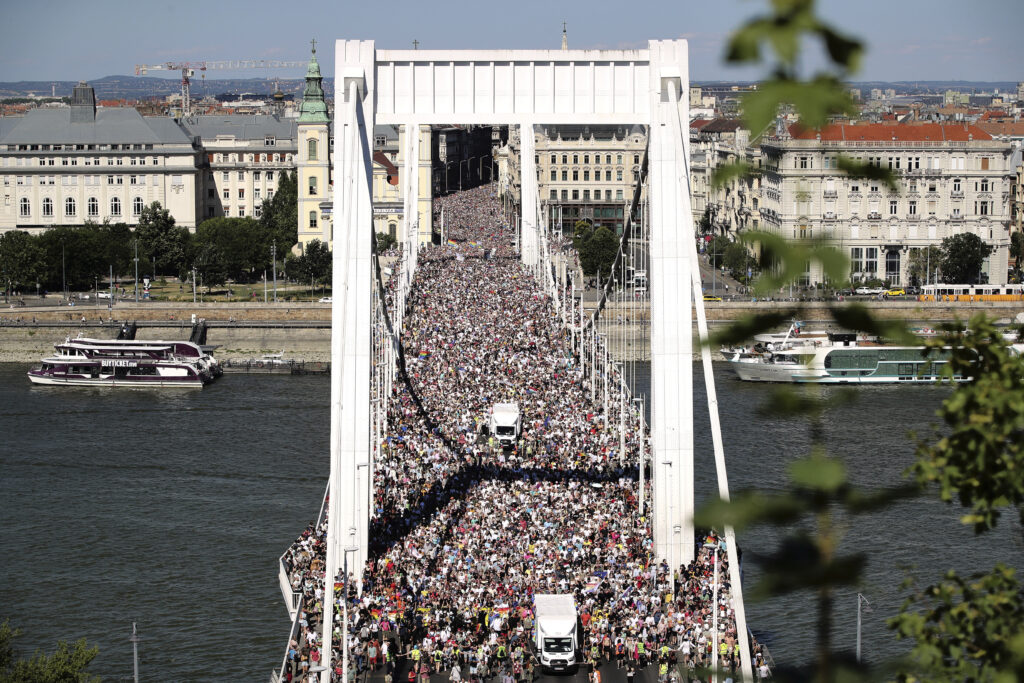
And beyond Hawai‘i, the world offered a stark reminder of what is at stake when we fail to stay engaged. On Saturday, tens of thousands of people in Budapest marched for Pride in defiance of a new government law banning LGBTQ+ events. It became the largest Pride gathering in Hungary’s history, not just because of LGBTQ+ participants, but because allies showed up to stand with them against a government determined to silence their existence. Their courageous stand underscored that Pride is never guaranteed and that rights can disappear quickly if we fail to protect them, even in places where they once seemed secure.
“Just because it doesn’t impact you shouldn’t be the reason you don’t stand up for people’s rights, because somebody stood up for your rights when it didn’t impact them,” said Golojuch Jr. “You’ve got to return the favor. You’ve got to pay it forward because somebody paid it forward for you.”
It’s a lesson I’ve sometimes lost sight of myself, and one I’m more determined than ever to keep front of mind.
 Sign up for our FREE morning newsletter and face each day more informed.
Local reporting when you need it most
Support timely, accurate, independent journalism.
Honolulu Civil Beat is a nonprofit organization, and your donation helps us produce local reporting that serves all of Hawaii.
ContributeAbout the Author