Hawaiʻi’s Model For Global Ocean Recovery Starts With Community
The ridge-to-reef model is grounded in Hawaiian cultural practice and ecological science.
June 27, 2025 · 5 min read

About the Author
As we mark World Oceans Month, we’re reminded that the fight to protect our planet’s most vital resource — our oceans — must begin not at the water’s edge, but at the top of the mountain.

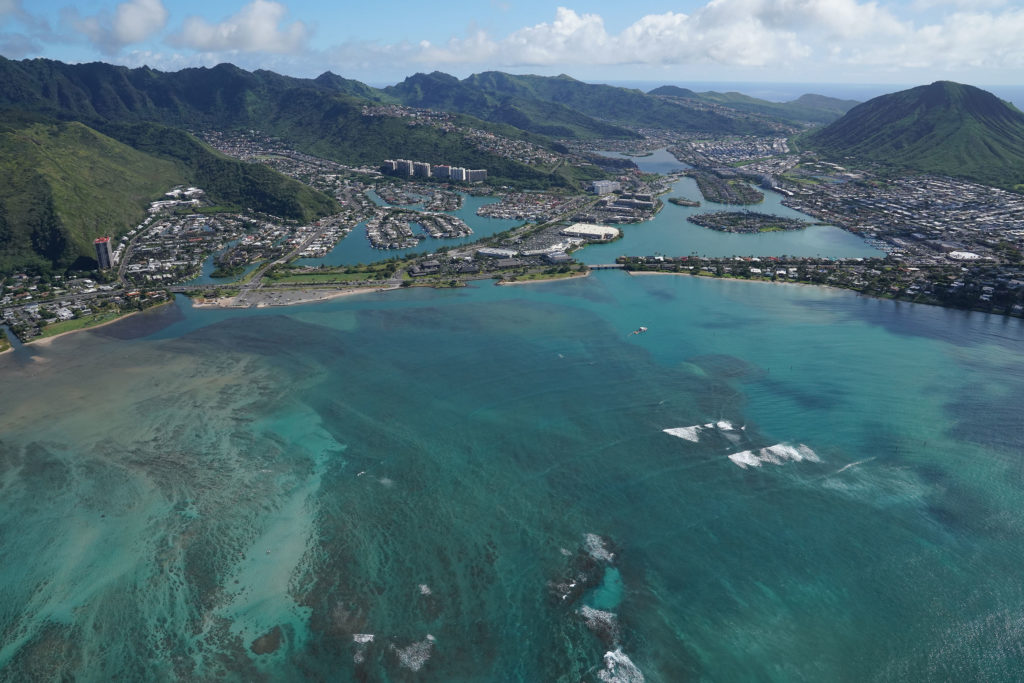
At Mālama Maunalua, our work over the past two decades has been rooted in a simple yet powerful idea: that what happens on land directly affects the health of our reefs and oceans. Through a community-driven, ridge-to-reef approach, we are restoring one of Oʻahu’s most iconic bays — Maunalua Bay — and, in the process, have built a model that is gaining recognition as a blueprint for coastal communities.
But here’s what we’ve learned along the way: none of this is possible without people. It is our community — our kūpuna, keiki, volunteers, educators, scientists, and neighbors — who make this work real, meaningful, and lasting.
Why Ridge To Reef Matters
The ridge-to-reef model is grounded in Hawaiian cultural practice and ecological science. In traditional times, land was managed in ahupuaʻa — vertical land divisions from the mountains to the sea — recognizing the deep interconnection between land and ocean. Today, that concept is more relevant than ever.
In East Honolulu, 10 watersheds drain into Maunalua Bay. These watersheds carry runoff, sediment, pollutants, and debris downstream, directly impacting coral reefs, marine life, and water quality. By addressing the sources of degradation upstream, we’re improving ocean health downstream.
This approach guides everything we do, from removing invasive algae in the bay to planting resilient coral, installing rain gardens in neighborhoods, and supporting residents in adopting green infrastructure on their own properties.
Measurable, Meaningful Progress
The results are compelling. Since 2005, we’ve removed over 4 million pounds of invasive alien algae, giving native marine life a chance to recover. We’ve restored over 20 acres of nearshore habitat, constructed rain gardens to absorb and filter runoff, and are planting 4,000 heat-resilient corals as part of a pioneering reef restoration effort.
Thanks to support from various financial supporters, we’re scaling this work across the entire Maunalua region. In 2025, we’ll support over 300 households across Oʻahu with sustainable landscaping, rain barrels, and native trees to mitigate rainwater runoff — and we’ll continue building local capacity to lead and sustain this work for generations to come.
And yet, these achievements only scratch the surface of what truly powers our success: the people behind it.
Community At The Core
Every pound of algae removed, every coral fragment planted, and every drop of stormwater filtered represents the hands, hearts, and hours of a vast network of community partners. Over 46,000 volunteers have joined us over the years from local students and kūpuna to businesses, educators, nonprofit collaborators, and policymakers.
We’ve worked side by side with more than 21,000 students in place-based education programs, and we’ve trained 124 environmental interns to be the next generation of stewards.
Our work thrives because so many people feel a connection to this place and want to be part of its healing. And that’s what makes our model so powerful. It’s not just a scientific method, it’s a community movement.
We’ve built a shared kuleana (responsibility) that crosses generational, cultural, and sector boundaries. Restoration, for us, is not something that’s done to a place, it’s something that’s done with the people who love it.
Model For The World
The threats facing Maunalua Bay — pollution, climate change, habitat loss — are not unique. Communities around the world are experiencing similar challenges. But what we’ve shown here in Hawaiʻi is that when solutions are rooted in culture, science, and community partnership, real change is possible.
This is the value of Mālama Maunalua’s ridge-to-reef work, and why it can serve as a global model. It proves that integrated, people-powered restoration can work.
And we’re just getting started.
Our Moment To Act
When we see the ocean, let’s remember that the health of it begins far from the shoreline. It starts in our neighborhoods, our watersheds, and the choices we make every day. Whether you’re a student planting your first native tree, a kūpuna sharing your knowledge, or a neighbor helping to care for a local stream, this work belongs to all of us.
The challenges we face are big. But if there’s one thing our journey in Maunalua Bay has shown, it’s that lasting change doesn’t come from any one person or project. It comes from people coming together with humility, purpose, and aloha to care for the places that care for us.
The ocean gives us life. It’s up to us to give back.
 Sign up for our FREE morning newsletter and face each day more informed.
Community Voices aims to encourage broad discussion on many topics of community interest. It’s kind of a cross between Letters to the Editor and op-eds. This is your space to talk about important issues or interesting people who are making a difference in our world. Column lengths should be no more than 800 words and we need a photo of the author and a bio. We welcome video commentary and other multimedia formats. Send to news@civilbeat.org. The opinions and information expressed in Community Voices are solely those of the authors and not Civil Beat.
Read this next:

Local reporting when you need it most
Support timely, accurate, independent journalism.
Honolulu Civil Beat is a nonprofit organization, and your donation helps us produce local reporting that serves all of Hawaii.
ContributeAbout the Author