Kirstin Downey: Sacred Burial Sites Are Being Destroyed In This Town
Local and state officials are joining forces to protect and preserve iwi kūpuna that are more frequently turning up in Kailua.
June 27, 2025 · 8 min read

About the Author

The Oʻahu Historic Preservation Commission has mobilized a coalition to address what many people consider a crisis of accidentally exhumed human remains in Kailua, where thousands of bodies are believed to have been buried.
Earlier this week, the commission laid out a plan to bring state and local agencies together to better map historic Native Hawaiian burial grounds and provide incentives to homeowners who often don’t know iwi kūpuna remains are on their property until they do some sort of construction project.
For the past two years, ever since the commission began meeting, the group has taken testimony and analyzed reports about the persistent problem of remains inadvertently dislodged in excavations — particularly swimming pools dug into the sands that make up Kailua, including in the Lanikai, Kalama and Coconut Grove neighborhoods.

“Through my long career I have seen way too many crushed babies, broken skulls and snapped femurs in backhoe buckets,” said commission member and veteran Hawaiʻi archaeologist Thomas Dye, who is leading the commission’s burial preservation efforts.
A recent flashpoint came in March when an apartment building at 330 Ku‘ulei Road began construction without archaeological monitoring or oversight even though the property is located near other known grave sites. The Office of Hawaiian Affairs, the Society for Hawaiian Archaeology and Native Hawaiian groups wrote letters of protest to the city. They were told that no remains had been discovered at the site.
At its meeting on Tuesday, the commission convened key stakeholders — the State Historic Preservation Division, the city’s Department of Planning and Permitting, the Honolulu City Council, the Society for Hawaiian Archaeology, the Kailua Hawaiian Civic Club and the Oʻahu Burial Council — and extracted a pledge from each of them to work together toward solving the problem. All promised to participate.
The commission proposed creating a memorandum of understanding between state and city officials to identify areas that likely contain burials to ensure they receive enhanced monitoring. The details of that remain unclear.
The commission also proposed a new system of tax credits or tax preferences for homeowners whose properties are affected and who take pains to protect and preserve human remains intact at their location — similar to tax advantages given to people who own historic properties and manage them sensitively.
“This is the culmination of a number of very important discussions we have been having since this commission began,” said commission chair and archaeologist Kēhaunani Abad, vice president of Kamehameha Schools and previously director of community affairs at the Office of Hawaiian Affairs. “Everyone here is very eager to take action.”
The topic of burials in Kailua Beach was brought to the commission soon after it was established in 2023. That October, the Association of Hawaiian Civic Clubs formally asked the commission to identify the Kailua sand berm as a “highly sensitive area of significant adverse impact to iwi kūpuna,” noting that some 338 sets of human remains had been encountered there since 1930, including at least 157 since the passage of Hawaiʻi state burial laws in 1990.
Public concern was galvanized that year when a pool construction company operating in Kailua on an unmonitored site scraped up and then callously dumped a pile of excavated sand containing human bones in a horse paddock in Waimānalo.
Kihei de Silva, representing the Kailua Hawaiian Civic Club, told the commission this kind of thing has happened repeatedly in Kailua. He has appeared regularly at commission meetings over the past two years, repeating the group’s concerns.
Kailua’s Geology Made For Ideal Burial Grounds
At issue are areas characterized by the presence of Jaucas sands, the quick-draining, rapidly permeable soils common to vegetated beach areas, according to a map prepared last year by the city’s Department of Planning and Permitting.
Areas with Jaucas sands were particularly favored by Hawaiians as graveyards. Archaeological studies and analysis by Native Hawaiian groups has caused experts to estimate that some 3,000 to 5,000 people were buried in the Kailua sands.
“We know this is a sacred burial site,” said archaeologist Nick Belluzo, president of the Society for Hawaiian Archaeology.
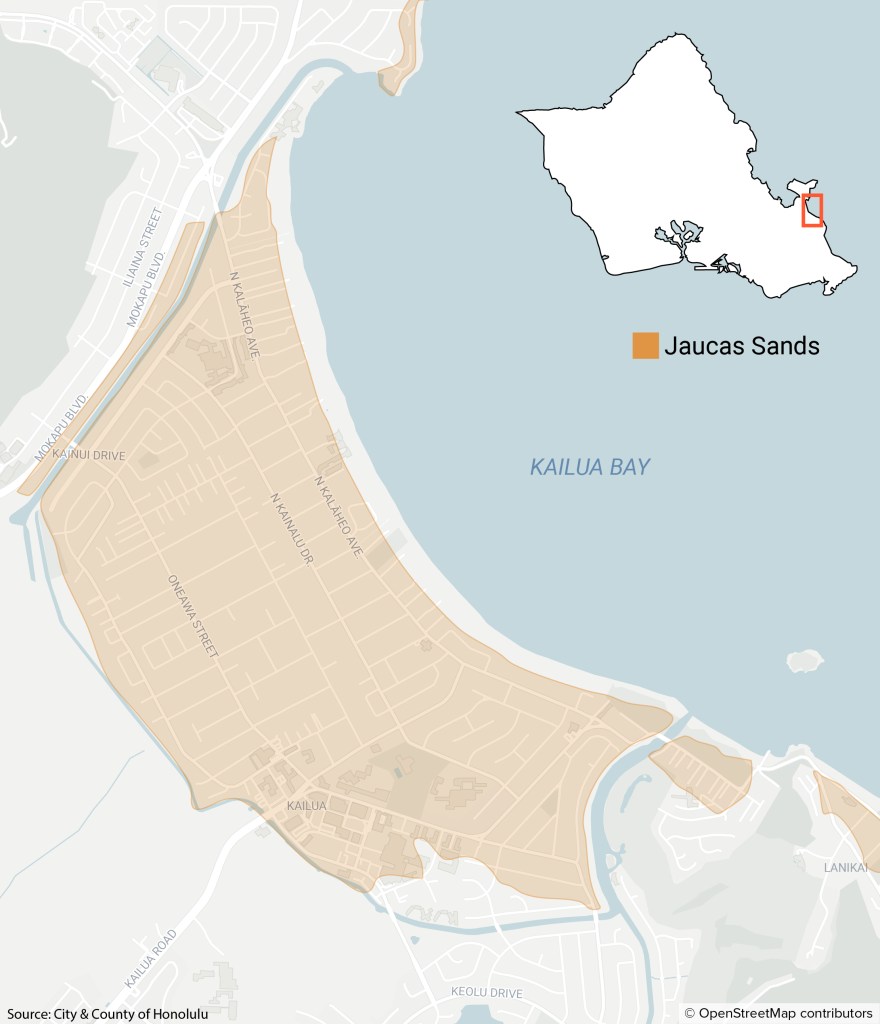
These soils stretch from Marine Corps Base Kāneʻohe on Mōkapu Peninsula to Waimānalo. In Kailua, the area is roughly defined, starting from the water, by South Kalāheo Avenue on the makai side to Kīhāpai Street on the mauka side, on the north by Mōkapu Boulevard and to Lanikai on the south.
No one is asking for construction to be stopped. At meetings, commission members acknowledge they are acutely aware that there is an important balancing act between private property rights and historic preservation goals. They say they just want projects to be handled much more carefully, with more Windward side residents made aware that underground construction projects in certain areas are likely to contain burial locations.
Ideally, however, they would prefer human remains stay onsite where they were originally laid to rest, with minimal disturbance.
Under current law, the State Historic Preservation Division is precluded from reviewing permit applications for single family residences unless they are on the Hawaiʻi or National Register of Historic Places, so excavations for residential pools and other home construction are not monitored. Even when the historic preservation division is called into action, its overburdened staff is unable to act quickly.
Commission members were told on Tuesday that the preservation division now has only one archaeologist to handle the entire island of Oʻahu, with five other slots vacant.
The problem of inadvertent exposures of human remains has grown more acute. The small plantation houses of Kailua’s past, with their wide green lawns, where graves lay undisturbed below the ground, have been replaced by much larger homes built up to the lot lines of the properties, often with in-ground swimming pools within their walled confines.
Homeowners today are also boring into the ground to install deep footers to protect their properties against sea level rise, abandoning traditional slab-style construction built on-grade, which in the past helped minimize underground soil disturbance.
State burial laws, passed in 1990, prohibit removing, destroying or altering any burial sites except as permitted by local burial councils. But the councils have their own problems. Staffed by volunteers, they too are plagued with vacancies, which often means they lack the quorum needed to gather for official action. A bill to address the problem by shrinking the size of the island burial councils died in the Legislature this year.
Residents Want Action
Some Kailua residents, meanwhile, are taking up the commission’s cause as well. The Kailua Neighborhood Board passed a resolution highlighting the problem last year.
Last month the group wrote a letter to the commission reiterating its support for taking stronger measures to protect iwi kūpuna. In their resolution, they asked city and state officials to develop a monitoring plan for all ground-disturbing work on Jaucas sands in Kailua and asked that the plans be mandatory and attached to every construction permit in the area.
“We trust the Commission’s action will help to address these concerns,” wrote William Hicks, the board’s chairman.
Some participants at recent commission meetings have pointed to recent situations, including the Ku‘ulei Road construction, as proof that government officials are not really committed to taking the time to monitor for human remains. That’s why the commission went to such lengths to get officials to show up at this week’s meeting and publicly commit to trying to reduce the number of occasions when human remains are dislodged and must be relocated.
“If we fail at this, and we can’t find a way to work together on the sands of Kailua, then we should have a really good public record of that because the city does a bang-up job of recording these things and posting them online and having them available for the public,” Dye said. “They will have a record of our failure that they can learn from and move forward, so that next time this kind of thing comes forward, it will have a better chance of being successful.”
 Sign up for our FREE morning newsletter and face each day more informed.

Local reporting when you need it most
Support timely, accurate, independent journalism.
Honolulu Civil Beat is a nonprofit organization, and your donation helps us produce local reporting that serves all of Hawaii.
ContributeAbout the Author