Kirstin Downey: Streetfront Exhibit Brings Internment Camp History Downtown
About 400 local residents were among the people confined at the camp during World War II.
June 20, 2025 · 8 min read


About the Author

A prime piece of Honolulu real estate has been turned into a pop-up museum exhibit this month to commemorate a dark chapter in Hawaiian history.

The front-facing windows of the headquarters of the American Institute of Architects at Fort Street Mall are being used as a traveling display to highlight a national monument in Hawaiʻi that has never actually come into existence.
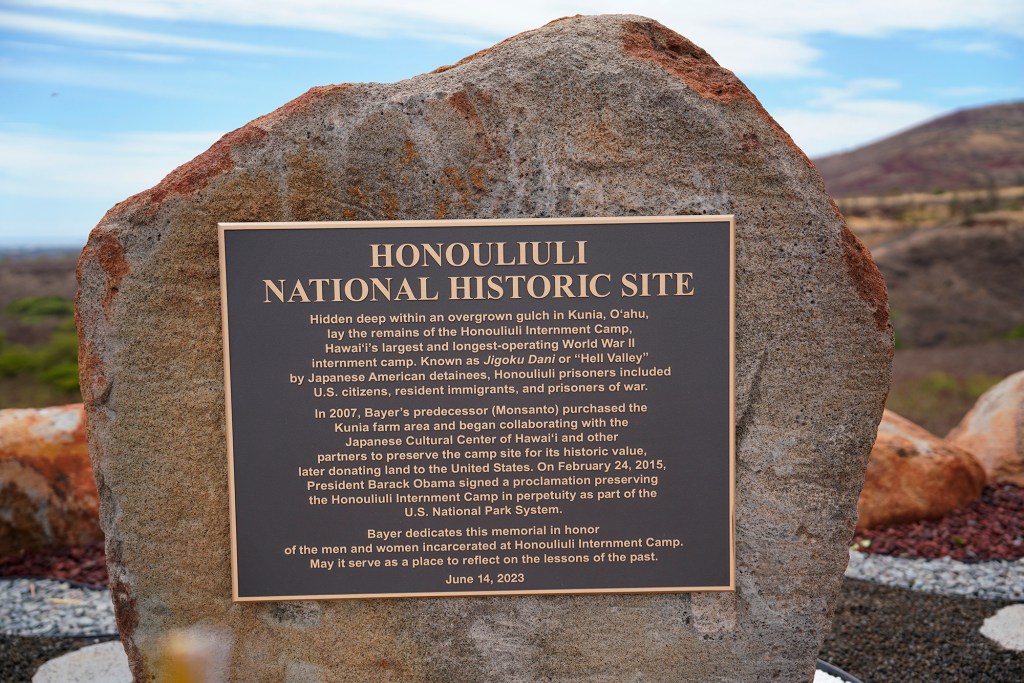
It’s been 10 years since President Barack Obama proclaimed the Honouliuli Internment Camp in Kunia a national monument, later known as the National Park Service’s Honouliuli National Historic Site. Following the successful attack on Pearl Harbor, some 400 people in Hawaiʻi, many of them of Japanese descent, were rounded up and incarcerated there, along with about 4,000 prisoners of war.
Despite being held on allegations of disloyalty, none of the Japanese-American civilians imprisoned there were ever found guilty of sabotage or espionage against the United States, Obama said.
“Honouliuli serves to remind every American about the critical importance of safeguarding civil liberties and maintaining our values during times of crisis,” Obama said in the proclamation.
In 2015, it seemed the monument’s creation, backed by the president himself, would move forward promptly, with an interpretive center and informational displays explaining the complex story the site represents.
But somehow it hasn’t been able to get off the ground. A notation on the NPS website, under the Plan Your Visit tab, warns that there is no public access to the park and that it does not have any “trifolds, brochures or pamphlets available for distribution.”
And now new perils are looming. Cost-cutting measures by the Trump administration are threatening even well-established national parks, and the recent presidential order he calls Restoring Truth and Sanity to American History is a thinly veiled attempt at whitewashing history, according to parks and civil rights advocates.
Raising Awareness
The Honouliuli project has long had a raft of problems.
The federal government owns the roughly 123 acres of land that were the subject of the original national historic register listing in 2009 but the site, located in a narrow valley north of H-1 and west of Kunia Road, is difficult to access. The area is not connected to a public roadway, so visitors are dependent on neighbors permitting access, which can be complicated to arrange. The site is also densely overgrown, making it difficult to distinguish what was there during World War II.
There have been bureaucratic delays as well. The first permanent site superintendent, Hanako Wakatsuki, wasn’t appointed until March 2021. About 18 months later, in October 2023, Sally Martinez replaced her. Less than a year later, Christine Ogura, raised on Oʻahu and formerly employed in the U.S Fish and Wildlife Service, moved into the job, in June 2024. Ogura is moving to turn things around.

Now a major planning process is underway.
The AIA exhibit is part of an initiative Ogura is spearheading to raise awareness of the national site by building ties in the community. In July, the pop-up will be moved to reach a new audience at Kapolei Public Library. In September, it will appear at the Salt Lake-Moanalua Public Library and in October it goes to Kahuku Public and School Library.
This is all part of a one-year celebration of the park’s 10th anniversary, also launched by Ogura, which started with a kick-off event at the Japanese Cultural Center in March. On Sunday, the movie “Untold Story,” about the internment and incarceration, will be aired at the Doris Duke Theater at Honolulu Museum of Art.
Each month of the year ahead has a particular focus, including sessions on prisoners of war from Okinawa and Korea, on daily life in the camp and how martial law was administered. There’s a steady upcoming roster of speeches, poetry sessions and book talks listed on the NPS website.
In a recent video discussion about the park, Ogura sounded sanguine about the long delay in opening the park to the public. She said that previous years had been spent in planning and conducting inventories in preparation for eventual construction.
“On average it takes 20 years for a park to be fully established,” she said. She hopes to begin offering limited tours soon.

Ogura’s job requires a delicate balance in telling a nuanced story that had immense and painful impacts for the affected families.
Hawaiʻi shifted overnight to a war footing on Dec. 7, 1941. Residents were terrified that the Japanese would return and invade the islands in the same way they had advanced on and conquered other nations in the Pacific Rim.
The federal government declared martial law in Hawaiʻi, granting U.S military authorities almost absolute control over civilian life, establishing curfews, blackouts, censorship, wage freezes, travel limitations and oversight of judicial procedures. Military investigators were given the power to interrogate and detain anyone suspected of disloyalty. Hawaiʻi’s 159,000 residents of Japanese descent, about one-third of the population, came under suspicion, as well as civilians of German, Italian or other European ancestry.
Military officials singled out business, civic, labor and religious leaders, particularly those educated in Japan, for prosecution and detention. These civilians were moved from place to place, and ultimately were incarcerated at the Honouliuli camp, which was constructed specifically for this purpose. Families were dislocated or torn apart; many experienced financial ruin.
Searching For The Site
The camp was closed in 1946, after the war had ended.
Those events became disturbing and embarrassing memories for people who had been incarcerated. They suffered social and psychological stigma because they were believed to have been disloyal. Many declined to talk about their experiences afterward. The flimsy, temporary structures built at the site were demolished or deteriorated and the area became overgrown with foliage. In time, the camp’s existence and its whereabouts came to be almost forgotten.
For decades, some people in Hawaiʻi believed that the islands had been somehow immune from the draconian round-ups that occurred on the West Coast and devastated Japanese-American families there. Indeed, the scale of incarceration here was less than on the continent because many local people defended and supported the Japanese-American population as their friends and neighbors and vouched for them.
In 1998, after the World War II movie “Schindler’s List” was released, a news reporter called the Japanese Cultural Center asking where the large internment camp on Oʻahu had been. Researcher Jane Kurahara answered the phone but didn’t know the answer. This set in motion an investigation that lasted for years. Ultimately the former camp was located with the help of farmers in the Waipahu area who recognized it from old pictures, drawings and descriptions.
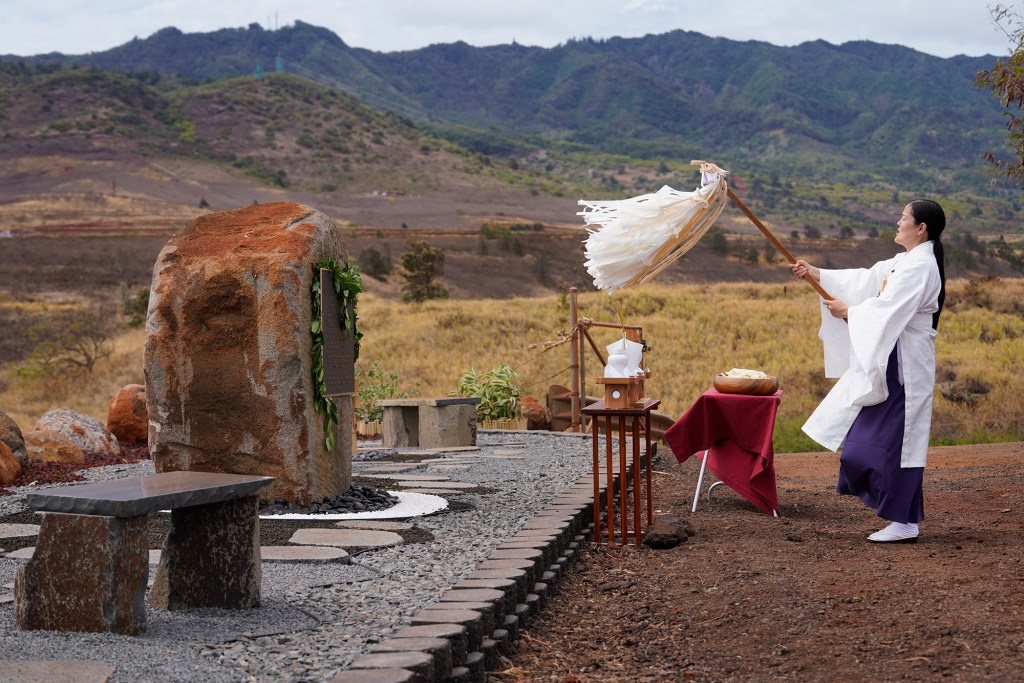
Volunteers at the center partnered with archaeologists to study the site. They began advocating for its historic preservation and public recognition of its importance. In 2009, the site was named to the historic register. Then, in 2015, came the national monument designation.
The group remains active in the effort. The Japanese Cultural Center hosts a historic exhibit that is open to the public and maintains an oral history project for reminiscences of the era.
But the AIA’s exhibit, which will run until the end of June, literally takes the cause to the street, and is allowing a wider audience to hear the story and be reminded of its significance. Early this year Ogura approached the AIA’s leaders and asked them to place the banners in their windows.
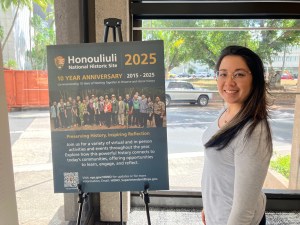
Jacie Katsuda Roughton, the AIA’s events manager, didn’t know much about the internment camp until she began planning for the installation of the banners, which explain the monument’s history and future. A fourth-generation Japanese-American, she knew more about her grandfather, who had served in the celebrated 442nd Regimental Combat Team, than she knew about Honouliuli.
Now Roughton is intrigued and wants to know the rest of the story. She plans to attend the screening of the movie at the Doris Duke Theatre.
“I definitely am going to go and learn more,” she said.
 Sign up for our FREE morning newsletter and face each day more informed.
Local reporting when you need it most
Support timely, accurate, independent journalism.
Honolulu Civil Beat is a nonprofit organization, and your donation helps us produce local reporting that serves all of Hawaii.
ContributeAbout the Author