Paying Tribute To Guam’s World War II Survivors And Liberators
A new book, co-authored by a Honolulu journalist, and museum exhibit will be unveiled July 12.
June 30, 2025 · 6 min read

About the Author
Army photographer Frank Buchman was sent to Guam in 1944 to document military activities just after the United States defeated Japan’s occupying troops near the end of World War II.

The federal government had begun a massive buildup on the war-torn Pacific island, and at one point the military population swelled to more than six times the local one.
Changes swept the civilian world as well. The indigenous people of Guam, Chamorros, had just survived nearly three years of brutal conditions under Japan’s rule.
While dealing with the trauma of war, they faced the monumental task of rebuilding their lives as their traditional agrarian system gave way to a cash-based, consumer-driven one.
With his free time, Buchman, then in his early 20s, could’ve spent most of it unwinding with his Army buddies. But he chose a different path. With his camera in tow, the Austrian immigrant spent hours in the villages mingling with and photographing locals.

Some 80 years later, it is those images of everyday life that stand out. Buchman’s work depicts an unusually rich visual record of Chamorros just after the war, surpassing in breadth and quality other collections from that period. At the time, few Chamorros had cameras of their own. Japanese soldiers had confiscated such equipment during the occupation, and any resident caught with a camera faced torture or even execution.
Pulitzer Prize-winning photographer Manny Crisostomo, Johnny Cepeda Gogo and I, all Chamorros (or CHamorus, as we use in our book) whose parents survived the occupation, recognized the value of Buchman’s collection as soon as we saw it. We were given access to his 500-plus images in November when we visited Buchman, then 102, at his Pittsburgh care home.
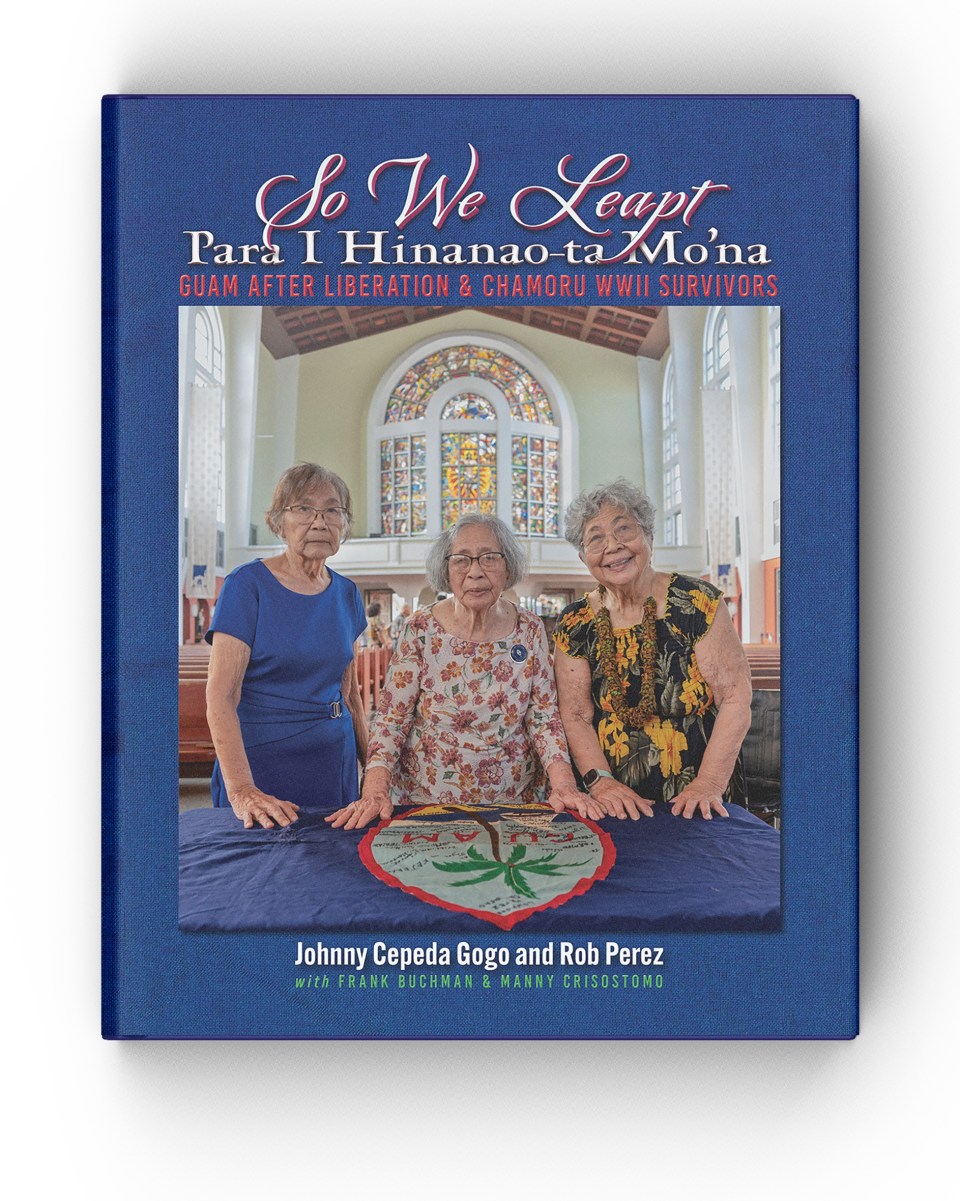
Eight months later, we’re highlighting Buchman’s work as part of a two-pronged effort to pay tribute to Guam’s World War II survivors and the U.S. military personnel who helped liberate the island. His photos are at the core of our new book, “So We Leapt, Para I Hananao-ta Mo’na” (“For Our Journey Forward” in Chamorro) and a new exhibit at the Guam Museum. Both will be unveiled July 12 on Guam.
The book and exhibit also will include photos from a flag-signing project that Gogo, a California judge, started five years ago, also to honor Guam’s war survivors and liberators. In his free time, Gogo has been traveling around the country to thank them, listen to their stories and ask them to sign Guam flags.
“Appreciative Spirit”
So far over 200, including Buchman, have done so. Their portraits and the two flags with their signatures will be featured in the book and exhibit. Sadly, Buchman died on Memorial Day, about six months after signing the flag. He was 103.
Buchman and his two children told us that his time on Guam changed his life. He was deeply moved by the Chamorro’s appreciative spirit, an attitude they maintained despite losing so much in the war. He spoke generally of his photography but couldn’t recall details of many of the photos.

Most lacked caption information. We had no names, no descriptions, nothing to help piece together what was portrayed. Our own research, however, revealed some fascinating back stories.
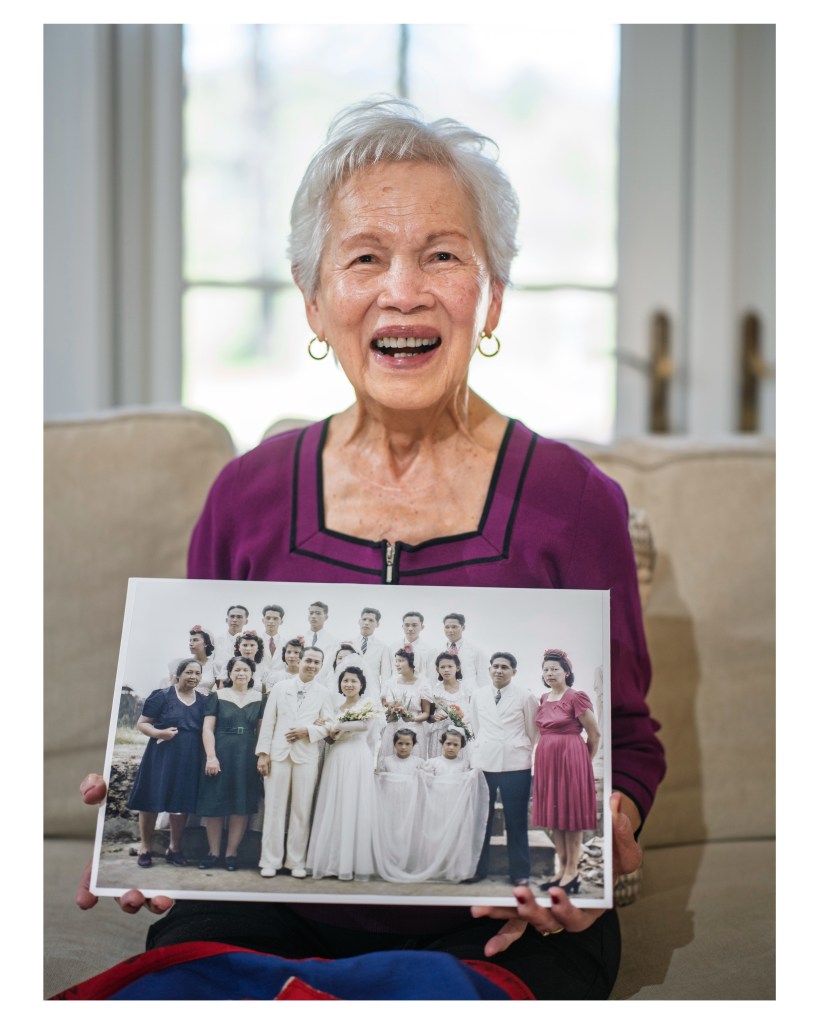
Take a stunning color portrait of a wedding entourage. We learned that the marriage of Francisco Perez and Rosita Suzuki took place on Oct. 7, 1945, just over a year after the Japanese surrendered the island.
Damaged and destroyed buildings still dotted the landscape. But that didn’t put a damper on the party, attended by a large crowd of civilians and military. Four Navy bands performed, and Buchman was one of several military photographers there to document the event.
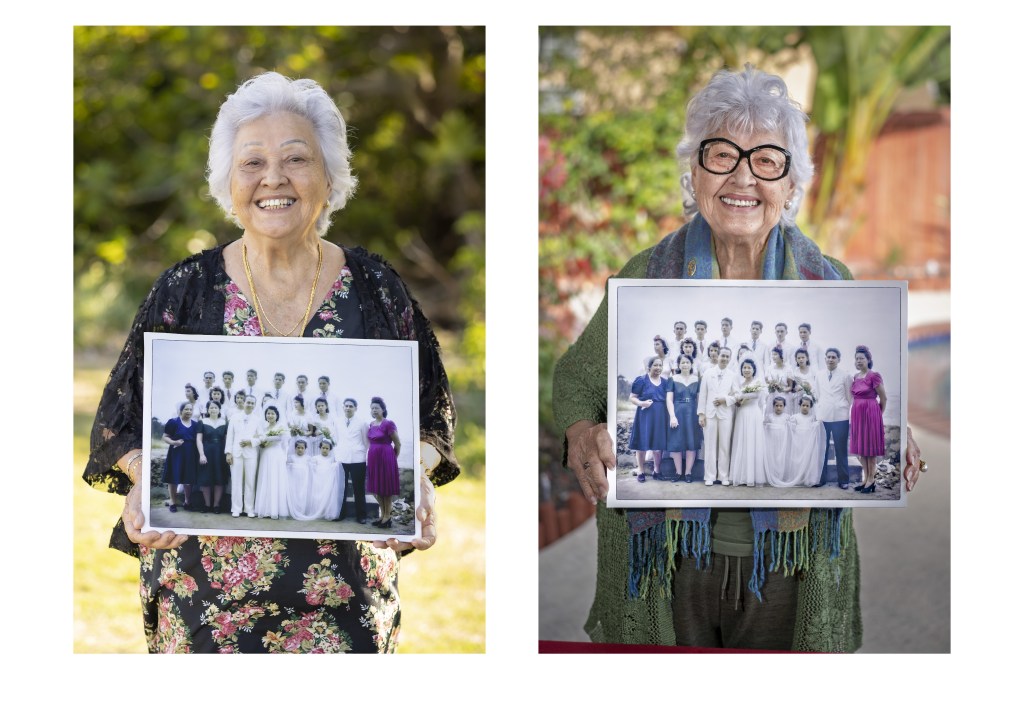
During that shoot, he experimented with color photography — a rarity in those days on Guam. The color portrait of the wedding party included a teenage groomsman Ricardo “Ricky” Bordallo, who three decades later would become Guam’s governor, and Cristobal Duenas, who more than 20 years later would become the island’s chief federal judge. Both were friends of the bride and groom.
We also discovered that the twin flower girls, then 6, and one of the bridesmaids, then 13, were still alive. One of the flower girls, Sylvia Perez Artero DeLong, now 85, recalled going to the home of the Perez couple when she was a teenager to attend an annual novena.
A statue of St. Joseph, a key figure in the Catholic Church, was always present. During the occupation, DeLong said her grandparents buried the statue in the jungle, fearful it might be confiscated or destroyed by enemy soldiers. Once the occupation ended, the family unearthed the heirloom, and it once again became part of the family novena.
We learned about this collection thanks to a young Chamorro woman from Las Vegas who happened to be dating Buchman’s great nephew. When they visited the elder man last year, they went through dozens of his black-and-white prints, which he mostly kept in a cardboard box for the past 80 years.
They were amazed when she found several portraits of her relatives Buchman had photographed right after the war. Once we learned of her discovery, we contacted Buchman’s family, received access to the photos and soon started uncovering more stories.
The vast majority of the Buchman photos, however, still remain a mystery, lacking identifying information. Through the book and exhibit projects, we hope to obtain more clues, helping us unlock additional stories behind the images from that cardboard box.
 Sign up for our FREE morning newsletter and face each day more informed.
Community Voices aims to encourage broad discussion on many topics of community interest. It’s kind of a cross between Letters to the Editor and op-eds. This is your space to talk about important issues or interesting people who are making a difference in our world. Column lengths should be no more than 800 words and we need a photo of the author and a bio. We welcome video commentary and other multimedia formats. Send to news@civilbeat.org. The opinions and information expressed in Community Voices are solely those of the authors and not Civil Beat.
Read this next:
Local reporting when you need it most
Support timely, accurate, independent journalism.
Honolulu Civil Beat is a nonprofit organization, and your donation helps us produce local reporting that serves all of Hawaii.
ContributeAbout the Author