UH Study Points The Way To A Better Oʻahu Jail And Justice System
It should be read and studied by everyone who cares about public safety and how tax dollars are spent.
July 11, 2025 · 6 min read


About the Author

Five months ago, the University of Hawaiʻi Community Design Center, which includes faculty, staff, students, and allied professionals at the University of Hawaiʻi Mānoa, published a groundbreaking study that shows how the new jail to replace the Oahu Community Correctional Center could improve both public safety and public health if developed in conjunction with a health, housing and justice continuum of care.

The study, entitled “Breaking Cycles: Alternative Models for Rehabilitation and Restorative Justice on Oʻahu,” was commissioned by the Department of Public Safety in 2022. Itʻs a long document — 265 pages — and every page is packed with policy and design ideas for a jail which, if built, would be a model for the entire country. The study has not garnered much public attention, but it should be read and studied by everyone who cares about public safety, and everyone who cares about how their tax dollars are spent.
The first goal of the study was to find out what the community wants in a new jail. That was accomplished by conducting more than 120 “talk story” sessions with a broad range of community groups. University of Hawaiʻi Community Design Center staff also made 18 site visits, held eight design workshops, five community practice meetings to share ideas and obtain feedback, a two-day symposium (which attracted an overflow audience), and meetings with current and previously incarcerated men and women to learn first-hand the barriers they face and their unique perspective on programs and the jail environment.
The study reveals that first and foremost, the community wants system reform. They want diversion and reentry programs that will decrease incarceration and increase community-based care. They want a public health perspective for corrections.

They want bail and sentencing reform to facilitate more diversion, starting with low-risk individuals with non-violent offenses. They want temporary and permanent supportive housing options so that justice involved individuals do not perpetually cycle through our jails and hospitals.
And they want a crime prevention strategy in which intervention begins at an early age and includes support for adolescent mental health, and community cultural centers to assist vulnerable populations.
The community also wants a complete transformation of the correctional system, not just a name change. They want the state to re-think and re-define the function of correctional facilities, and develop a new identity, mission, vision, and value system for the entire correctional system.
They want a change in the culture of corrections, and training for correctional workers that aligns with the new identity, mission, vision, and values. They want the Department of Corrections and Rehabilitation to develop community partnerships, leverage federal funds, and design a jail that enhances the health and welfare of residents, staff, and community.
And importantly, the study found that the community wants to be continuously involved in reimagining and redefining the justice and correctional systems, and be full partners in planning and designing the jail going forward.
Design Principles
Based on the extensive and in-depth community engagement phase of the study, the University of Hawaiʻi Community Design Center developed an array of design principles for the new jail. Among the recommendations:
- adopt a holistic, health-centered, and trauma informed approach to corrections;
- provide spaces that interact with the ʻāina and honor diverse cultures and identities;
- demonstrate respect for the resident population by creating humane and dignified environments; and
- create opportunities for improvement and empowerment.
The study also sets out a series of design considerations that include a campus style facility rather than a high-rise, various ways to use the limited space at the proposed site for the new jail in Hālawa Valley, and designs that are program-centered and oriented toward open space, natural light, and access to nature, all of which are proven to promote healing and well-being.
The study does not just talk about change, it illustrates what change looks like through dozens of diagrams, renderings, and stunning illustrations that bring abstract concepts to life.
The study is also noteworthy for building past studies and reports ranging from the 2010 OHA report on the Disparate Treatment of Native Hawaiians in the Criminal Justice System, to the 2024 Sequential Mapping Project prepared by the Hawaiʻi Health and Harm Reduction Center.
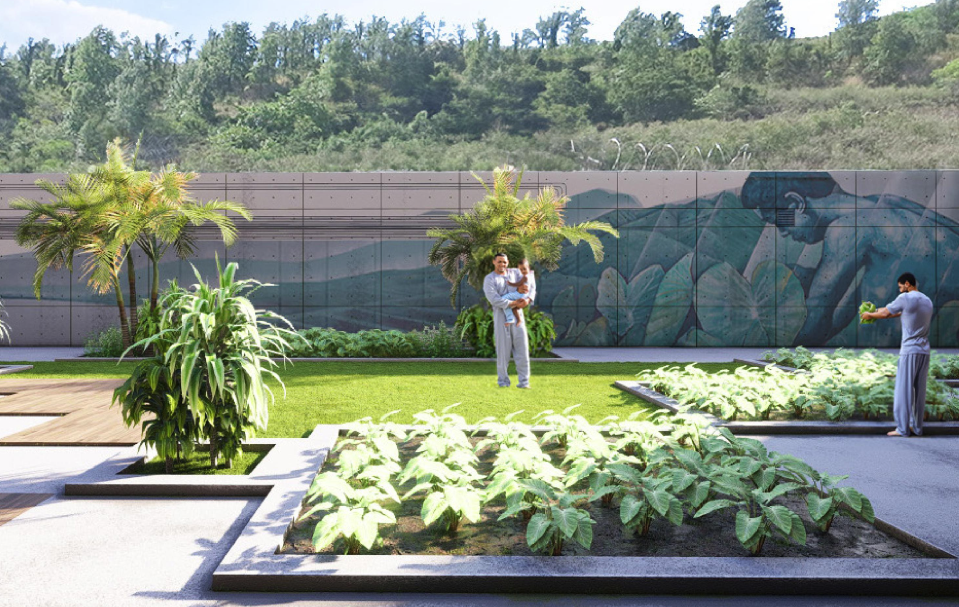
And finally, the study recognizes the prevalence of Native Hawaiians in the correctional system and incorporates Native Hawaiian concepts, values, and practices into facility design, programs, and operation.
“Breaking Cycles” is not a blueprint for the new jail, it is a proof of concept study that reports on what the community wants, and shows how their ideas and priorities can be realized in practice. It is the type of study that should have been done in 2015 when the state started talking about replacing OCCC.
And from the beginning, the state, like the University of Hawaiʻi Community Design Center, should have reached out to community stakeholders for help and support instead of adopting a dismissive “we know best” attitude that has put it on a path to a billion-dollar jail that will be a monumental failure.
The state’s jail planning team and its public relations firm have become adept at using rehabilitative and restorative justice terminology in their newsletters and press releasees, but everything we have seen and heard tells us that the state is planning a conceptually obsolete, harmful, and trauma-inducing “custody and control” jail: It is not planning the type of jail the University of Hawaiʻi Community Design Center study envisions.
We cannot let the remarkable design center study be filed away or shelved like so many other correctional studies and reports, but that is what’s happening. DCR barely mentioned the study in its latest newsletter on the new jail, and when asked what the department planned to do with the study, one of the DCR planners said they would “winnow through it” and see what they could afford. That is unacceptable.
We call on Governor Green and the Legislature to stop planning a billion-dollar jail, and partner with community stakeholders like the Correctional Reform Working Group to use the $30 million the Legislature appropriated last session to make real and meaningful system change that will enable us to create a smaller, less expensive, and truly rehabilitative jail based on the “Breaking Cycles” study.
The “Breaking Cycles” study can be accessed here.
 Sign up for our FREE morning newsletter and face each day more informed.
Community Voices aims to encourage broad discussion on many topics of community interest. It’s kind of a cross between Letters to the Editor and op-eds. This is your space to talk about important issues or interesting people who are making a difference in our world. Column lengths should be no more than 800 words and we need a photo of the author and a bio. We welcome video commentary and other multimedia formats. Send to news@civilbeat.org. The opinions and information expressed in Community Voices are solely those of the authors and not Civil Beat.

Local reporting when you need it most
Support timely, accurate, independent journalism.
Honolulu Civil Beat is a nonprofit organization, and your donation helps us produce local reporting that serves all of Hawaii.
ContributeAbout the Author