Will Bailey: Collapse Of Banyan Drive Is A Sign Of Hilo's Selective Neglect
A Big Island shoreline meant to welcome the world is now a corridor of decay.
July 30, 2025 · 6 min read


About the Author

In Hilo, the banyans bow over broken concrete, still remembering.
They’ve stood through sugar ships and tour buses, county project delays and continental dreams. The banyans along Hilo’s once-grand shoreline, the historic heart of the Big Island’s east side, don’t just cast shade, they cast witness. To arrivals. To departures. To silence where there used to be sound.
The banyans didn’t grow here by chance. Planted in the 1930s to honor visiting dignitaries, each tree bears a plaque. Amelia Earhart planted one before her final flight. Another carries Franklin Roosevelt’s name, from when Hilo smoothed the road for his motorcade in 1934. These trees meant to greet the world — living monuments of welcome and ambition — are now wilting in neglect.
In high school, we all stayed at Uncle Billy’s hotel on prom nights and during sleepovers for school meets at Hilo High or Waiākea. It was a place locals could afford for a night or two, a reset for the week ahead.
My grandma lived next door at the Country Club Condos. Downstairs, a sometimes-rowdy local bar buzzed with regulars swapping stories, blowing off steam, slipping upstairs before Monday loomed. On quiet, happy weekends, we’d savor eggs benedict at Uncle Billy’s restaurant. Our tradition, a small ritual of connection by the bay.

Ideas showcases stories, opinion and analysis about Hawaiʻi, from the state’s sharpest thinkers, to stretch our collective thinking about a problem or an issue. Email news@civilbeat.org to submit an idea or an essay.
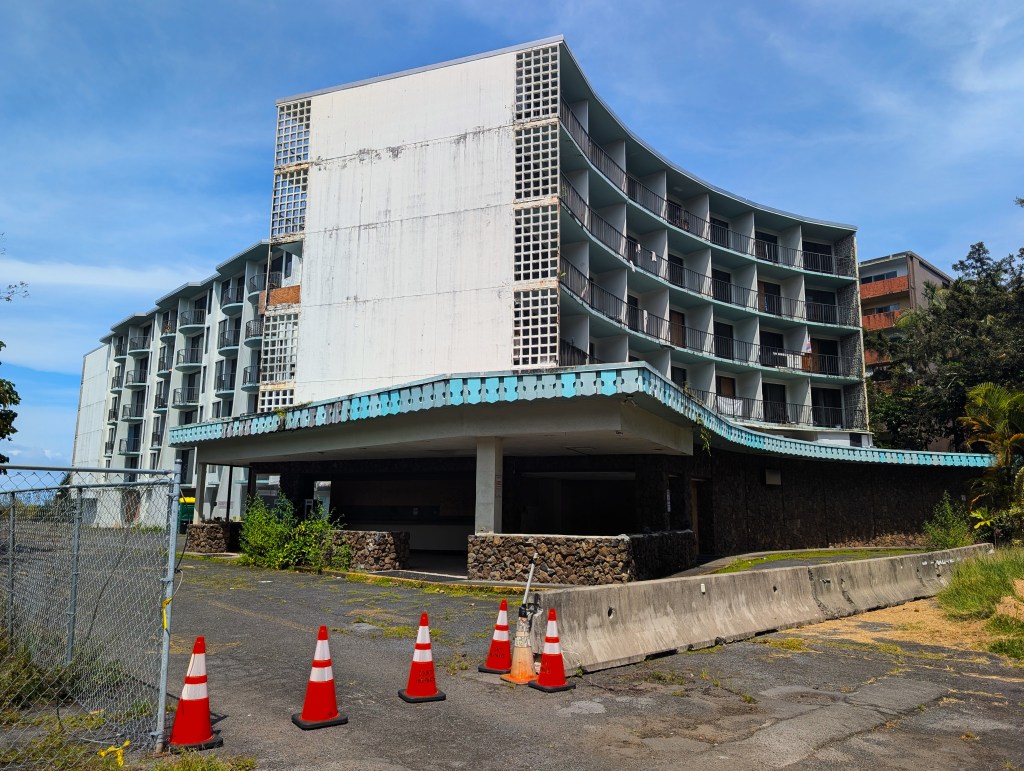
Back then, the Country Club Condos pulsed with life. My grandma’s third-floor apartment overlooked the bay. I remember her waving to fishermen, paddlers or the occasional tug, hanging towels to dry in the breeze. Now the balconies stare blankly out to sea. Much of the glass is gone. The spirit, too.
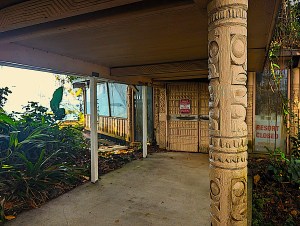
Uncle Billy’s? Fenced off. The tiki facade sags behind cones and caution tape. The county began demolition in 2025, eight years after its closure. Long enough for fires, break-ins, dawn raids. Long enough to rot.
And the Country Club? It followed the same path, just more quietly.
Same decay. Same silence.
A shoreline meant to welcome is now a corridor of collapse.
Nearly two years after the state approved a $20 million redevelopment deal in 2023, the Country Club Condos remain untouched. The first developer backed out when mainland funding dried up. The second wavered. The Department of Land and Natural Resources slashed the rent from $4,600 to $100 a month to keep the lease alive, claiming it was the only way to prevent another Uncle Billy’s.
But the building became that anyway.
Now it sits condemned. Windows gone. Squatters long since pushed out. No crew. No cleanup. Just a fence and another press release. Another promise with no footsteps behind it.
Oceanfront Wasteland
Meanwhile, Hilo’s shoreline remains blocked. From Coconut Island to Reed’s Bay, shuttered hotels and beachfront condos line the coast. There’s no path through, no public access, no park proposals. A few picnic tables at the edge don’t change the fact that this waterfront, the heart of Hilo’s memory, is functionally closed.
Despite years of discussion, no serious proposals have emerged to open this stretch to the public. No coastal trails. No small parks. No vision for a shoreline shared by all. What should be one of Hilo’s most walkable and scenic places, a vibrant link to the past, lies walled off by rust and neglect.
Even the banyans are struggling.
Invasive insects burrow into their bark. Cooking fires and midnight heat scar their roots. Some trees are dying, not from age, but from abandonment.
Just days ago, a banyan fell along Kīlauea Avenue, and the bodies of two women were found beneath the limbs. Authorities suspect they were struck by the limbs as the tree fell. DLNR described the tree as having received “regular maintenance,” though the last recorded service was in 2021.
It wasn’t Banyan Drive, but it was Hilo. And it was another reminder that what goes untended doesn’t just fade. Sometimes, it fails.
After dark, Banyan Drive isn’t just quiet. It’s uneasy. Families no longer walk here. Tourists don’t linger. The banyans still arch overhead, but the promise beneath them is gone.

Different Story On West Side
It wasn’t always this way.
Puna’s subdivisions were carved out to feed Hilo’s tax base, sending revenue upslope. But now even Hilo is bleeding. The buildings crumble. The shoreline closes. And the investment? It flows west.
Kona gleams while Hilo buckles.
Aliʻi Drive isn’t just prettier, it’s curated. Funded. Landscaped. Protected. A central artery of commerce and culture, where miles of oceanfront hum with surfers, shops, restaurants and heiau. The sidewalks are clean. The banyans are thriving.
Not because Kona is better, but because it was chosen.
That’s the truth that stings out here. It’s not just that Hilo is neglected. It’s that someone made it so.
They say banyans grow wide before they grow tall. That their roots reach down before the branches reach up, always searching for something to hold on to.
Maybe that’s what Hilo needs now. Not more waiting. Not more plans.
But roots. Memory. Weight.
Imagine a coastal trail lined with banyans, open to families and visitors, where Hilo’s shoreline is reclaimed as a shared space for stories and connection.
Because this isn’t just about old hotels or unclaimed leases. It’s about what kind of island we want to be.
One where the east side falls while the west side shines? One where the shoreline is sold off, section by section, behind locked lobbies and gated lots? Or one where the banyans mean something?
People still live here. Still walk this road. Still carry memories under these trees.
The ones who remember what it was. The ones who haven’t left.
The ones who know that neglect isn’t neutral.
It’s a choice.
 Sign up for our FREE morning newsletter and face each day more informed.
Read this next:

Local reporting when you need it most
Support timely, accurate, independent journalism.
Honolulu Civil Beat is a nonprofit organization, and your donation helps us produce local reporting that serves all of Hawaii.
ContributeAbout the Author