Campaign Reform Is Forcing Lawmakers To Raise More Cash In Non-Election Years
Joint fundraisers in odd-numbered years are more prevalent than they used to be.
August 24, 2025 · 7 min read


About the Author

Two new laws intended to slow the easy flow of money to lawmakers while they’re in session significantly crimped incumbents’ cash-raising abilities during the 2025 session.
But the new restrictions have not stopped special interest money from finding its way to state legislators at other times. Many legislators are simply holding more fundraisers during non-election years, a Civil Beat review of fundraising records shows.
The main idea of both laws was to help restore the public’s trust in their elected officials by preventing the flow of cash to legislators while they were making decisions about bills. The reform came after two lawmakers pleaded guilty in 2022 to taking bribes to steer legislation.
One new law stopped legislators from holding organized fundraisers during session while the other banned contributions by lobbyists right before, during and just after sessions. Incumbents can still take donations during session, just not from lobbyists or at organized fundraisers.

A Civil Beat review of fundraiser schedules filed with the state Campaign Spending Commission dating back to 2015 shows that it was far less common to organize an event to raise money in an odd-numbered year five or 10 years ago. Even during the Covid pandemic in 2020, more legislators raised money that summer — many of them over Zoom or Facebook Live — than in the summer of 2019.
But, with the new laws on the books, legislators held five times as many fundraisers in the summer of 2023 as compared to summer 2019. The trend continued with even more incumbent fundraisers held this summer — 39 by House incumbents and nine by Senate incumbents as of Aug. 1 (even though six of those senators are not on the ballot until 2028).
The fundraising fest started in May, barely three weeks after session concluded, when more than three dozen House members held fundraisers over three consecutive nights in Honolulu. The groups and people that contributed to the legislators reads like a who’s who of the major players in the lobbying business.
Five Hawaiʻi island reps including House Finance Committee Chair Chris Todd fundraised together July 17 at the Hilo Hawaiian hotel, while Speaker Nadine Nakamura helped five House freshmen navigate the fundraising ropes at the Pacific Club on July 29.
Details from those last two fundraisers won’t be released until January. But the combined take for the legislators who fundraised together at the May events totaled around $190,000. Several raked in more than $10,000 each.
Colin Moore, a political scientist with the University of Hawaiʻi Economic Research Organization, described the local trend as part of what is called the “hydraulics of campaign money,” meaning money will always find a way to flow to politicians just as water finds its way through any crack in a water system.

“It finds its way around,” said Moore. “You block it here and then it sneaks through somewhere else.”
“Candidates have to raise money,” he said. “The people who donate are well attuned to when the fundraisers are happening, and they want to continue to donate because it really buys them access. It doesn’t necessarily buy favors, but it means your calls will get returned and the issues you care about will at least get some consideration. And it’s a relatively small investment for what you get.”
Appearance Of Undue Influence
The fundraiser trend is described by several lawmakers as a new reality in the wake of the 2023 bills.
Both bills were praised and endorsed by government watchdogs as going a long ways to prevent or reduce appearances of corruption and undue influence and help restore public trust in government.
Not all legislators held fundraisers this summer, but a majority did. And most of the donors represented well-established bankers, developers, shippers, insurers, real estate agents, energy companies, medical organizations, agricultural groups, telecommunication giants, tourism interests, landowners, small businesses, government employees, public and private sector unions and more.

Rep. Andrew Garrett, who was part of the May 22 fundraiser at Murphy’s Bar & Grill, jointly fundraised with eight other incumbents who, like him, were first elected in 2023 — after the session donation restrictions became law. They are known as the Class of ’23, or the sophomores.
“Generally speaking, people are going to fundraise with their colleagues that they’re closest with,” he said. “It could be faction-based as well.”
Factions are the way the House has organized, with the speaker needing 26 of the 51 members to lead the chamber. But legislators say alliances have been upended in recent years.
One reason is because of the large number of new and younger House members, many of them elected in only the last three years and several others appointed by Gov. Josh Green to fill vacancies. The biggest change to traditional alliances came with Rep. Scott Saiki’s primary loss in 2024, which led to the elevation of Nakamura to take his place.

The fact that Nakamura fundraised with five freshmen reps at The Pacific Club suggests that she is trying to solidify her coalition. Nakamura did not return a call to talk about fundraising for this story.
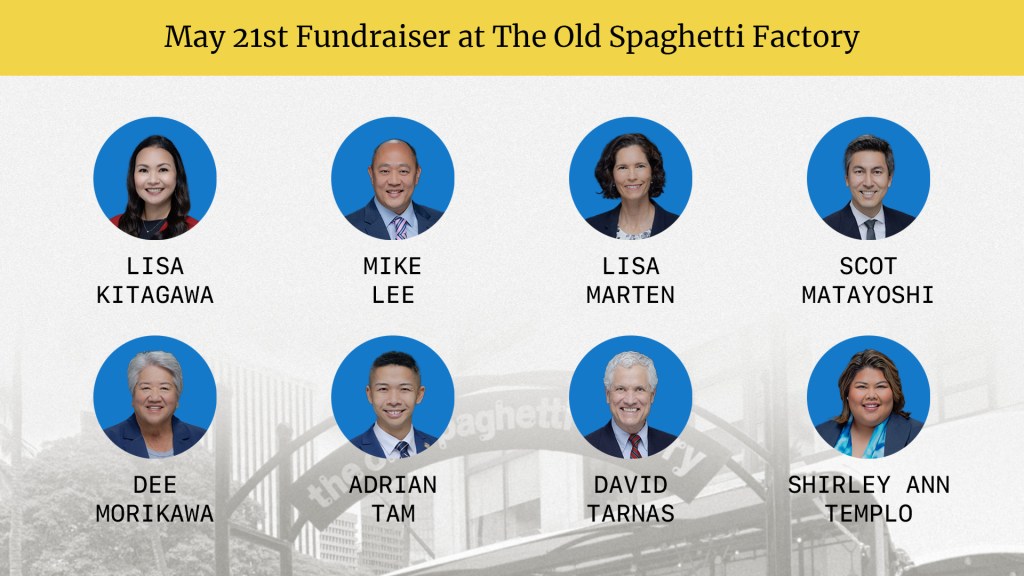
While some legislators may fundraise together as a way to build and secure factions, Rep. Scot Matayoshi said that does not mean everyone shares the same ideology. He was part of a fundraiser with seven House colleagues May 21 at Old Spaghetti Factory, including some he says he does not always see eye to eye with.
Matayoshi, who was first elected in 2018, acknowledges that the “no fundraisers during session” law was a major factor in scheduling this summer’s events.
“I guess we all have the same general concept in mind — you know, maybe give it a bit of a breather (after session) and then have a fundraiser.”
It’s also cheaper to fundraise as a group. Garrett said the tab for renting space at Murphy’s was around $3,000.
“That’s a lot for one person to assume, but when you go in with others, it helps keep the cost down on a per person basis,” he said.
Sean Quinlan, the House majority leader, said the narrower window puts pressure on legislators to find the time to raise money. Hence the slew of fundraisers in May, when many lawmakers were still on Oʻahu.
“You’re going to get groupings of fundraisers,” said Quinlan, who was not one of the reps raising money this summer. “I have no problem with the laws, and no one has complained to me, ‘Oh, geez, I wish we could still have fundraisers during session.’ But that just means we have got to find times where everyone is on-island, especially for neighbor island legislators.”
Moore, the political scientist, said he believes the best way to address the appearance of undue influence in campaign fundraising is to have a comprehensive public-financing system in place.
But the very same legislators who raised lots of money this May in an off-election year have killed that proposed legislation the last several sessions.
Civil Beat’s reporting on the Hawaiʻi State Legislature is supported in part by the Donald and Astrid Monson Education Fund.
 Sign up for our FREE morning newsletter and face each day more informed.
Read this next:

Local reporting when you need it most
Support timely, accurate, independent journalism.
Honolulu Civil Beat is a nonprofit organization, and your donation helps us produce local reporting that serves all of Hawaii.
ContributeAbout the Author