Denby Fawcett: Mayor Wants To Buy Wo Fat Building In Chinatown For Housing
Developers ran out of money to convert the landmark former restaurant into a hotel.
August 12, 2025 · 7 min read


About the Author

Honolulu Mayor Rick Blangiardi is talking to private investors to partner with the city to buy the Wo Fat building in Chinatown.
His goal is to turn the former Chinese restaurant and nationally recognized historic site into affordable housing.
Blangiardi vowed that the cityʻs purchase of Wo Fat will happen before he leaves office, which he counts as 835 days from now.
“It is such a landmark place,” he said Friday in an interview. “The name is so cool. It screams to do it right, I will make that happen on my watch.”

Ideas showcases stories, opinion and analysis about Hawaiʻi, from the state’s sharpest thinkers, to stretch our collective thinking about a problem or an issue. Email news@civilbeat.org to submit an idea or an essay.
Wo Fat opened 87 years ago at the corner of Hotel and Maunakea streets at the center of Chinatown. It was a popular restaurant famous for family banquets and celebrations until it closed in 1993.
Its intriguing name was used for a fictional villain, the Chinese spy and treacherous criminal Wo Fat in the “Hawaii Five-0” TV series.
Wo Fat is for sale now for $4 million after a project to develop it into a 23-room boutique hotel and restaurant ran out of money. Project manager John Davenport of the development partnership Mighty Wo Fat LLC did not return calls to explain what caused the financing to dry up.
The Mighty Union, a hotel and restaurant development company in Houston, was the parent company of the project.

‘A New Heartbeat’
When planning was in full swing, Davenport said in a newspaper interview in 2019: “Such a great building. We are going to give it energy. We are going to give it a new heartbeat. We are going to ride this baby for the next 100 years.”
He said investors were planning to spend $10 million to create a deluxe restaurant-hotel.
Now the structure is locked up. Looking through its dusty ground floor windows Sunday, I saw tiles and air conditioning equipment and various building materials, sitting idle as if waiting to swing into action again.
One of the investors, former University of Hawaiʻi football coach June Jones, deferred to Davenport for detailed answers but texted: “… he ran out of money to finish … sad … but way life goes sometimes.”
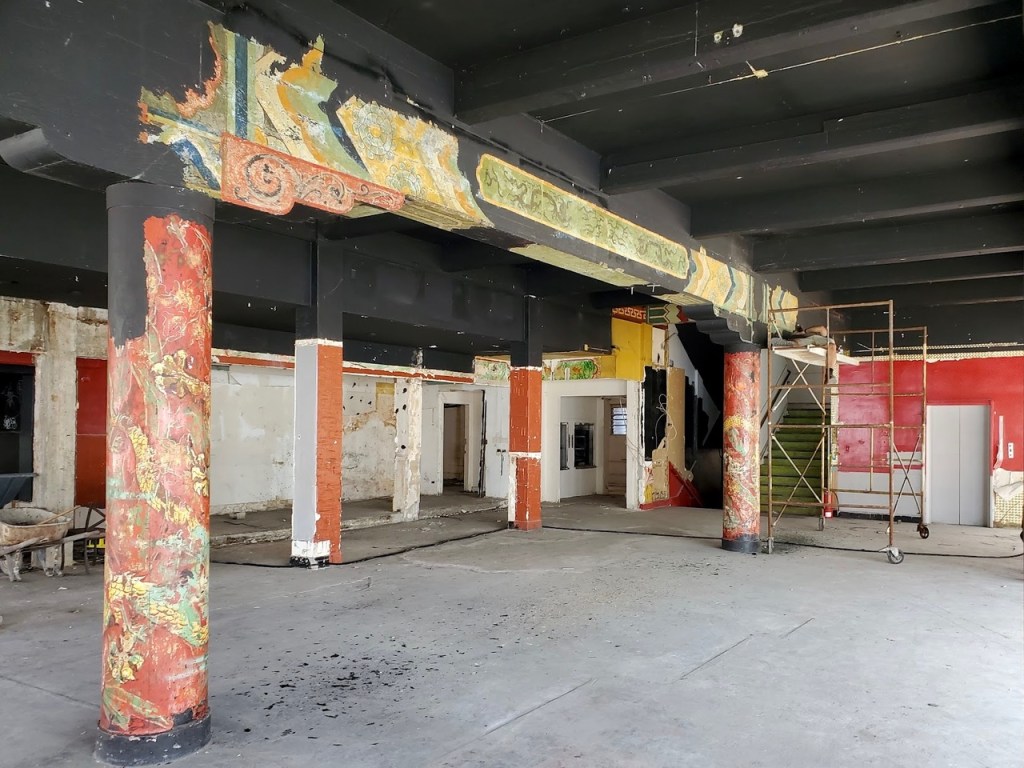
David Mulligan, the projectʻs general contractor, said construction came to a halt in February 2023 after the investors refused to pay his White Sands Construction Inc. the $3.5 million it was owed for work it completed since construction started about three years earlier.
“We were on a roll then, moving forward to build a boutique hotel, a restaurant,” Mulligan said. “The money was coming in. Until it wasnʻt.”
He filed a mechanic’s lien against the Wo Fat, hoping it would prompt the investors to pay up. He said they didn’t.
After the Wo Fat property went into foreclosure in July 2024, White Sands became the owner in a foreclosure auction with the winning bid of $3.5 million — the bid was based on the amount of money it was owed, Mulliagan said. He put the building up for sale in April, asking $4 million.
More Than One Vision
Mulligan said work on the originally planned hotel-restaurant concept is 70% completed. His dream would be to find a new buyer to finish the work he started.
The mayor said affordable housing is a more feasible option with the hotel rooms on the second and third floors ready to be reconfigured into rental units.
He said the city’s plan would call for retail establishments on the ground floor.
Mulligan said with lots of daily foot traffic, a bus stop right in front and a rail stop planned two blocks away, he can envision a successful coffee shop and a restaurant on the ground floor featuring historic photos of the Wo Fat in its heyday.

He switches on the Wo Fat neon sign out front on weekend nights to let people know what he calls “the beautiful lady” is still there.
“She is solid with great bones. All she needs is lipstick and high heels to be ready to go,” he said.
The cheeful sign seems to say: “Don’t give up. Something may still come of this.”
I hope so. Wo Fat restaurant was a big deal when I was young. As children growing up in Territorial Hawaii in the 1950s, we considered ourselves lucky if our parents ever took us out for dinner.
There were very few fancy places to eat in the islands in those days. People mostly entertained at home or went out to dinner at their clubs. You could count on your fingers the few thrilling restaurants suitable for special occasions.
High on any list was Wo Fat Chop Sui House, which to me was a mysterious and romantic presence in Honolulu’s then-bustling Chinatown.
My best friend Judith Jones’ parents took us there one night when we were about 10. We tried our luck with chopsticks over steaming platters of the Americanized cuisine considered Chinese in those days: egg foo young, sweet and sour pork, fried rice and chicken chow mein.
But what I remember more than the food was Wo Fat’s huge main dining room on the second story with its wooden floors able to seat hundreds of people for wedding banquets and family milestone birthday parties.
Not just the room but the building itself seemed magical, a three-story edifice with jade green upturned eaves, a pagoda tower sprouting out of the tiled roof and handpainted dragons and clouds on all the interior walls and columns.
Three Wo Fats Through The Years
The building was designed by Wahiawā-born Yuk Tong Char, a Chinese-Hawaiian man who received his architecture degree from Cornell University in 1915.
The current structure is actually Chinatown’s third Wo Fat. The 1900 Chinatown fire destroyed the first — a bakery that expanded into a restaurant and candy-making operation on Maunakea Street. A second Wo Fat opened in a new wooden building on Hotel Street in 1904, advertising “candies, Saimin and ‘other Fancy Chinese soups.'”
Decades later, a group of local Chinese businessmen pooled their money to build the current concrete building, which opened with great flair in 1938, billed as “the Territory’s oldest Chinese restaurant.”

A revitalized Wo Fat, just like the restored Hawaii Theatre, is valuable as a catalyst to encourage future quality projects to re-energize Chinatown, said Kiersten Faulkner, executive director of the Historic Hawaiʻi Foundation.
“It elevates the neighborhood,” she said, adding the mayor’s quest to turn Wo Fat into affordable housing has merit.
“This can be done well and is a useful way to meet both the city’s affordable housing goals and respect the neighborhood character and history,” she wrote in an email.
Wo Fat’s investors may have bailed out, but they left something good behind.
 Sign up for our FREE morning newsletter and face each day more informed.

Local reporting when you need it most
Support timely, accurate, independent journalism.
Honolulu Civil Beat is a nonprofit organization, and your donation helps us produce local reporting that serves all of Hawaii.
ContributeAbout the Author