Momentum Grows For Farm-To-School Programs In Hawaiʻi
It’s been years in the making, but with DOE and legislative backing there are now real signs of progress.
August 11, 2025 · 3 min read

About the Author

Across decades, Hawai‘i’s educators, farmers and food advocates have championed a stronger, vital connection between our local food system and public schools. The vision is clear: nourish students with fresh, local meals and provide stable, reliable opportunities for island farmers and food producers.

Turning this vision into a consistent, large-scale reality has been difficult and often delayed, but today, we may be witnessing a pivotal shift.
For long-time champions of this cause, it is gratifying to see renewed purpose and focused leadership translating farm-to-school ideals from aspiration into plans for action. This heightened alignment is underscored by recent news releases demonstrating robust public support from key leaders, including Hawaiʻi First Lady Jaime Kanani Green, Honolulu Mayor Rick Blangiardi, legislators like Sen. Donovan Dela Cruz and Rep. Kirstin Kahaloa, and Superintendent Keith Hayashi. Their unified endorsement sends a powerful message: farm-to-school is a necessity, and the time for decisive action is now.
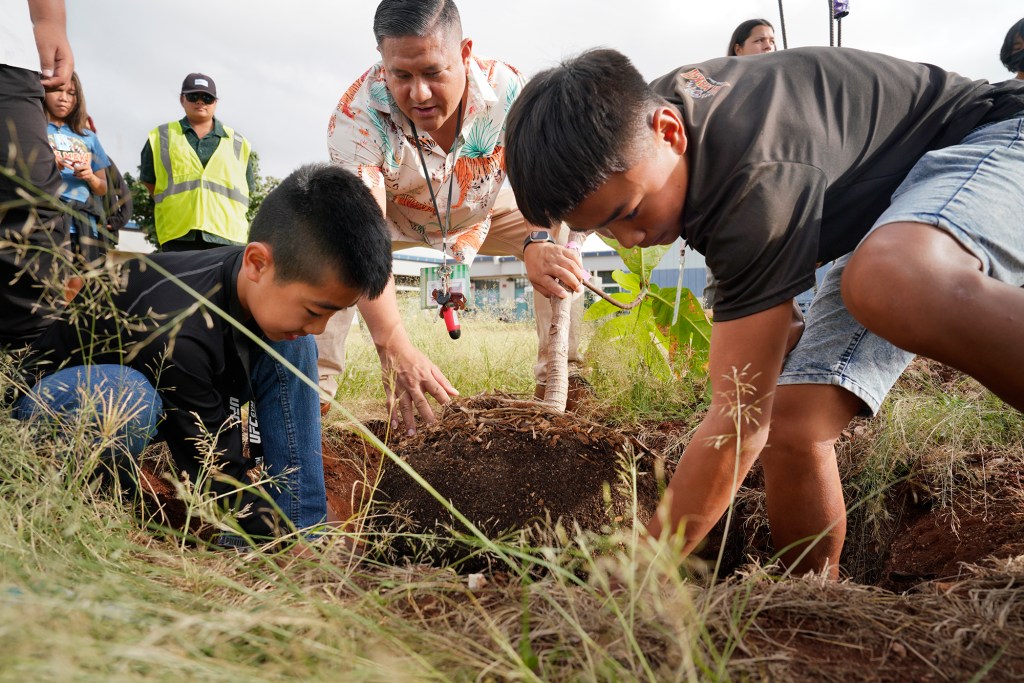
After years of stop-and-go progress, the Hawai‘i Department of Education is now taking tangible, visible steps toward building a more localized and sustainable school food system. This includes strategic investments in infrastructure and redesigning menus that will feature locally grown ingredients and appeal to students’ local tastes. By integrating more locally grown produce, HIDOE is starting to actively embrace the significance of its role in growing Hawai‘i’s food economy.
This momentum is not accidental — it is backed by a legislative mandate. In 2021, Act 175 took a critical first step by establishing statewide benchmarks for the department’s local food procurement. While this initial legislation was lauded by advocates (including Ulupono Initiative), its implementation was lacking.
A concerning drop in local ingredients in student meals (from 6.2% to 5.4%) and vague legislative reports clearly showed that better planning, accountability, and strategies to hui up with local farmers were needed.
Hawai‘i’s farm-to-school goals are ambitious, but they are achievable with the right systems and support from local leadership. No longer a niche idea, farm-to-school is now widely recognized as a smart, long-term investment yielding significant returns in student health, robust local economies, and enhanced educational outcomes. This movement is a clear win for our students, farmers and families across Hawai’i.
Momentum is not accidental. It’s backed by legislative mandate.
Still, HIDOE cannot do this alone. Reaching these goals requires strong teamwork among agencies, close partnerships with local farmers and food hubs, and ongoing investment in essential infrastructure like packaging and distribution. As the state’s largest food buyer, HIDOE’s leadership is key to this success.
For all who have championed this cause for years, this is a moment of hope and excitement for the future. With strong leadership and shared purpose, we can finally make local food in every school not just a goal, but a given.
 Sign up for our FREE morning newsletter and face each day more informed.
Community Voices aims to encourage broad discussion on many topics of community interest. It’s kind of a cross between Letters to the Editor and op-eds. This is your space to talk about important issues or interesting people who are making a difference in our world. Column lengths should be no more than 800 words and we need a photo of the author and a bio. We welcome video commentary and other multimedia formats. Send to news@civilbeat.org. The opinions and information expressed in Community Voices are solely those of the authors and not Civil Beat.
Read this next:

Local reporting when you need it most
Support timely, accurate, independent journalism.
Honolulu Civil Beat is a nonprofit organization, and your donation helps us produce local reporting that serves all of Hawaii.
ContributeAbout the Author