Overstating Tsunami Threat May Lead Some To Ignore Warnings Next Time
Hawaiʻi was not overwhelmed by big waves on July 29 but by misaligned emergency communication.
August 6, 2025 · 5 min read


About the Author

On July 29 at 1:25 p.m. Hawaiʻi Standard Time, a magnitude 8.8 earthquake struck off Russia’s Kamchatka Peninsula. This was a large earthquake by historical standards, the largest since the Fukushima earthquake in 2011.

By 2:43 p.m., the Pacific Tsunami Warning Center issued a tsunami warning for all Hawaiʻi with expected wave heights of 3-10 feet in exposed harbors facing north and northwest, and “urgent action” was advised statewide. Note that tsunami is a Japanese word from a double root: tsu, meaning port or harbor, and nami, meaning wave.
The estimated first wave arrival time for Kauaʻi was 7:10 p.m. and for Maui 7:17 p.m. In response, Hawaiʻi Emergency Management triggered tsunami warning sirens to start sounding within 30 minutes of the warning and then continued at regular one-hour intervals throughout the afternoon and evening — typically sounding 10 minutes after each hour — until approximately 6:45 p.m., which was 30 minutes before the expected first wave at 7:15-7:17 p.m.
At 7:15 p.m., the wave window opened — but flooding was minimal, limited to parking lots and marinas in harbor areas on the north sides of the islands.
There were no reports of casualties or major damage. Wave amplitude observations (crest above sea level) were 4.0 feet in Haleʻiwa on Oʻahu, 4.9 in Hilo on the Big Island, 5.7 in Kahului, Maui, and 3 in Hanalei, Kauaʻi. No discernible tsunami waves were observed on the south shores of the Hawaiian Islands.
After 10 p.m., the Pacific Tsunami Warning Center confirmed that the worst threat had passed and downgraded the warning to an advisory at approximately 10:38 p.m. By 11:05 p.m., Maui County lifted evacuation orders; similar rollbacks occurred statewide shortly thereafter.
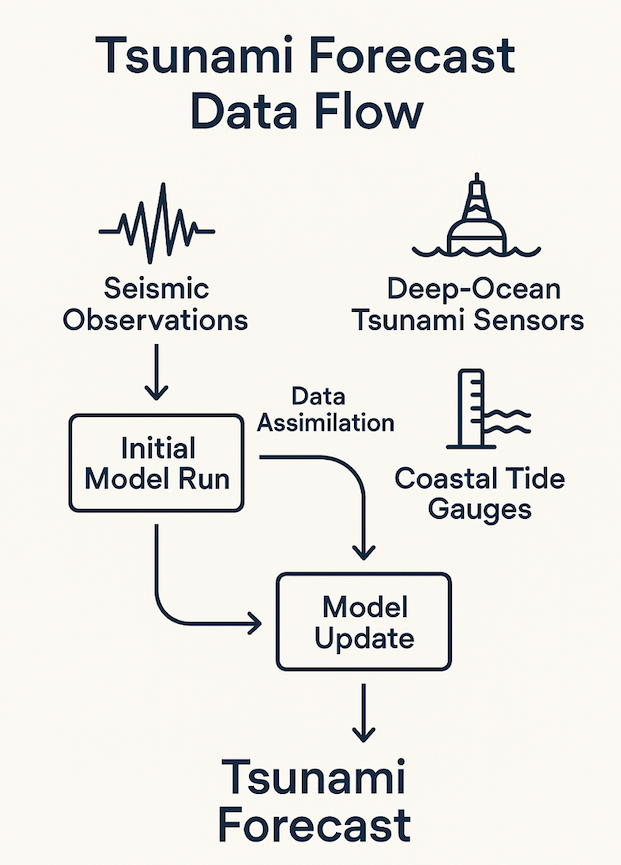
Tsunami modeling is challenging in the short term, because there isn’t a one-to-one relationship between the size of an earthquake and the size of the resulting tsunami wave. The depth of the earthquake beneath the ocean and the fraction of the energy directed into the vertical column of water above are key. Therefore, the initial warning cannot be very specific about the size of the threat.
Tsunami forecast modelers use observations of the amplitude of the waves to calibrate and update the tsunami model forecast. These critical observations are provided by special Deep-Ocean Tsunami Sensors buoys in the North Pacific, satellite altimetry data, ship-borne GPS data, and observations from coastal tide gages on intermediate islands. Once buoy and tide gauge data are assimilated, tsunami wave-amplitude predictions are within 10%-20% of observed values.
Luckily for Hawaiʻi, the Pacific Tsunami Warning Center in Hawaiʻi has access to a full range of data in real time and a tsunami model with ocean depth (bathymetry) data to produce state-of-the-art tsunami wave inundation forecasts here.
Despite well predicted, very modest wave impacts, in an updated tsunami forecast from PTWC, communities in Hawaiʻi experienced significant upheaval. Sirens sounding hourly amplified alarm across the entire Island of Oʻahu, including south shore areas that saw no measurable tsunami activity.
State offices and schools closed early, and hospitals canceled surgeries and shuttered care centers. Flights were canceled and cruise ships departed, leaving hundreds stranded as panic spread among tourists and port staff.
Traffic froze islandwide, parking lots and roads clogged as people fled to “higher ground,” even when south-shore zones saw no threats.
Miscommunication Or Incomplete Messaging?
The Pacific Tsunami Warning Center forecasts were region-adjusted: they identified likely stronger impacts on north- and west-facing harbors, with language specifying zone-based wave risks. Civil Defense, however, never updated the blanket statewide warnings, sirens and evacuations, and did not communicate the nuanced regional guidance from PTWC — exposing south-shore residents to unnecessary disruption.
The downgrade from warning to advisory occurred after closures and evacuations were in full effect, with no clear mid-event update to allow orderly return or de-escalation. Shelter guidance was generalized, with no clear instructions for south shore residents whose areas ultimately saw no surge.
The risk in overstating the hazard is that the public can become inured to future events and may fail to respond when the size of the tsunami is significantly greater, a circumstance that many people this week described as “crying wolf.”
In conclusion, the PTWC’s models were accurate — wave heights verified by gauge readings remained modest (4-5.7 feet) and localized. Yet communication translation between PTWC and Civil Defense lacked precision. Uniform statewide directives, delayed downgrade messaging, and indiscriminate alarms amplified panic and gridlock, especially in areas unaffected by the tsunami.
A more effective Civil Defense response would tie sirens and evacuations to specific zones, avoiding blanket alerts; provide real-time updates to downgrade risk, allowing safe return; and coordinate transport and shelter logistics with messaging to prevent gridlock.
On July 29 and 30, Hawaiʻi was not overwhelmed by a tsunami — but by misaligned emergency communication.
 Sign up for our FREE morning newsletter and face each day more informed.
Community Voices aims to encourage broad discussion on many topics of community interest. It’s kind of a cross between Letters to the Editor and op-eds. This is your space to talk about important issues or interesting people who are making a difference in our world. Column lengths should be no more than 800 words and we need a photo of the author and a bio. We welcome video commentary and other multimedia formats. Send to news@civilbeat.org. The opinions and information expressed in Community Voices are solely those of the authors and not Civil Beat.

Local reporting when you need it most
Support timely, accurate, independent journalism.
Honolulu Civil Beat is a nonprofit organization, and your donation helps us produce local reporting that serves all of Hawaii.
ContributeAbout the Author