The Sunshine Interview: SHOPO — 'We Want A Leader, Not A Boss'
Officials with the statewide police union have a lot to say about the many issues that Hawaiʻi’s law enforcement agencies are grappling with.
August 10, 2025 · 35 min read

About the Author

Police news is one of the hottest topics in Hawaiʻi these days, from major shakeups in the Honolulu department to the struggle to fills hundreds of jobs statewide to the search for new police chiefs in three counties at the same time.
That’s why we asked officials with the State of Hawaiʻi Organization of Police Officers to spend some time with our reporters and editors this week for an in-depth discussion on the many things SHOPO is concerned about.
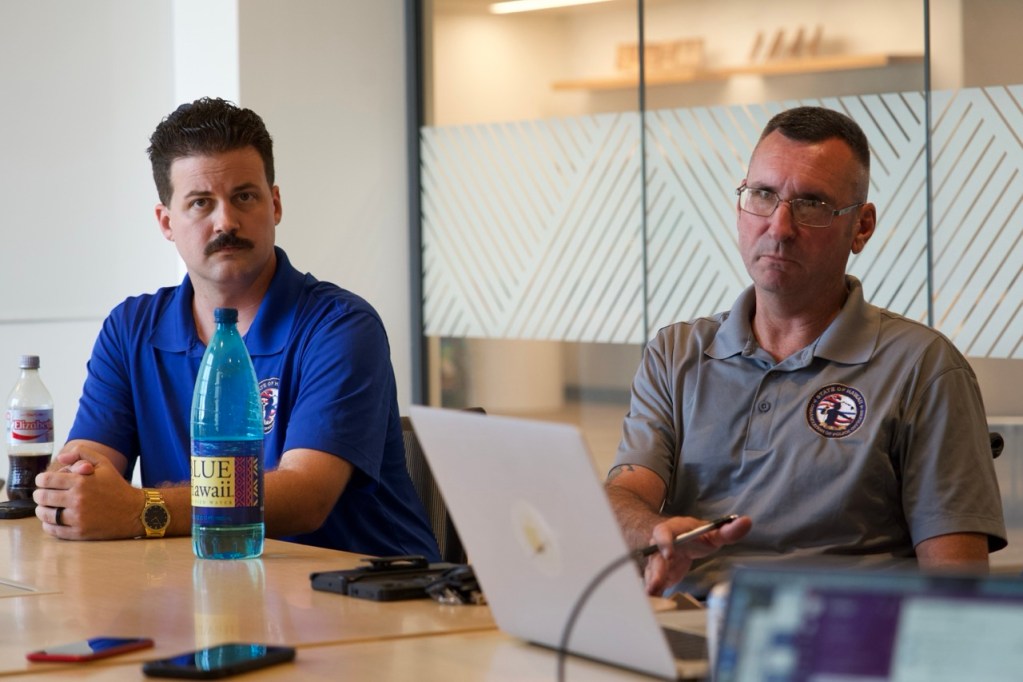
We weren’t disappointed. In a wide-ranging session that lasted more than 90 minutes, three SHOPO leaders — Sgt. Jonathan Frye, Cpl. Nicholas Schlapak and Dustin DeRollo, a SHOPO consultant — spoke frankly and passionately about how the issues making daily headlines are affecting their members, the ability to do their jobs and their lives. More importantly, SHOPO has clearly put a lot of thought into how to at least begin to solve some of the problems playing out statewide but especially in Honolulu, the state’s largest police agency.
“We all know that this department isn’t functioning well,” Frye, an HPD patrol sergeant and chair of the Honolulu SHOPO chapter, told us.

That’s why the selection of a new chief is of critical importance to SHOPO and the union is trying to proactively make a difference by making their members’ expertise, opinions and concerns an early part of the conversation as the Honolulu Police Commission begins its search process.
Schlapak, the SHOPO treasurer and an HPD corporal who works vehicular homicides, articulately describes a broken system — one that includes a dysfunctional Police Commission as well as a chief and top-level administrators who have long been out of touch with modern-day policing practices and the needs of the rank-and-file, particularly in the patrol division.
“We’re just as frustrated with the dysfunction of the situation as anybody else out there,” Schlapak said.
Now, they want to be an effective partner in turning things around. They bring front-line experience to the table, first-hand knowledge of the problems and promises of an increasingly complex policing system that now includes body cams and technology their current bosses never had to contend with. And they want to be at least listened to.
On Wednesday, the day after we sat down with SHOPO, the trio of union execs presented the Police Commission with the survey of its membership, which they hope will be a meaningful starting point as the commission considers candidates for Honolulu chief.
That same day the Honolulu City Council heard from Mayor Rick Blangiardi’s nominee to take one of two open seats on the seven-member commission. Chris Magnus, a retired chief now living in Mānoa who has led police departments in Tucson, Arizona; Richland, California; and Fargo, North Dakota, passed the first step Wednesday and will have another hearing before the council Public Safety Committee before going back to the full council, likely next month, for approval. He came across as a total professional, enthusiastic to be on the commission and already aware of and concerned about numerous issues he’s seen with HPD.
There should be plenty of time for Magnus and a second new commissioner that Blangiardi has yet to identify to get up to speed and have solid impact in the hiring of the next Honolulu chief. Police commissioners acknowledged at their meeting Wednesday that it will be at least eight or nine months before a new chief is identified.
“March, if we’re lucky,” Commissioner Laurie Foster said, laying out the plan to hire a search firm (still months away from signing a contract) and then have the company identify and screen applicants (a four- to five-month process, commissioners say.)
This interview has been edited for length and clarity and with an eye toward potential breakout news stories. Frye began by identifying some of the key issues facing the union and police departments statewide. The talk quickly turned to the recent departure of Chief Arthur “Joe” Logan, his legal claims against the mayor and the city, and the search for a new chief and what Logan’s action have done to the morale of the department.
Frye: I represent Honolulu, but the issues that we’re facing are the same ones all other counties are facing. And right now, the biggest topic is selection of a new police chief for the three counties. It’s a great concern to us, because this is essentially the first time in my history in this department that we’ve had three chiefs gone at the same time, and all of them left under various circumstances that are not normal.
So the question comes up: How do we go about now selecting the next chief? And obviously this is a question for the Police Commission, but SHOPO’s stance is we need to be directly involved in this, because the old route, the old method, has resulted in three chiefs now resigning or leaving under various questionable circumstances.
So moving forward, we want to be more directly involved, at least in providing our own input and thoughts on what qualifications make a good chief. Not so much selection — that’s going to be the Police Commission’s choice who they pick. But maybe helping to guide them in figuring out what qualifications or what characteristics or aspects of a person makes a good chief. And so that’s where we’re focusing a lot of our attention on right now.

Schlapak: One of the things that we have done on Oʻahu with regards to the selection of the chief’s replacement is to conduct a survey with our membership. This was done done electronically.
Membership was given a series of questions and their responses were whittled down to some very basic characteristics, which they think are the most important things a potential candidate should exhibit if they are to assume the position of the chief of police.
We hope that they will be taken seriously, because a large member of our membership did respond, and there are actually, interestingly enough, some pretty core basic values that we feel a police chief should have that, from my point of view, have just been overlooked over the years.
What would be at the top of that list of those core values that are important?
DeRollo: The core value that police officers in general are looking for, and they’re looking for it because it’s missing, is: They’re looking for a champion. What does that mean? That doesn’t mean, “Hey, everything we do is right.” They want somebody that’s going to be visible and stand up for the department, meaning we need the resources that we should have, the resources that we need, and being a champion for the good work that it does.
We need to be directly involved in this, because the old method has resulted in three chiefs now resigning or leaving under various questionable circumstances.
Jonathan Frye, SHOPO Honolulu chapter chair
When an officer does a good job, say so. When they see political activities that are going to hurt public safety or hurt the safety of an officer or the community, somebody’s going to stand up and essentially, from their point of view, speak truth to power in that sense. And then somebody that is going to be visible standing next to them when they need help.
They’re looking for somebody that has empathy with what they’re going through every day. We want them to have field experience.
Frye: It comes down to real simple terms: We want a leader, not a boss. We want somebody that’s going to help guide this department forward, that understands the hardships that patrol goes through and those at the lower levels, because those right now at the top that we’re seeing just haven’t experienced policing like the current generation that’s doing it now. They remember back 20 years ago, “this is how I did things,” but they weren’t wearing cameras. They weren’t having to deal with the changing environment of policing, which seems like every other year there’s something new that’s changing how we conduct business — in a lot of ways for the better. But it’s a different animal, and if you haven’t experienced it yourself, it’s hard to lead without that knowledge.
Schlapak: Jon’s been doing this job in Honolulu as a police officer for 15 years. I’ve been doing it for 17, and the bulk of our work has always been in patrol. I did my first 14 years as a beat cop, and Jon did at least 10 to 12 that way. We were the guys that if you called 911, we were the people that showed up. It didn’t matter if it was a parking complaint or an assault in progress or your house was burning down. Those are the kinds of cases that we handled with everything in between.

When we started, tasers weren’t even issued on a regular basis. A body-worn camera was a fantasy. People didn’t have phones that could record video for more than five seconds at a time. Home-surveillance systems were for the extremely rich, building surveillance systems were poor at best.
What we see now is an evolution of technology that helps with policing, and we’re completely open to that. But at the same time, we realize that the technology that our officers are being asked to use now that’s being employed in the field is the type of technology that upper administration in any county in this state has never actually had to utilize themselves.
And so there’s a gigantic disconnect between the rank and file who are held to standards based on using this technology — and an administrative review board that’s making decisions about the rank and file, be it policy, procedure or discipline, based on that technology and their instant access to it.
DeRollo: I think just to that point, because we see the technology, that’s the visible part that we all can relate to. But if you think about it, we talk about police reform. How much police reform has happened in the last 20 years? A lot. And where does it all happen? This level, right on the street, how they do things public-facing. There has not been police reform of administration, of management.
We’re asking police officers to be critical thinkers, but when you come back to the station you’re not asked what your opinion is. You’re not asked to be part of the solution. You’re told what to do. And so you’re made to feel less. And so right there that bakes in the morale problem. I see it in all the departments. “Everybody tells me what to do. I’ve been doing this job for 20 years. Nobody asked me how I could do things different.”
In order to be fully transparent, you have to, as the top leader of the department, admit that your department has problems.
Nicholas Schlapak, SHOPO treasurer
We have a huge budget. Nobody knows what it is, let alone to be able to make (decisions) based on data, making decisions to make things better and more efficient. There’s been zero reform from the administration standpoint. We’re modernizing at the field level very rapidly, but not here, and that’s the problem.
We’re going to look for three chiefs. Three chiefs just failed. What are we looking for? Who’s asking that question of what do we want in the chief? Because if it’s the same thing, this problem is not going to get better. Status quo.

What would be a concrete example of something that you want the new chief in each county to bring in?
Frye: They’ve got to be able to look at the way things are done and find a better way and a better solution to it. Lately, I’ve been doing a lot of looking around this department with regards to something like infrastructure or the way these buildings are. And if you go to any station on this island, you’re going to see that there’s gutters falling off the buildings. There’s things that are rotting, concrete that’s cracking, and I don’t know if there’s active work orders for these things or not. But what I do know is that when there is something that’s wrong, it has to get fixed.
In the meantime, that little bit of damage like the falling gutter continues to get worse and worse, and by the time it gets fixed, now you’ve got a building that you’re potentially looking at tearing down and replacing rather than just fixing a simple problem that could have been fixed several years ago.
So that’s just one example, but we need a chief that’s going to come in here and look at the way things are currently getting done and saying, “Is there a better way? Is there a faster way? Do we sit here and just let the status quo continue, or do I find a solution to move things forward in the right direction?”
Schlapak: I honestly feel that when it comes to a police department, in order to be fully transparent, you have to, as the top leader of the department, admit that your department has problems. And you have to reveal those problems to the public in a way so that you’re advocating for your department and you’re rallying your community to help fix those problems.
So that’s what I would like to see the chief of police of any one of these three counties do. I would like them to redefine transparency from just simply using it to actually owning it in a way so that they can bring focus to what’s going on from politicians and from stakeholders in the community, to actually help the chief fix what the shortcomings of the department are.
It sounds like, from what you all have just said, the current top echelon of the departments, especially Honolulu, don’t have recent field experience, and they also don’t seem to be able to admit that something’s wrong or to look critically at their own departments. So does that mean you all are not really supportive of any of the current deputy chiefs to take on the top spot?
Frye: I think that’s a fair question. We’ve gone on record in saying that we’re not going to endorse anybody, and this union won’t. We’re looking for great candidates, and we will have very in-depth, serious discussions about those candidates when the field gets smaller and smaller and it’s looking like there are a core to choose from.
How do you feel about mainland versus local? Would you be open to mainland candidates?
Frye: That was one of the questions that we actually asked in our survey. And there’s a mix of feelings on it, but the majority their belief is that we need somebody that understands Hawaiʻi and the different counties. Of course, I can’t speak for the other counties, but at least for the Honolulu survey, the majority wants somebody from the inside, and I think that’s fair to say, coming from the outside — I’m a transplant to the state myself — you come here, there’s a big learning curve, and it can take years to acclimate to the local culture.

And to bring in someone from the outside that doesn’t understand the local culture and the citizens that we represent, the officers that they represent, I believe, is more detrimental than it is beneficial. So having somebody on the inside that’s going to display those qualities that we’re looking for and achieve is really going to be the ideal candidate.
What do you think about this dustup between the mayor and Logan? What’s your take on Logan and his demands?
Frye: I’m absolutely disgusted by it. And that’s honestly how I feel. I’m absolutely disgusted by it. His whole time here in this department, Chief Logan would continuously say, “It’s not about the money. You go into this career, you choose this profession because it’s a calling.” And he abandoned his calling, and now he’s asking for $780,000. So I have to ask him, “Is it about the money, or is it about the calling?” And I think we all know the answer to that one.
Schlapak: I want to make it clear that I share John’s frustration with Arthur Logan and his decision to threaten to file this lawsuit and demand an apology from the mayor. I think it is silly and unbecoming of someone who used to be the chief of police of a major metropolitan city in this country. It underscores his ineptitude when it came to his performance as the chief of police, and I think it is absolutely the wrong way for him to leave, given the circumstances as this is playing out.
What’s the responsibility of the Police Commission here? It just seems they let this whole thing get out of hand by not really being a stronger board. There’s going to be charter amendments to change the Police Commission, changes in who hires the police chief. Should it be the mayor? Should it be the commission?
Schlapak: I feel that the situation brings up a lot of faults with regards to the Police Commission, the City Charter and the mayor that were hiding in plain sight for years and years and years and have only been exposed through the mechanics of this process.
There’s a lot of hope and well wishes that this is going to really be a positive turnaround, but it’s all going to very much depend on who’s selected as the next chief.
Jonathan Frye
The quandary is that the mayor can make a recommendation and the chief of police can be hired by the Police Commission, but the Police Commission can only essentially rate the performance of the chief and fire the chief for cause. But if the chief is not living up to the expectations that the mayor has, then the chief can stay in plain sight the entire time and nothing gets done. And I think that that dysfunction which was going on behind the scenes for years — clearly we can see it now — has only added to all of the problems that the Honolulu Police Department has suffered through in the last four years.
With that said, I do believe that the public needs to take some very serious stock of how this system works, and they need to agree to start rethinking all of this, because I do feel, as much as I have respect for certain police commissioners, that the quandary that Arthur Logan got stuck in was that he had a police union which was critical of his performance. He had a mayor who was not able to address any shortcomings that the mayor thought were there, and you had a Police Commission which was outwardly not listening to the mayor or the police union and telling Arthur Logan, “You’re doing great.”
So even though I think that it’s ridiculous for Arthur Logan to threaten to file this lawsuit, there is a small part of me that can see him saying, “But wait a minute, my bosses, the Police Commission, not the mayor, but the Police Commission, told me, year after year after year, I was doing fine. Why should I have to listen to a police union? I’m the chief of police. Why should I have to listen to the mayor? I’m the chief of police. The only authority that can address me is the Police Commission, which, strangely enough, can only make recommendations about how I do my job.”
As you know, the Honolulu Charter Commission is soliciting questions right now to put before voters. As a union, what would you like to see put before voters regarding the authority of the commission, the chief, the mayor?
Frye: That’s a great question. It’s something that we haven’t actually discussed yet. But I mean, moving forward, I think we’re going to have to discuss this and figure out our strategy.
Schlapak: I would say, if the opportunity is there, we’ll take it. We want to be contributors in a positive way to this situation. We’re just as frustrated with the dysfunction of the situation as anybody else out there.
What kind of people would you like to see on the Police Commission? What are the qualities you’d like to see?
Schlapak: To the best of my recollection, the last police officer who sat on the Honolulu Police Commission was Boyd Andrade, and if I’m not mistaken, he left the Police Commission in 2011. Does that sound about right? Maybe 2012. Now, we’ve got some attorneys on the Police Commission in Honolulu. Currently we have a former EMS administrator, if I’m not mistaken, we have a former HFD administrator. So we have a mix of county experience and we have a mix of law experience. We have someone from the media, but at the same time, we haven’t had anyone from law enforcement on there in the longest time.
And I think that a recent retiree from local law enforcement — and it doesn’t really matter which county — but someone who has the kind of up-to-date experience in the field that we were talking about earlier, a familiarity, or at least some type of empathy with the type of day in and day out operations that your average beat cop has to go through. That’s probably somebody that I think would be a great resource. And when I say resource, I mean for the Police Commission itself, because what I don’t see is the Police Commission trying to find information about the Honolulu Police Department except from the administration of the Honolulu Police Department, which I feel may have gotten them into this problem in the first place with Arthur Logan.
Frye: Anybody with the experience, the qualifications that we just listed for chief, I think, can really be transferred over to qualifications for commissioner as well. Somebody that understands the background, who’s had those experiences.

Ultimately, the commission is going to make whatever decisions they’re going to make, and right now they have a first responder on there from (the) fire (department), right? Ken Silva is heading that commission. But what I caution is, is first responder experience doesn’t translate into law enforcement experience. I would never want to sit on a commission for the fire department or EMS not knowing what they do. I may understand basically what they do, because we interact on a daily basis. Fire helps us out. We help them out all the time, but our job duties and our experiences and our personal knowledge and skills are completely different skill sets, and so we need somebody that understands that on the commission.
So, as Nick pointed out, a recent retiree, someone with 25 to 30 years spending most of it probably in patrol. I’m thinking a sergeant or a lieutenant capacity would probably be better suited for advising and counseling the rest of the commission on law enforcement practices than somebody that served in a long-term administrative capacity.
I think one of the other charter commission proposals we’ll see is to expand or to change the membership of the Police Commission to have more representatives from disadvantaged communities, minority communities, the Micronesian community, the West Side, that kind of thing. How do you guys feel about that?
Schlapak: It’s a bit more of a mainland model. If I’m not mistaken, I think a lot of cities in the West Coast have adopted those kinds of policies with their police commissions or their police oversight boards, whatever you’d like to call them. I’m not opposed to it by any means. I do think that that community stakeholders should have a say in that kind of situation, wherever they come from, socio-economic background and so on.
I do believe that the public needs to take some very serious stock of how this system works.
Nicholas Schlapak
However, I also feel that in order to assume that responsibility, whoever takes the job must understand that it is a group, and they are responsible for interacting and sort of maintaining an organization that is dedicated toward law enforcement and only wants the best for its community. So I would ask that whoever that person is does not take the job with an agenda of dismantling a police department, or, for lack of a better term, removing it from the community, so that the community is at a safety risk of some kind.
How do you feel about who hires the police chief? Do you think it should be the mayor that does the hiring with candidates brought forward by the Police Commission? Or are you guys good with the way it is now?
Frye: I would say that what we have now isn’t working as effectively as I would like to see. Whether the mayor’s proposal is the better option, time will tell. We’ll see where things go. At the end of the day, what we’re looking for is just to have a system in place where we can get an effective chief into the position that can be held accountable and do the best for our officers and for the community. Whatever the system comes up, as long as it works, that’s really what we’re looking for.
Back to Logan’s resignation and his lawsuit — what do they think of his resignation and how is that impacting morale of the officers that are still there? And do you think it could have a negative effect on recruitment or retention?
Frye: I never like to punch a guy when he’s down, but he did file a $780,000 lawsuit, so he decided to open that door around the department. It’s being viewed as a positive. I know there’s a lot of hope and dreams out there that our next chief is going to really help to turn around this department for the better. You know, there’s always that buzzword “morale,” right? And we’re not talking about the superficial stuff — “I want this, or I want that” —we’re not talking about those little things.
We all know that this department isn’t functioning well. Everybody sees it, whether it’s the infrastructure or the way things are, like special assignments are handed out to the way discipline is handed up. For years and years, we’re seeing all these these issues and disparities, and that, as itself, is what the morale issue is. And so there’s a lot of, like I said, hope and well wishes that this is going to really be a positive turnaround, but it’s all going to very much depend on who’s selected as the next chief, and if they have the qualities that make those improvements to try to turn this department in the right direction.
Schlapak: Morale is a condition it’s not a feeling. And so this is a condition that I think has been growing within the department over the last three to four years, and I don’t feel that our officers can really get in stride here. We had Louis Kealoha, who left on a very bad note — and by the way, also received a severance, strangely enough. We have Susan Ballard, who was very endearing to the membership and very well loved, but had a disagreement with the Police Commission and decided to leave on her own terms as well, abruptly. We had a long span of time where we had an interim chief who’s the same interim chief that we have now, and then we hired Arthur Logan with a lot of hopes to be able to go forward. And instead, we had a staffing crisis that rose exponentially, and we had a myriad of other issues that came with it.
Morale is something that I don’t think (Logan’s) administration could really put their finger on. They were commonly telling our people that there is not a morale problem, instead of asking people, “What is wrong with this situation? Why are we losing people?”

I think the answer that they didn’t want to hear was, “You’re not paying us enough,” and that’s naturally a turnoff to your boss. However, money does talk to a certain extent, and I think we can all admit that the problem that Arthur Logan’s administration made was that they didn’t go beyond the “What else can we do other than pay you more” question. They never put together any think tanks. They never polled the membership as a whole. They never went out and actually tried to put together groups of normal people, normal beat cops and say, “What works, what doesn’t? How can we keep you?”
So I’m hoping that the department is sort of opening up to new ideas, if that makes sense.
Frye: Nick said it — it’s a condition, this morale issue, and it’s a matter of feeling, but not really feelings themselves. We all know in this department, we look around, we see that there’s problems, whether it’s with policies and procedures or, you know, buildings, or whatever it is. But the feeling I’m getting at is that nothing we do will fix this. That’s what they’re looking at, and that’s why you got these 25-year veterans that are saying, “You know what, I’m tired of trying to improve everybody’s working conditions. I’m tired of doing this. You know what? I got a job offer, working here or there, private sector. I can retire and I can go enjoy the rest of my life with my family, working in a profession, whatever it is, in the private sector, that I love and respects me for who I am.”
And that’s the feeling that we’ve had a hard time conveying to the administration. Because when we mention the word morale, it comes off as, well, “You guys just want something more or you just want more money.”
Schlapak: And it’s not that it paints us as petty gripers.
Frye: I did agree with a lot of Logan’s words that it’s a calling, and it’s not about the money. I have believed that since the first day. I would have never gone into this job if I wanted to make plenty money. There’s a lot of other career fields I could have chosen, but I wanted to make a difference, and that’s every officer in this department in Honolulu, as well as our partners in the other counties. That’s exactly how they feel. They want to make a difference, and when they get to a point in their career where they feel like nothing they do is going to make a difference because they’re just being stifled, they give up. They can only take so much.
How much worse do you think the staffing issue is going to get if people are kind of demoralized? And I heard that once the (Covid) hazard pay comes through for people, there might be a rash of departures after they collect that money, and then at the end of the year people tend to retire and leave anyway. So do you think it’s going to get worse before it gets better?
Frye: Dustin said it earlier. To date, the administration, pretty much in all the counties, has not admitted or acknowledged the fact that there’s a retention problem. So as he said earlier guys are saying I’ll put up with it for $10,000 that that’s basically what’s going on with the hazard pay right now. Yeah, they’re still going to get it if they retire, but they’re looking at their retirement, they’re looking at their future and that hazard pay is going to come to some degree into their retirement.
So a lot of these guys right now are saying, “Look, I’m for that little bit of boost, even if it’s another $50 a month in my retirement. For that little bit, I’ll wait at least until that’s settled.” But once it’s settled, once that goes into their paycheck, once it’s calculated into their Employees’ Retirement System, there’s a lot that are not interested in staying and putting up with this anymore.
There’s a lot of other career fields I could have chosen, but I wanted to make a difference, and that’s every officer in this department in Honolulu, as well as our partners in the other counties. That’s exactly how they feel. They want to make a difference.
Jonathan Frye
And to the contract point, same thing depending on the outcome of that contract. There are some that they say, OK, for that pay raise, I’ll stay a little longer, because that’s going to help me in my retirement, help me in my golden years. But if it’s not good, they might just up and leave, and it’s a very personal choice. So what’s good for one person is not good for another. But we see it every single contract, every single contract. Come December, people just up and leave, and we’re in a contract year, which means this December, I fully expect to see an increased number of retirements.
I tracked this stuff all the way back to 2016 and you can see it consistently. Every four years there’s a much larger increase in the number of separations come December.
So you’re under a current two-year contract that expires?
DeRollo: It’s a four-year contract. It expired June 30.
And then this is for all four counties?
DeRollo: Correct. We’re in arbitration. It’s kind of now to the final argument and decision point. We’re expecting something in the next couple weeks.
Police scanners have been in the news a lot. There’s legislation proposed by the council and differences of opinions. Where’s the union on this?
Frye: I kind of look at this similar to the way body-worn cameras are, right? It’s something that there’s going to be a lot of opinions on. They’re going to have arguments on both sides. Ultimately, at the end, if all the interested parties come together and talk about what our concerns are, I believe there is a solution in there that is amicable to everybody. There are ways to do these things, but we have to have that discussion. So the stakeholders in the media, the police department, the policymakers, even the union, if we can get all into one room together and discuss all of our concerns, there’s a solution somewhere in there. And that’s really what we should be looking for.
Schlapak: Yeah, I’d like to agree with that as well. I feel that the main concerns for our membership with regards to officer safety — and don’t get me wrong, I know that’s used all the time, and we don’t want to beat that drum.
That somehow the media’s presence compromises situations.
Schlapak: It’s not necessarily you folks listening, it’s other folks who may be listening in as well. And I think we can agree, though, that there are certain situations where officers are in the middle of rapidly unfolding situations and they need a measure of security to what they’re doing, because they don’t want these other actors to somehow gain situational awareness that gives a tactical advantage to the malfeasant and not the law enforcement officer. That is a genuine concern.
The other concern that a lot of our members have is exposing any private or confidential information over the air. However, I agree with Jon. I think that there are certain ways that the department can meet you folks halfway to find a medium. It’s just really a matter of actually sitting down and having these conversations to understand where that middle ground is.
Within the Joe Logan legal filing, there was this one line as he talked about all the coercive things the mayor could do, and he said Chief Logan was also aware that Mayor Blangiardi could use the police union to create false claims against Chief Logan. What is your reaction to that?
Schlapak: I’ve read that, and it’s absolutely absurd.
Frye: If the mayor could use us, he’d be the best mayor in the entire country. I’m sorry, but no mayor anywhere has control over a police union, and it’s absolutely absurd. We’re going to say whatever we want to say, whether it’s good or bad.
Schlapak: Excuse me, it’s laughable, because this union has on many occasions attempted to reach out to Arthur Logan and his administration to offer assistance or give opinions on how things can be fixed, and we were continuously over and over either completely rebuffed, or when we were given an opportunity to actually sit down we weren’t talking to him, we were talking to other administrators — which, quite frankly, is insulting when you’re trying to help fix things.
If a young person who you personally, truly cared about came to you and said that they were considering a career in law enforcement, would you discourage them or encourage them?
Frye: So, this is hard, because if you had asked me this 10 years ago, I would have said, “It’s just the ride of your life here. Do it. Absolutely do it.” My daughter wants to be a police officer. I don’t want her to and she’s only 6, so she’s got a ways to go. But I do not want this profession for any of my loved ones or my family, not as it is now. That’s why I’m so involved with this union. I have been most of my career, because I believe it can be brought back to being a great profession. And I’m not saying go back to the good old days, because there’s a lot of things that have improved in terms of policing. And we don’t want to go back to the good old days.
But we do need to fix the culture and make this something that it’s the calling that it used to be — something that you’re proud to do, that regardless of all the hardships and the traumas and the things we deal with on a daily basis, is something that I wake up every morning and I want to go into it. And I want to return it to that profession, so that the younger generation loves it and they love serving. But right now they don’t.
Schlapak: I do have a bit of personal stake in this, although I do not have children. I have a classmate from the academy who was extremely dear to me, closer than even a brother could be. And some years ago, he committed suicide, and when he passed, he had a young son who I keep an eye on as a measure of faith to my friend, and that boy is going to go into the sixth grade right now — actually, this week — and he wants to be a police officer and is, unfortunately, a bit too young to remember his dad very well at all.
I have made a commitment to myself that if I do stay in the department beyond 25 years, it’s going to be for him, if he is still committed to become a police officer when he’s of age to get hired. However, I keep a very close eye on law enforcement with respect to that, and I would say that if he was still interested when he was 20 or 21 or eligible, I would like to get this department up to a point where I feel that it would support him fully in a complete career as a cop in Honolulu, nowhere else. That’s it, here in Honolulu, because it’s his home.
But also, I don’t see the point of working anywhere else. I really don’t. I mean, I know people are attracted to money and other incentives and so on and so forth, but when we look at the community that we serve out here, I think, as a cop, you can’t go wrong. I think it’s the best place to work in the whole country.
 Sign up for our FREE morning newsletter and face each day more informed.
Local reporting when you need it most
Support timely, accurate, independent journalism.
Honolulu Civil Beat is a nonprofit organization, and your donation helps us produce local reporting that serves all of Hawaii.
ContributeAbout the Author