Are Hawaiʻi Lawmakers Just Rubber-Stamping Bills Every Session?
A new research tool shows the vast majority of bills pass out of the Legislature with no opposition.
September 21, 2025 · 11 min read


About the Authors


Hawaiʻi lawmakers rarely vote no on bills whether in committee or on the floor, according to an analysis of votes cast during the 2025 legislative session.
Out of 94,561 total individual votes cast for bills, 92,717 were yes votes while just 1,934 were noes. That works out to voting in the affirmative 98% of the time.
Surprising? Yes and no, according to people who work in the Legislature or follow it closely. They’d not seen the lopsided tally before but it’s to be expected, they say, in a body dominated by one party — Democrats — where bills are often decided by leadership and many lawmakers are careful not to aggravate colleagues and constituents by speaking out too much.
On the other hand, some legislation addressing critical issues receives wide support. In the last session, that included allocating more money for affordable housing, passing measures to mitigate against wildfires and increasing penalties on the use of illegal fireworks while giving law enforcement more tools to crack down on violators.

Explore detailed legislator profiles, voting records and what happens in hearings on Digital Democracy.
But many more significant measures don’t pass or even get a hearing. Legislation from minority Republicans or Democrats not part of the power elite is rarely considered. And mechanisms that allow a handful of legislators in the majority party to control the gatekeeping on all bills — such as the power of a committee chair to unilaterally kill a bill or not hear it all — remain obstacles to achieving greater inclusion and consideration of policy.
“The reason (for the overwhelming number of yes votes) is that bills — at least in Hawaiʻi, and I think this is true of most states where there’s a single party that dominates — if there’s disagreement, they’re killed ahead of time,” said Colin Moore, a political scientist at the University of Hawaiʻi Manoa. “They don’t make it out of committee. They don’t get heard. Most of the debate, most of the disagreement, happens behind closed doors. And so once a bill actually comes up for a vote, it usually has a huge majority behind it.”
Summary of Total Legislative Votes 2025:
Debating Assault Weapons
The overwhelming agreement on legislation that emerges from the Legislature can leave the public without a real understanding of what their elected representatives are really thinking about an issue.
“The end vote is transparent, but you don’t really get to see how the sausage is made, which is always part of the legislative process,” Moore said. “I think that it makes it very hard to understand why this choice was made and this wasn’t, or when it was made because legislator X wanted it that way. You are always kind of reading the tea leaves at the end to try to piece it together, or talking to somebody later. But it’s not a process you can really observe in real time.”
One example of a hotly contested bill that ultimately failed after a close vote was the proposed prohibition on assault rifles, assault shotguns and .50 caliber firearms. The public floor debate on Senate Bill 401 drew passionate speeches from lawmakers before Senate President Ron Kouchi killed it with a tie-breaking no vote.
In March, SB 401 had been easily approved by the Senate, 20-5. But on April 30, just two days before session concluded, Sen. Lynn DeCoite moved to amend the bill on the floor.
Among other points, a review of the hearing on Digital Democracy shows, she argued that the bill did not adequately preserve the rights of subsistence hunters and conservation workers, “especially Native Hawaiians.” Assault weapons, she insisted, help to combat feral pigs and axis deer.
“And every time we remove a tool from the people on the front lines, our hunters, ranchers, landowners, and conservation crews, we increase the cost,” said DeCoite, a Democrat who represents a very rural district on Maui, Molokaʻi and Lānaʻi. “Without access to lawful and effective tools, we are tying one hand behind our back in the fight against these invasive species.”

The author of the bill, Sen. Karl Rhoads, opposed DeCoite’s amendment. “The big picture is this amendment creates a huge carveout for the sale of assault weapons,” he said. “If we pass it, it basically eviscerates the underlying bill.”
Rhoads said other concerns about SB 401 such as the passing of weapons to younger generations through family inheritance were addressed in his bill.
But it was too late. SB 401 was recommitted on a 13-12 vote, meaning it was sent back to committee for further discussion, effectively shelving it for the year.
In the Senate gallery during the vote, groups on both sides of the measure turned out in force, making their presence known to senators.
“It can make a difference when there’s just a huge outpouring of testimony,” said Moore. “If people really show up for something, then they know, ‘Oh, we’ve misjudged how the public is feeling about a bill, or we’ve misjudged the ability’ of one of the interest groups to really raise hell and motivate folks to come down to the Capitol.”
Debating Midwifery
The practice of midwifery is another issue that has split legislators for several years. Bills have failed, sometimes without even a vote, until a compromise was reached this past session. House Bill 1194 made permanent the regulation of midwives and the practice of midwifery while allowing for Native Hawaiian traditional and customary practices.
An emotional debate on April 14, easily accessible on Digital Democracy, shows how lawmakers finally came to grips with the issue just weeks before the session ended. The yes votes outnumbered the no votes 34-16 as the House took its final floor vote.
That day, discussion was initially disrupted by a group of women protesting in the House gallery, later identified by Rep. Chris Muraoka, a Republican who would vote against the measure, as residents of Hawaiian Paradise Beaches.
“Those are the people we were elected to serve and their voices should count and should be heard,” he said on the floor. “We are not here for ourselves or the people who donate to us or stand behind us.”
Another Republican, Rep. Elijah Pierick, explained in his remarks that he and his siblings were birthed with the help of midwives. He added that Jesus was born “without a licensed midwife. So I think the standards of Jesus are good enough for us, and I recommend we vote no on this bill.”
Pierick’s short speech was met with wild cheers in the gallery, prompting House leaders to warn the public that such disruptions were not appreciated.
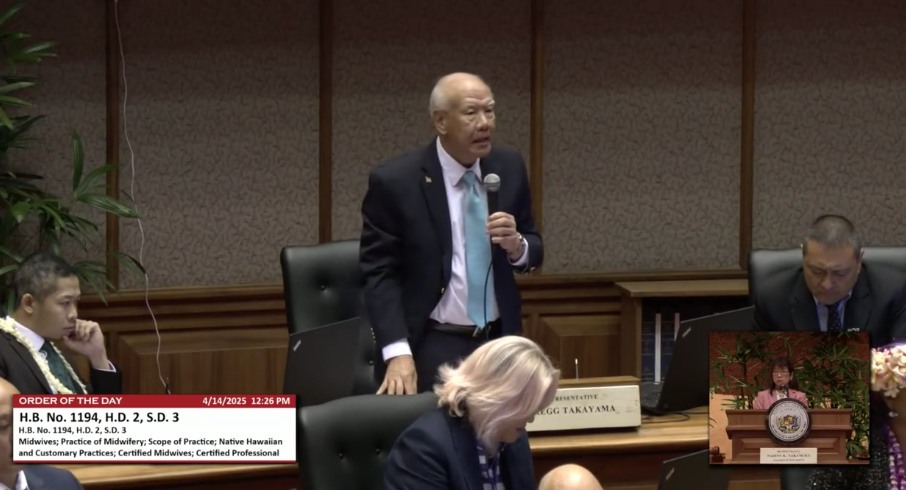
Rep. Gregg Takayama, a Democrat, defended HB 1194, describing it as “the product of many, many hours of hearings and debate in both the House and Senate.” He said the measure would enact professional standards of training, experience and knowledge for midwives “so that all expectant mothers can be assured of a safe quality of care when they utilize the services of a licensed midwife.”
Digital Democracy lists major supporters of the measure such as the Hawaiʻi chapter of the American Academy of Pediatrics, as well as opponents like the Hawaiʻi Midwifery Council, illustrating that it was not just legislators who were divided.
Timeline of House Bill 1194 vote during the 2025 legislative session:
Yes Votes Reflect Reality
Sen. Jarrett Keohokalole says he’s not surprised by the vast number of yes votes because the Legislature is based on consensus and compromise.
“The vast majority of work done at the Legislature is consensus-based governing that is necessary and has to happen,” he said. “It’s the necessary governance that has to take place every year that does not get the attention of the public or even of the media, because it is boring.”
Keohokalole, chair of the Senate Commerce and Consumer Protection Committee, dismissed the notion of backroom dealing when it comes to deciding legislation.
“People are going to hate to hear this, but I think less backroom dealing is actually done than people think,” he said, adding, “You cannot guarantee anything in the legislative session. No one can.”

Keohokalole described a process in which “a custom and practice” has developed over time “to grant a certain level of deference to the chairs, because the chairs are the ones that have to sift through their colleagues’ bills and figure out which ones to hear, knowing you don’t have enough time.”
“And then I will make recommendations, and then they will vote accordingly,” he said. “I don’t set any conditions or anything on the way people vote, and we’re an overwhelmingly Democratic body, so there’s also that layer of deference that takes place.”
Hawaiʻi Legislators
Explore detailed legislator profiles, voting records and what happens at hearings on Digital Democracy. Visit Digital Democracy
In striking a balance, Keohokalole said, a lot of bills are going to die or never get heard. But the bills that do advance go through an extensive vetting and amendment process “to try to get the bill to the finish line.”
Rep. Lauren Matsumoto, the House minority leader, was also not surprised by the high rate of yes votes. But she is frustrated by the way Hawaiʻi does things as compared to other legislatures, something she described as “a kind of culture” at the Capitol.
“Because you’re presumed a yes, there’s no action you actually have to take on the floor other than sit there and you will vote,” she said, “versus if there were buttons and you had to actually put in a vote every time a bill came up with either a green for a yes or a red for a no where there has to be active engagement.”
She pointed out that some states use large screens to show actual vote tallies, something she has been fighting to get in Hawaiʻi.
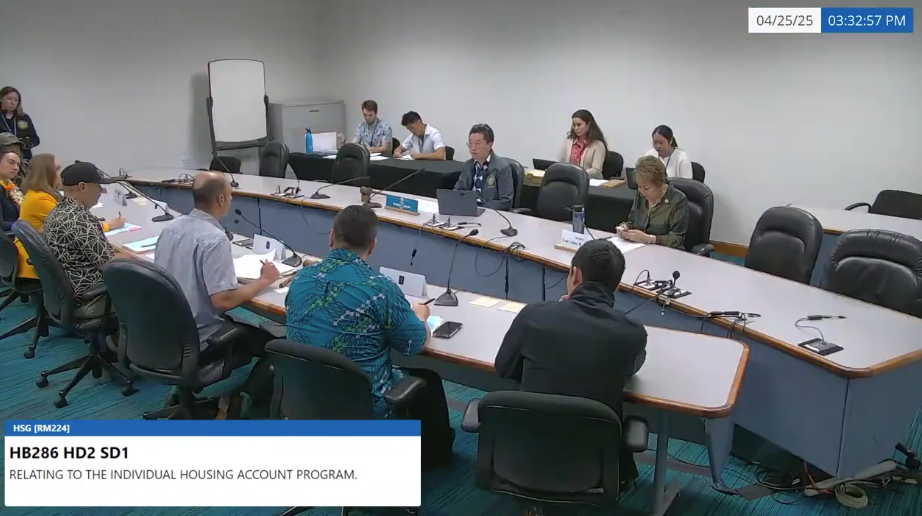
A more open process, Matsumoto said, would ensure “that the person that you elected to office is actively engaged in every single vote and having to make a decision every time, and just doesn’t sit in their seats and have all of their votes be an automatic yes. You have to actually register a vote and ensure engagement.”
Democrat Matt LoPresti is a former lawmaker who watched his colleagues in the House stay silent rather than oppose a bill and risk the political consequences — losing influence in the caucus and possibly reelection.
“You’re going to annoy or anger whoever introduced the bill if you vote no, and you’re going to annoy or alienate the chair who just is moving that bill out of committee because they worked hard to get that bill passed,” he said. “There’s some handful of people who spent political capital to get that bill to that stage, and when you vote no, you are pouring cold water on people’s hard work inside and outside that building.”
What that means, said LoPresti, is that the lawmaker who stands up is going to see their bills die.

LoPresti said he has seen people vote no passionately on the floor, “but behind the scenes they say, ‘Oh, I totally support this. You know, I just have to vote no because my constituents.'”
He called it a dishonest process and “political theater.”
“It’s a game to so many of those people,” he said. “It’s like high school, and it’s so stupid, because it’s so much more important than that, right? But the game is, if you say no to them, they’re going to kill all your stuff.”
Foaad Khosmood, a computer science professor at Cal Poly San Luis Obispo, contributed to this report.
We need your help to improve Digital Democracy in time for the 2026 session. Please give it a try and drop us a note at digitaldemocracy@civilbeat.org with anything we need to fix and interesting ideas for us to look into.
 Sign up for our FREE morning newsletter and face each day more informed.
Read this next:

Local reporting when you need it most
Support timely, accurate, independent journalism.
Honolulu Civil Beat is a nonprofit organization, and your donation helps us produce local reporting that serves all of Hawaii.
ContributeAbout the Authors