Suit Challenges How Legislators Turn Blank Bills Into Mid-Session Surprises
League of Women Voters targets the use of short-form measures that start out as empty shells.
September 7, 2025 · 5 min read

About the Author

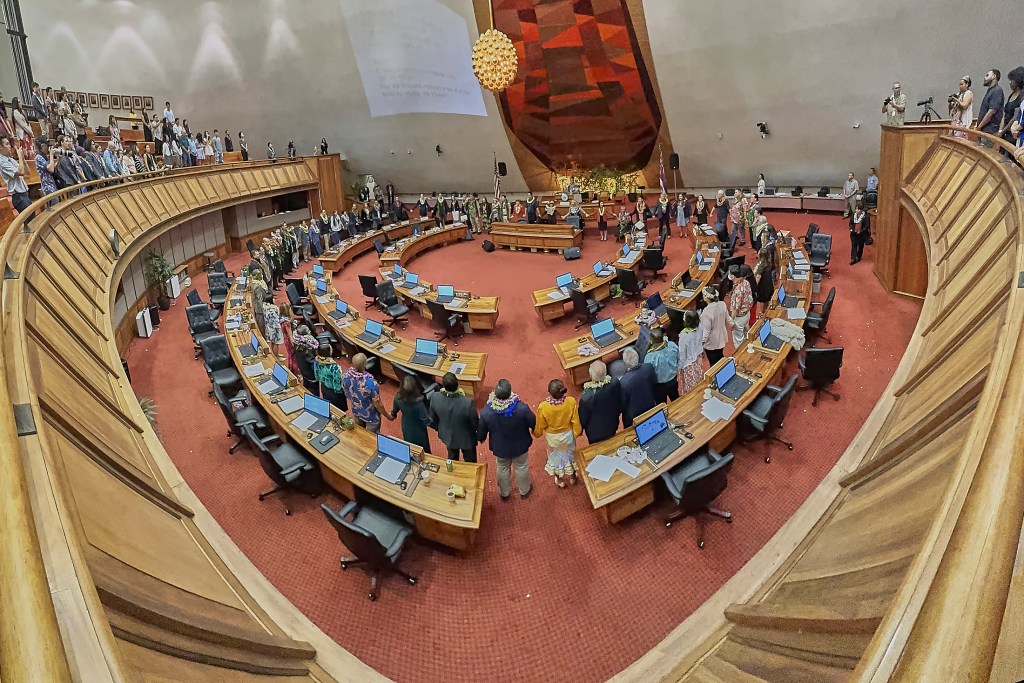
The Hawaiʻi Legislature’s practice of introducing mostly blank placeholder bills and then transforming them into substantive measures mid-session is unconstitutional, the League of Women Voters of Hawaiʻi says in a new lawsuit.
The suit, filed last week, specifically targets Senate Bill 935, which reduces pensions for future Hawaiʻi judges. It was signed into law by Gov. Josh Green on July 3.
SB 935 started out with the innocuous title, “Relating to Government.”
It turned into a lengthy proposal from Sen. Donovan Dela Cruz to reduce the pensions of judges hired after 2030.
It was one of 124 so-called “short-form” bills introduced last session. The suit argues that practice violates the section of the state constitution that states, “Each law shall embrace but one subject, which shall be expressed in the title.”

The intent of the suit is not so much to overturn SB 935 as it is to prohibit legislators from introducing short-form bills in future sessions, according to Judith Mills Wong, president of the League of Woman Voters of Hawaiʻi.
“It doesn’t give the public access to information in a timely manner so that they could be fully informed and provide testimony either supporting or opposing the bill,” Wong said in an interview.
‘They Can Just Slip By Us’
The deadline to introduce bills was Jan. 23, but the explicit version of SB 935 didn’t emerge until Feb. 18. And even though the bill still received committee hearings after it was reconstituted, the mid-session metamorphosis makes it more difficult to track, she said.
“What we do, and other organizations do, is we’re very active before that deadline, tracking the bills that are coming up to see what we want to testify on,” Wong said. “And without that information, things can get just kind of slip through the sieve.”
“We would prefer that it be done in the way the constitution describes,” she said. “It standardizes how the public, including organizations like ours, look at bills and know that they’re coming up. The whole legislative process is just a race from start to finish, and if we don’t track the bills, they can just slip by us without us knowing.”

Such was the case with two other short-form bills last session related to gambling.
In early February, Senate Bill 893 was an empty shell titled “Relating to the Economy.” An email announcing that it was now a measure pushed by Sen. Glenn Wakai to grant 20-year licenses for casinos in two Oʻahu areas appeared in Civil Beat’s inbox less than an hour before a public hearing was scheduled on the bill.
Another short-form bill, Senate Bill 891, was converted into a proposal to create a Gaming Working Group within the Department of Business, Economic Development and Tourism to “develop a comprehensive gaming policy framework” for the state.
Those bills completely took the League of Women Voters by surprise, Wong said.
“We were tracking a bunch of other things,” she said. “Someone from another group called me and said, ‘Have you seen this?’ That’s what happens when you use these bills that have no description and no guts. They can make it through the process without coming to the attention of groups that actually have an opinion and would like to testify on them.”

Short-Form Bills Ballooned Last Session
Legislative leaders, including Dela Cruz, Senate President Ron Kouchi and House Speaker Nadine Nakamura, did not respond to requests for comments about the lawsuit.
Dela Cruz did write a lengthy defense of SB 935 in a June 25 email.
And when she was still majority leader in 2024, Nakamura spoke glowingly about the process to Civil Beat’s Chad Blair.
“A short-form bill outlines its purpose broadly,” she said of almost blank measures with titles like “Relating to Government.”
“Amendments require committee approval, and the bill, after a floor vote, is recommitted for a public hearing,” Nakamura said then.
Legislators have said that short-form bills provide options for lawmakers to respond to unforeseen circumstances during sessions, but Wong said that hardly applies to either the gambling bills or the suit’s specific target, SB 935.
“Let’s take a look at this particular bill,” Wong said. “It is a bill about retirement calculations. It is something like 30 pages long, in incredible detail that did not spring to life overnight. It was not an emergency.”
The two organizations teamed up with Common Cause Hawaiʻi in 2018 to challenge what was then a similar longstanding practice of the Legislature — gutting bills mid-session and replacing them with sometimes entirely different measures.
The number of short-form bills introduced in the House ballooned from 36 in 2024 to 78 in 2025, Nakamura’s first year as speaker. In the Senate, the number rose from 29 to 46.
Wong said increased use of short forms was one reason the League of Women Voters chose to challenge the practice in court with the assistance of the Public First Law Center.
The two organizations teamed up with Common Cause Hawaiʻi in 2018 to challenge what was then a similar longstanding practice of the Legislature — gutting bills mid-session and replacing them with sometimes entirely different measures.
At the time, those dramatically altered bills didn’t even have to go back through the public hearing process.
Three years later, the Hawaiʻi Supreme Court ruled in the plaintiffs’ favor, prohibiting the gut-and-replace practice.
After the ruling, then-Common Cause executive director Sandy Ma said it was a message to the Legislature identical to what Wong is saying now:
“Just follow the constitution.”
Read the lawsuit:
 Sign up for our FREE morning newsletter and face each day more informed.
Read this next:

Local reporting when you need it most
Support timely, accurate, independent journalism.
Honolulu Civil Beat is a nonprofit organization, and your donation helps us produce local reporting that serves all of Hawaii.
ContributeAbout the Author