Kirstin Downey: This Trio Helped Unlock The History Of Polynesian Voyaging
Building on their work with Yosihiko Sinoto a half-century ago, the archaeologists have reunited at Bishop Museum.
October 10, 2025 · 6 min read

About the Author
Fifty years ago, a team of young archaeologists from Bishop Museum began traveling together to Tahiti to participate in excavations that would open a window into the breathtaking extent of Polynesian ocean voyaging in the past.
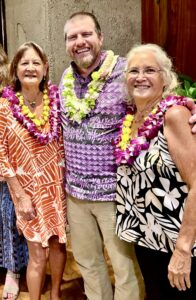
Today, three of those scientists, all now retirees, are back at the museum, volunteering as a team to reexamine and advance their work, which included making some of the biggest discoveries of Southern Pacific history.
They are sorting through binders of the original data, digitizing the records of their finds, making sure the information is properly recorded as a starting point for future work. And they are planning a publication that will explain the significance of what they found.
Toni Han-Palermo, Elaine Muffet Jourdane and Eric Komori were all proteges of Hawaiʻi’s world-renowned anthropologist Yosihiko Sinoto, one of the early pioneers of Polynesian archaeology. An anthropologist at Bishop Musuem, Sinoto combed historic sites and excavated lost artifacts throughout the region. His work took him to islands all over the Pacific, but Sinoto eventually became particularly widely revered in Tahiti.

Ideas showcases stories, opinion and analysis about Hawaiʻi, from the state’s sharpest thinkers, to stretch our collective thinking about a problem or an issue. Email news@civilbeat.org to submit an idea or an essay.
In the 1970s and 1980s, the trio served as Sinoto’s assistants on Huahine, a picturesque island located about 110 miles by sea from Papeete, the capital city of French Polynesia and the site of many of the archaeologists’ most important discoveries.
They found some 5,000 artifacts, including adzes, fishhooks, weapons and ornaments, but their most famous discovery was the buried remains of a 65-foot Polynesian voyaging canoe, along with the finished tools that would have accompanied voyagers when they set out on a long sea journey.
Planks from the vessel, a 12-foot steering paddle and a 35-foot mast had survived under swampy soil, possibly left behind when a massive tsunami swept the area, destroyed the villages and broke up the web of human life. That may explain why so many valuable items were left behind, spread across the surrounding landscape, preserved in the sandy mud.
A Boost To Building Replicas
This discovery helped provide evidence of what the Polynesian voyaging canoes actually looked like, information that was instrumental in helping others design canoes like the Hōkūleʻa, the vessel that has traveled the world as an emissary of Hawaiian culture.
Artist Herb Kane began painting ancient canoes based on drawings from European explorers. He also visited Huahine to meet with Sinoto and his students, seeking more information about canoe construction in the past from genuine surviving evidence.
The remains of the canoe at Huahine were uncovered when workers were building a tennis court at the Hotel Bali Hai. Workers had discarded some of the material by the time the archaeologists rushed to the scene, but many important sections and fragments were found and later excavated and preserved.
The archaeologists had hit the jackpot.
“Everywhere the backhoe went, artifacts were being exposed,” Han-Palermo recalled.
The work at Bishop Museum formed part of a wave of new knowledge about the history of Hawaiʻi and all Polynesia that reshaped thinking about the time.
Now the once-young archaeologists are racing against time to properly record all that was found before they run out of time themselves.
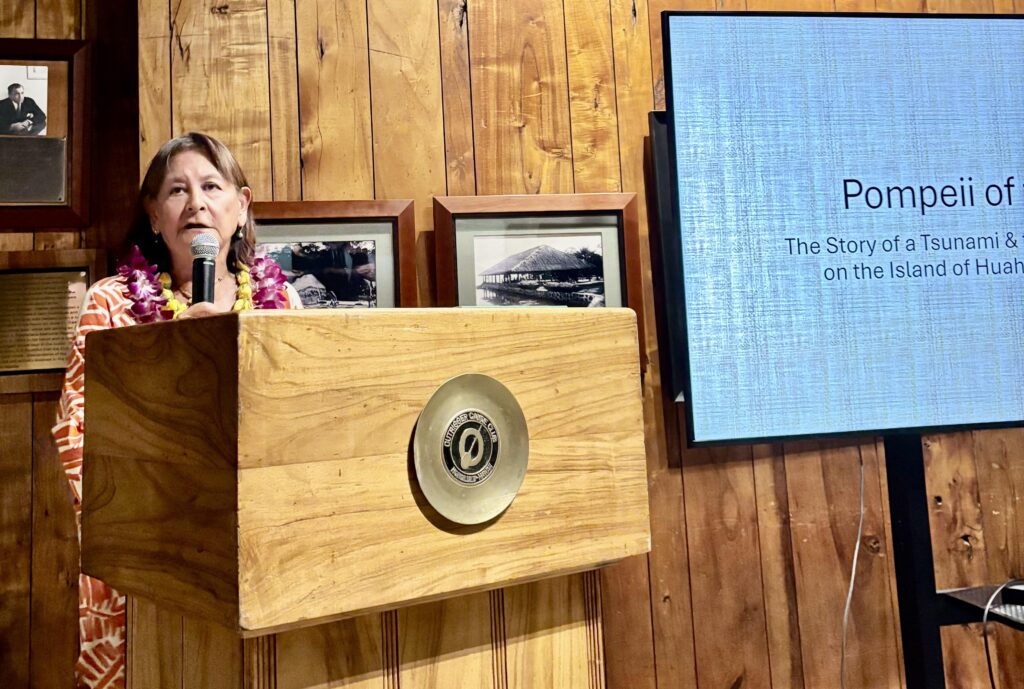
“We’re retired, and we’re back at the museum, and what do you know, we came back full circle,” Han-Palermo said recently, while giving a talk at the Outrigger Canoe Club in Waikīkī, where I had a chance to speak with her.
Their experiences at Huahine were a highlight of their professional and personal lives, Han-Palermo told the group, describing the heady era of those adventuring days, spending long hours digging in muddy trenches but filled with the excitement of possible discovery.
It wasn’t easy, living in villages without electricity, television or air conditioning and where the supply ship arrived only once a week, but they were infused with enthusiasm for the work, aware that they were playing a role in rewriting the known history of the world.
Many Trips To Huahine
Sinoto died in 2017. His remarkable life has been chronicled in at least two books, “Curve of the Hook: Yosihiko Sinoto, an Archaeologist in Polynesia,” published first in Japanese in 1994, and in an English translation in 2016. “Huahine, Island of the Lost Canoe” was published in 2005.
Sinoto’s work for Bishop Museum is highlighted at Tahiti’s national museum in Papeete.
A fluent speaker of Tahitian, Sinoto was visiting Huahine, engaged in preservation work and excavation, when he made his first major find. Workers reconstructing a traditional meeting house uncovered an unusual object and brought it to him. Sinoto recognized it as a hand club made of whalebone — an object that had previously been found only in New Zealand. This fact indicated that either the object itself or this kind of object was being transported across Polynesia from early days, with cross-oceanic travel likely a regular occurrence.
Sinoto and teams of co-workers from Honolulu traveled to Huahine three months each year for more than a decade, working on excavating, recovering objects and recording them. Then they would return to Hawaiʻi to their regular work at the Bishop Museum. Sinoto was employed there for more than 60 years, until he retired in 2013.
Han-Palermo, Muffet Jourdane and Komori worked at the museum for a combined 100 years themselves, in collaboration with Sinoto. Han-Palermo became the museum’s collections manager and Muffet Jourdane later held the same job.
But Bishop Museum, perennially cash-strapped, couldn’t offer much in the way of pay and benefits, and all three eventually left for more sustaining jobs elsewhere by becoming state employees. Han-Palermo worked at the Department of Land and Natural Resources and later in the Judiciary Department. Muffet Jourdane and Komori went to work for the State Historic Preservation Division and later did private archaeological consulting work.
In retirement, though, they have reunited.
And for Han-Palermo, this offers a chance to return once again to Huahine, which she plans to soon visit for several weeks. There is still work left to be done there, on an island that has been called the “Pompeii of the Pacific.”
“Huahine is a very special place,” she said.
 Sign up for our FREE morning newsletter and face each day more informed.

Local reporting when you need it most
Support timely, accurate, independent journalism.
Honolulu Civil Beat is a nonprofit organization, and your donation helps us produce local reporting that serves all of Hawaii.
ContributeAbout the Author