What Happens In The Brain When People Grow Up Speaking Hawaiian And English?
Most research focuses on global languages like English, French or Chinese. Hawaiian voices have largely been left out.
October 10, 2025 · 3 min read

About the Author

More than 40 years ago, our kūpuna and community leaders fought to bring ʻōlelo Hawaiʻi back to life. They dreamed that our language would once again be spoken in homes, schools and classrooms.
Today, that dream is alive in our keiki who grow up bilingual in Hawaiian and English.
But while Hawaiian is strong in our communities, there is one place it has not yet fully reached: the world of neuroscience.

Ideas showcases stories, opinion and analysis about Hawaiʻi, from the state’s sharpest thinkers, to stretch our collective thinking about a problem or an issue. Email news@civilbeat.org to submit an idea or an essay.
Around the globe, researchers study how bilingualism shapes the brain. They measure how language learning changes memory, attention and even how our brains age.
The problem is that almost all this research focuses on global languages like English, French or Chinese. Hawaiian voices have largely been left out.
Each language interacts with the brain in unique ways. Without Hawaiian, we are missing a critical part of the story of what it means to be bilingual, and we lose the opportunity to show how Hawaiian strengthens both minds and identities.
That is what my work hopes to change.
I grew up at Pūnana Leo o Kawaiahaʻo, attended Punahou and Princeton, and I am now a Ph.D. student at the University of Hawaiʻi Mānoa. My research looks at what happens in the brain when people grow up bilingual in Hawaiian and English.
With a team from linguistics, psychology and the medical school, I’m using MRI to see how Hawaiian-English bilinguals process language. Our goal is not only to better understand the science of bilingualism, but also to put Hawaiian into the same global conversation that already includes other languages.
Why does this matter for Hawaiʻi? Because language is inseparable from identity.
When Hawaiian is included in neuroscience research, it affirms that ʻōlelo Hawaiʻi is more than a symbol. It carries a worldview that is uniquely ours. By placing Hawaiian in the center of this research, we send a clear message: Hawaiian belongs in every conversation, be it cultural, political and scientific.
Language is inseparable from identity.
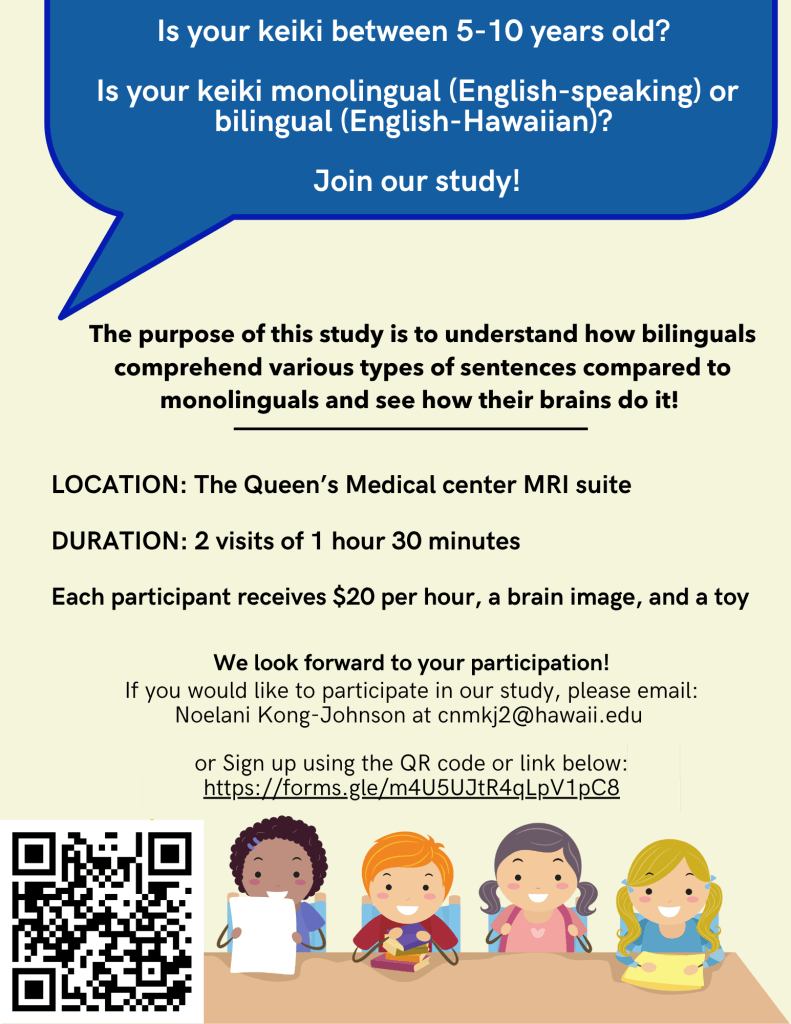
But this work depends on participation. We are looking for adults (ages 18-45) who began speaking Hawaiian before age 6, and keiki (ages 5-10) who are growing up speaking Hawaiian. Participants are compensated for their time, and keiki receive a small toy.
More importantly, every participant helps ensure that Hawaiian is seen, heard and valued in a global space where it has long been missing.
Our kūpuna revived ʻōlelo Hawaiʻi so it could thrive again in daily life. Now we have the chance to show how it also thrives in the mind. If you’re interested, please reach out to me at cnmkj2@hawaii.edu.
This research is for Hawaiʻi, and it can only move forward with our community.
 Sign up for our FREE morning newsletter and face each day more informed.
Community Voices aims to encourage broad discussion on many topics of community interest. It’s kind of a cross between Letters to the Editor and op-eds. This is your space to talk about important issues or interesting people who are making a difference in our world. Column lengths should be no more than 800 words and we need a photo of the author and a bio. We welcome video commentary and other multimedia formats. Send to news@civilbeat.org. The opinions and information expressed in Community Voices are solely those of the authors and not Civil Beat.

Local reporting when you need it most
Support timely, accurate, independent journalism.
Honolulu Civil Beat is a nonprofit organization, and your donation helps us produce local reporting that serves all of Hawaii.
ContributeAbout the Author