Will Bailey: What The Administration's New Warrior Mentality Really Means
The federal government shutdown is an unmistakable command to obey or face the consequences.
October 7, 2025 · 6 min read


About the Author

He spoke like a preacher, not a secretary of defense.
A man built for the camera, shoulders square, voice tuned to the cadence of prime-time outrage.
The lighting could’ve been straight from Pete Hegseth’s former Fox News set: flags behind him, applause cued on time, but the brass wasn’t smiling.
The hall was filled with career officers and the most senior NCOs — serious, hard men and women who had seen enough to know theater when they heard it.
They did not seem impressed.
You could feel the air tighten as Hegseth spoke. Every sentence landed like a commandment, as if disagreement itself were a kind of weakness.
He promised to restore discipline and purity to a country gone soft. He called it strength. But the sermon sounded more like warning, a gospel of obedience dressed as patriotism.

Ideas showcases stories, opinion and analysis about Hawaiʻi, from the state’s sharpest thinkers, to stretch our collective thinking about a problem or an issue. Email news@civilbeat.org to submit an idea or an essay.
The Sermon’s True Message
Days later, the government shut down.
Across the mainland, the consequences fell unevenly. WIC offices started to run out of vouchers. Clinics turned away patients when reimbursements froze. Public health labs went dark.
The same administration that claimed to protect America’s families had, overnight, cut off the air to the most fragile ones.
This wasn’t about budgets. It was about belief. Blue states and Democratic cities were in the crosshairs, places that still treat cooperation as strength and pluralism as duty.

The punishment was furloughed nurses, unpaid inspectors, closed doors. The creed of obedience had become governance by neglect.
A nation built on service now tests who can hold their breath the longest. Families who did everything right — filed their forms, showed up to work, followed the rules — are learning what happens when loyalty is measured in silence, not duty.
Islands In The Crosshairs
Honolulu might feel far from that fight, but the same veins run through us.
Federal health grants keep our rural clinics open. FEMA money rebuilds our roads after storms. Veterans’ care, food programs and housing vouchers all flow from the same federal hand now clenched into a fist.
If the shutdown drags on, Hawaiʻi’s federally qualified health centers lose Medicaid reimbursements and HRSA grant support.
WIC offices ration infant formula. SNAP recipients watch benefits stall at the end of a card’s balance.
VA clinics on Oʻahu and in Hilo trim schedules while veterans wait on travel pay and prescriptions.
Head Start classrooms send kids home.
That’s how a sermon preached in Washington reaches a waiting room in Kaʻū, a pantry in Puna, a classroom in Waiʻanae.
That’s how national theater becomes local hunger.
Honolulu will become one of the next test sites. Not with troops on the street — not yet — but through the slow starving of the systems that hold us together.
When the territory was governed from afar, when martial law replaced trust, when distant voices decided who could gather, speak or organize — those were lessons in discipline, too. And the islands learned what every empire forgets: Order without empathy always turns brittle.
The difference now is the branding.
This creed sells itself as restoration — a promise to make the nation “strong” again by demanding uniformity.
But obedience isn’t strength. It’s surrender.
And Hawaiʻi knows what surrender feels like. We also know what follows: the quiet rebuilding, the slow return of trust, the people who hold the line between command and conscience.
Strength Without Spectacle
Out here, strength looks different.
You feel it most in the hush that follows bad news — the pause before people decide what to do next.
Someone makes a call. Someone answers. The current moves. No banners, no broadcast — just the quiet circuitry of care.
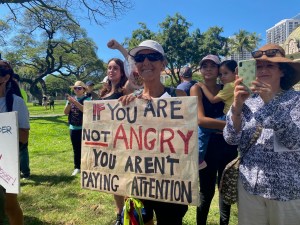
That’s what keeps this place alive: the reflex to reach out when systems seize up, the instinct to protect what’s human before it’s ordered from above. It’s not work or heroism. It’s memory, the kind learned from storms and scarcity, from generations who already knew how to improvise when distant powers stalled.
They want silence to sound like order. But Hawaiʻi has lived long enough to know the difference between quiet and peace.
If this new gospel of obedience keeps spreading, Honolulu will become one of the next test sites. Not with troops on the street — not yet — but through budgets, contracts and compliance forms.
Through the slow starving of the systems that hold us together.
And because this is an islands story, the delays ripple wider. A barge held at the dock means the hard hats wait, tools idle, another project paused until Washington remembers to sign the check.
The arithmetic of distance multiplies every federal pause.
When Silence Pretends To Be Peace
We’ve outlasted louder empires.
We remember what it felt like when power spoke for us instead of to us — when the measure of a citizen was obedience, not conscience.
We also remember who kept us human anyway. Real discipline isn’t submission. It’s conscience held steady under pressure. It’s service that doesn’t need permission.
So when the sermon comes again — when the voice on the mainland tells us to obey, to tighten, to wait — we can answer in our own language: We’ve heard that gospel before. We choose another.
And that choice still belongs to us in how we listen, how we speak, how we refuse to mistake silence for peace.
Because the test of strength isn’t who can follow orders. It’s who still knows right from wrong when the orders stop.
That’s the strength that built this country, and it’s the one that might still save it.
 Sign up for our FREE morning newsletter and face each day more informed.
Read this next:

Local reporting when you need it most
Support timely, accurate, independent journalism.
Honolulu Civil Beat is a nonprofit organization, and your donation helps us produce local reporting that serves all of Hawaii.
ContributeAbout the Author