Denby Fawcett: Hawaiʻi Author-Filmmaker Tom Coffman Dies At 83
In words and images, he examined the issues of social justice in a powerful way.
December 30, 2025 · 10 min read


About the Author

Tom Coffman was a news reporter before he became an important author and award-winning filmmaker. He brought to all his work a journalistic respect for facts, fairness and the excitement of telling a previously untold story.
He was the author of six books and more than 10 documentary films, many of them widely viewed broadcasts on PBS Hawaiʻi.
After a brief illness, Coffman died Dec. 15 at his home on the bluffs overlooking Kāneʻohe Bay with Lois U.H. Lee, his wife of 50 years, and his children close by his side.
I knew him as a fellow news reporter, a kind man with a generous personality, always ready to help others even when he had dozens of his own projects in the works.
People liked him because he made them feel important and heard.

Ideas showcases stories, opinion and analysis about Hawaiʻi, from the state’s sharpest thinkers, to stretch our collective thinking about a problem or an issue. Email news@civilbeat.org to submit an idea or an essay.
“He was always pondering, ruminating, never set in his ideas; he was always interested in hearing my perspective. He was a great listener,” said Coffman’s friend Tom Peek, a novelist with whom he spent time in Volcano on Hawaiʻi island, where they hiked through groves of fern and lehua and drank Irish whiskey in Peekʻs cottage in the rainforest.
What I remember most about Coffman besides his compassion was his intensity as a news reporter. He never let go of a story he cared about and it wasn’t just political news. He was deeply concerned about the disappearance of Hawaiʻiʻs natural landscapes to housing and commercial developments.
‘He Saw Things As They Were’
In May 1973, in a last-ditch effort to get then-Gov. John A. Burns to stop the bulldozers already filling up Oʻahu’s Salt Lake to make a golf course, Coffman got together a photographer, a bird watcher and a contractor who opposed the project to row a boat out onto the lake to take photos of native Hawaiian birds — some of them endangered — and minnows and shrimp to emphasize in a news story that wildlife was still thriving in the lake even though its waters had been polluted by past users.
But it was too late. Developer Clarence T.C. Ching had convinced the governor and other state officials it was too costly to dredge and clean up the lake, that it was better suited for golf links to enhance the surrounding high-rise buildings Ching was helping develop.
Coffmanʻs friends were amazed by the depth of his sensitivity for Hawaiʻi knowing he came from a landlocked place so different from the islands.

“Here is this guy from Kansas who landed in Honolulu,” said artist and filmmaker Meleanna Meyer. “He embraced the people. He had such a connection and appreciation for everything and everybody here, The Hawaiian community loved him. He was deeply respected. He understood the real issues not just of Hawaiians but Japanese, Koreans and Filipinos. He saw things as they were.“
Meyer knew Coffman for more than 30 years, most recently working as his co-producer on the 2020 documentary “Mauna Kea: Sacred Conduct/Sacred Mountain.”
Coffman had been fascinated by Hawaiʻi since he was young boy growing up in the small town of Lyndon in Osage County, Kansas.
Lois Lee said he told her that when he was 4 years old he looked out of the window of the family’s two-story house one morning to see a woman floating up the front stairs in a long, flowing muʻumuʻu and thought, “What in the world is this?”
“That did it for him. He loved Hawaiʻi,” said Lee.
In a newspaper interview, Coffman remembered the day: “My dad was in Hawaiʻi during the war and taken into the home of a Hawaiian family. And these brown-skinned Hawaiians showed up at our home in Kansas, when I was 4 years old, and I was enveloped into these warm hugs and flowing muʻumuʻus. I grew up with my little aloha shirts and a coconut that my father had mailed to me. I still have it with all the stamps affixed to it! As soon as I left the William Allen White School of Journalism (at the University of Kansas), I headed to Hawaiʻi.”
After a brief stint as a wire service reporter in New Mexico, Coffman arrived in Hawaiʻi in December 1965 to work as a state government reporter at the Honolulu Advertiser. He was making so little money the Advertiser’s managing editor, Buck Buchwach, had to loan him $600 for his plane ticket to Honolulu.
After two years at the Advertiser, Coffman became a political editor for the Honolulu Star-Bulletin.
‘No One Else Has Written Anything Close To It’
In 1972, he wrote “Catch a Wave: A Case Study of Hawaii’s New Politics,” a book that analyzed how John A. Burns used the relatively new medium of television advertising combined with old-fashioned door-to-door canvassing to face down his Democratic Party primary opponent, Tom Gill, and defeat general election Republican challenger Samuel P. King, to win a third term as governor.
“Catch a Wave” sold 5,000 copies the first week it was in print. Coffman had produced a well-researched yet reader-friendly book to describe to general audiences for perhaps the first time the day-by-day nuts and bolts of a modern political campaign in Hawaiʻi.
“’Catch a Wave’ remains the single best book about about any Hawaiʻi political campaign. No one else has written anything close to it,” said retired political science professor and Civil Beat columnist Neal Milner.
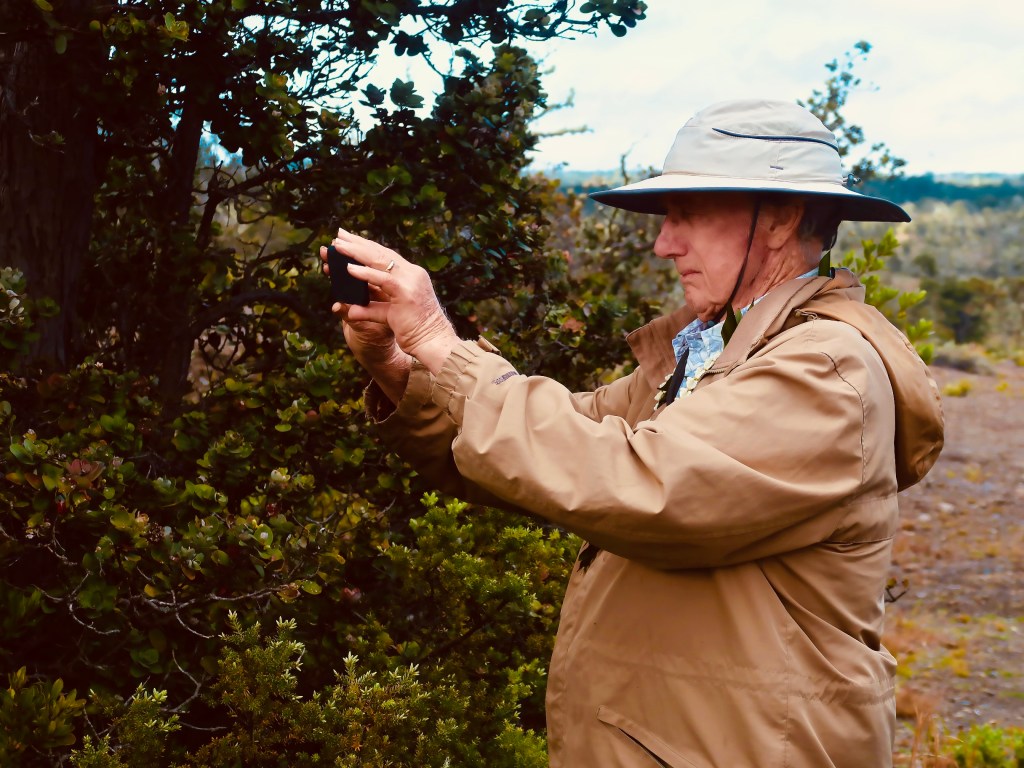
After the success of the book, Coffman left daily deadline demands of the news business to become an independent writer and researcher, producing more books and for the first time getting into filmmaking.
“One thing led to another. I got into video production when it became affordable, My opening into video production was the era of digitalization. … I could do what was (previously only) done in an enormously expensive studio. The more I perfected my tools, I could do everything on a desktop,” he explained in an interview with Hawaii Business Magazine.
He applied the same skills he had honed as a news reporter to filmmaking, producing a string of documentaries year after year such as “O Hawaiʻi: Of Hawaiʻi From Settlement to Kingdom,” “Nation Within: The History of the American Occupation of Hawaiʻi,” “May Earth Live: A Journey through the Native Hawaiian Forest,” “Gabare: Donʻt Give Up,” about the experiences of Japanese Americans in the early years of World War II, “Arirang: the Korean American Journey,” and “Ninoy Aquino & the Rise of People Power.”
“His personal politics did not affect his relationships with people he called for information. He could talk as easily to a business leader in downtown Honolulu as Native Hawaiian activist Walter Ritte of Hoʻolehua, Molokaʻi,” said Craig Howes, director of the University of Hawaiʻi Center for Biographical Research.
Howes said people trusted Coffman because he was fair, applying the same resposibility and ethics of news reporting to every project he embraced.
“Tom Coffman was one of the first haole writers to take a modern Native Hawaiian scholar seriously and insert her writing and scholarship into his own work.”
Jon Kamakawiwoʻole Osorio
What made Coffman unique was his ability to connect what was going in Hawaiʻi to larger events in American history, including American imperialism of the 19th century and racism. He gave his audiences new information about events they thought they already understood.
“Tom was a complex thinker. Most people have a few resources to draw from but he could think across time and space. He was curious about anything and everything,” said publisher Maile Meyer, the founder of Nā Mea Hawaiʻi.
The treatment of Japanese Americans during World War II fascinated Coffman, a subject many have written about before, focusing on the racism and the bravery of Hawaiʻiʻs Japanese American soldiers fighting in the war when Japanese families on the mainland were being locked up in internment camps.
Coffman descibed the same period of racial hysteria in a different way. He focused on an enigma many have never fully grasped: why after the Pearl Harbor attack Hawaiʻi’s Japanese residents did not suffer the same mass incarcerations.
The short answer was their labor was needed for the war effort, but Coffman drew a more fascinating and nuanced explanation in his book “Inclusion: How Hawaii Protected Japanese Americans from Mass Internment, Transformed Itself and Changed America.”
He described how a small interracial commitee of Honolulu community leaders successfully made clear to military officials, the FBI and political leaders on the continent that Hawaiʻi’s American Japanese were loyal to the country and could be counted on to serve at home and on the battlefields of Europe.
Interestingly, the group called the Council for Interracial Unity began its effort as early as 1939, anticipating then the Empire of Japan would eventually attack the islands. When it happened, they were ready to protect Hawaiʻi’s Japanese.
Honored Native Hawaiian Viewpoint
In Coffmanʻs book and film: “Nation Within: The History of Americaʻs Occupation of Hawaiʻi,” he highlighted scholar Noenoe Silvaʻs discovery that rather than passively accepting annexation, thousands of Hawaiians in 1897 had signed petitions to make it clear they did not want to become part of the United States.
In research for her doctoral dissertation, Silva had been astounded to see the name of her great-great-great-grandmother on one of the 1897 anti-annexation petitions she uncovered in a box in the National Archives in Washington, D.C.
She said the sight of so many Hawaiian names on different petition documents was a stunning refutation of the prevailing view that annexation was widely accepted, inevitable.

Silva rightfully pointed out that the petitions were enormously important, giving Native Hawaiians who saw their ancestors’ names on them a sense of urgency they might not have had before to be politically active in the modern Hawaiian sovereignty movement.
“Tom Coffman was one of the first haole writers to take a modern Native Hawaiian scholar seriously and insert her writing and scholarship into his own work,” said Jon Kamakawiwoʻole Osorio, dean of the Hawaiʻinuiākea School of Hawaiian Knowledge.
Osorio said that although Coffman was a public figure he was a humble person who shunned personal acclaim, insisting instead on drawing attention to the people he wrote about: “The afflicted, the dispossessed, the unjustly accused and disparaged.”
Coffman was noted for his hard work, never stopping. Sometimes writing books and producing films simultaneously.
“For example, ‘Nation Within,’ both a film and a book, took a total of 19 months to complete. I never worked so hard in my life, but I was determined to get it out before the 1998 observance of annexation, and I did,” Coffman said in an interview with Hawaii Business Magazine.
Joy Chong-Stannard, who edited and helped direct many of his films including “Nation Within,” called Coffman “a dogged researcher. He wrote so many books, so many articles and produced so many documentaries. It was like he never rested.”
“He was on a mission,” said Osorio.
It is unlikely anyone will emerge soon with Coffmanʻs singular focus and powerful sense of mission.
“This tall, pale Kansan was wedded to the islands like no other mainland haole I know,” said news reporter and colleague David Butwin.
 Sign up for our FREE morning newsletter and face each day more informed.
Read this next:

Local reporting when you need it most
Support timely, accurate, independent journalism.
Honolulu Civil Beat is a nonprofit organization, and your donation helps us produce local reporting that serves all of Hawaii.
ContributeAbout the Author