How The First Amendment Protects Americans' Speech — And How It Does Not
The law makes a few exceptions to its protection of free speech — not liking what you hear isn’t one of them.
December 21, 2025 · 7 min read

About the Author
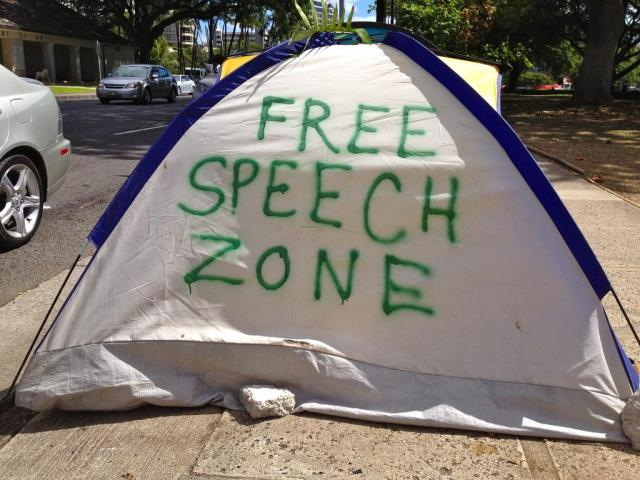
Imagine a protest outside the funeral of a popular political leader, with some of the protesters celebrating the death and holding signs that say things like “God Hates the USA/Thank God for 9/11,” “America is Doomed” and “Don’t Pray for the USA.”
No matter the political leanings of that leader, most Americans would probably abhor such a protest and those signs.
What would tolerate such activities, no matter how distasteful? The First Amendment.
The situation described above is taken from an actual protest, though it did not involve the funeral of a political figure. Instead, members of the Westboro Baptist Church protested outside the funeral of Marine Lance Cpl. Matthew Snyder, a U.S. service member killed in Iraq.
Through demonstrations like this, members of this group were conveying their belief that the U.S. is overly tolerant of those they perceive as sinners, especially people from the LGBTQ community, and that the death of U.S. soldiers should be recognized as divine retribution for such sinfulness.
Snyder’s family sued for intentional infliction of emotional distress, among other claims. A jury issued a US$5 million jury award in favor of the family of the deceased service member. But in a nearly unanimous decision issued in 2011, the U.S. Supreme Court found that the First Amendment insulated the protesters from such a judgment.
This holding is particularly instructive today.
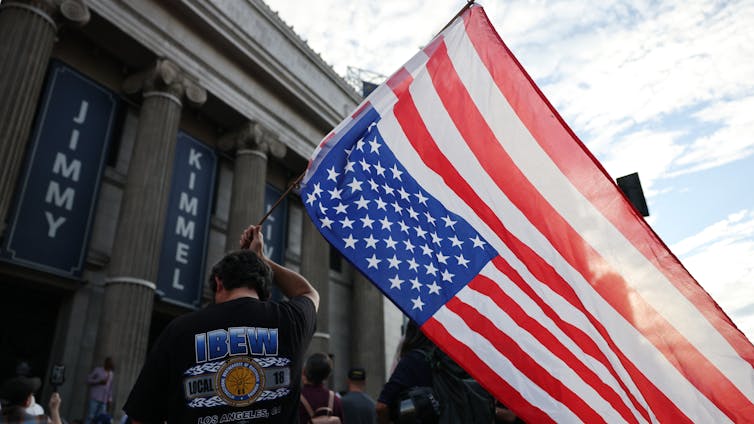
The Trump administration has vowed to crack down on what it calls hate speech. It has labeled antifa, a loosely organized anti-fascist group, a terrorist organization. And it has sought to punish figures such as TV host Jimmy Kimmel for statements perceived critical of conservative activists.
What the First Amendment makes clear is that it does not just protect the rights of speakers who say things with which Americans agree. Or, as the Supreme Court said in a separate decision it issued one year after the case involving the funeral protesters: “The Nation well knows that one of the costs of the First Amendment is that it protects the speech we detest as well as the speech we embrace.”
But free speech is not absolute. As a legal scholar who has studied political movements, free speech and privacy, I realize the government can regulate speech through what are known as “reasonable time, place, and manner” restrictions. These limits cannot depend upon the content of the speech or expressive conduct in which a speaker is engaged, however.
For example, the government can ban campfires in an area prone to wildfires. But if it banned the burning of the U.S. flag only as a form of political protest, that would be an unconstitutional restriction on speech.
Protected And Unprotected Speech
There are certain categories of speech that are not entitled to First Amendment protection. They include incitement to violence, obscenity, defamation and what are considered “true threats.”
When, for example, someone posts threats on social media with reckless disregard for whether they will instill legitimate fear in their target, such posts are not a protected form of speech. Similarly, burning a cross on someone’s property as a means of striking terror in them such that they fear bodily harm also represents this kind of true threat.
There are also violations of the law that are sometimes prosecuted as “hate crimes,” criminal acts driven by some discriminatory motive. In these cases, it’s generally not the perpetrator’s beliefs that are punished but the fact that they act on them and engage in some other form of criminal conduct, as when someone physically assaults their victim based on that victim’s race or religion. Such motives can increase the punishment people receive for the underlying criminal conduct.
Speech that enjoys the strongest free-speech protections is that which is critical of government policies and leaders. As the Supreme Court said in 1966, “There is practically universal agreement that a major purpose of (the First) Amendment was to protect the free discussion of governmental affairs.”
As the late Justice Antonin Scalia would explain in 2003, “The right to criticize the government” is at “the heart of what the First Amendment is meant to protect.”
Restrictions On Government Action
The First Amendment prevents the government from taking direct action to curtail speech by, for example, trying to prevent the publication of material critical of it. Americans witnessed this in the Pentagon Papers case, where the Supreme Court ruled that the government could not prevent newspapers from publishing a leaked – and politically damaging – study on U.S. military involvement in Vietnam.
But it also applies when the government acts in indirect ways, such as threatening to investigate a media company or cutting funding for a university based on politically disfavored action or inaction.
In 2024 the Supreme Court ruled unanimously that the state of New York’s efforts to punish companies that did business with the National Rifle Association because of the organization’s political positions violated the group’s First Amendment rights.
Similarly, in recent months, courts have ruled on First Amendment grounds against Trump administration efforts to punish law firms or to withhold funds from Harvard University. and a federal court in Florida threw out a lawsuit filed by President Trump against The New York Times seeking $15 billion for alleged harm to the president’s investments and reputation.
Nevertheless, some people fear government retribution for criticizing the administration. And some, like the TV network ABC, have engaged in speech-restricting action on their own, such as taking Kimmel temporarily off the air for his comments critical of conservative activists in the wake of Charlie Kirk’s killing.
Before Kimmel’s suspension, Federal Communications Commission Chairman Brendan Carr described his negotiations with ABC’s parent company, Disney, to take action against him. “We could do this the easy way or the hard way,” Carr said. And Trump said that some media companies might “lose their license” for criticizing the president. It is encouraging that, in the face of these threats, ABC reversed course and agreed to put Kimmel back on the air.

The First Amendment protects speech across the political spectrum, even speech Americans do not like. Both liberal comedian Jon Stewart and conservative commentator Tucker Carlson have recently agreed on this. As Carlson said recently, “If they can tell you what to say, they’re telling you what to think. … There is nothing they can’t do to you because they don’t consider you human.”
Just last year in the NRA case referenced above, the Supreme Court clearly stated that even indirect government efforts to curtail protected speech are indeed unconstitutional. In light of that ruling, efforts to limit criticism of the administration, any administration, should give all Americans, regardless of their political views, great pause.
This article is republished from The Conversation under a Creative Commons license. Read the original article.
 Sign up for our FREE morning newsletter and face each day more informed.
Read this next:
Local reporting when you need it most
Support timely, accurate, independent journalism.
Honolulu Civil Beat is a nonprofit organization, and your donation helps us produce local reporting that serves all of Hawaii.
ContributeAbout the Author