Neal Milner: Judge Seniors For What We Can Do, Not For What We Can't
Too many people only see the aging population as sick or incapacitated. That’s not the whole story.
December 11, 2025 · 6 min read


About the Author

It’s almost New Year’s, time to ring out the old and ring in the new. Except that famous phrase has it backwards.
Actually, we need to ring in the old because they’re the ones ringing in the new all the time.
Old folks are the real risk-takers, boundary-crossers and adventurers. It’s the young who are enfeebled.
Typically, people who aren’t old see seniors in terms of their infirmities and incapacities. The lame, the halt, and the blind.
That health-above-everything-else view is so one-dimensional. There is so much else to an older person’s life besides how well she walks, how clearly he sees, or how acute her hearing is.

Ideas showcases stories, opinion and analysis about Hawaiʻi, from the state’s sharpest thinkers, to stretch our collective thinking about a problem or an issue. Email news@civilbeat.org to submit an idea or an essay.
But enough cranky criticism. I want to focus on the bright side — what the elderly add to your life, things that will encourage you to take risks, not because the old person used to take risks years ago, but because she’s taking them right now.
And you’re probably not. You’re too busy, too distracted, too uninterested in stretching yourself. Maybe even too scared because you fear failure.
When old folks try new things, it’s tempting to call it “dabbling.” Like “uncle is dabbling in making bird houses.”
“Dabble” is a trivializing term. A dabbler is not to be taken seriously. When old people try woodworking, take tap dance lessons, Spanish or creative writing, why they couldn’t possibly be serious.
A better way of looking at it, one that takes them more seriously, is that they are studying, investigating and even risk-taking.
The risk may be physical, like fear of falling, or emotional, like fear of failing and making an ass of yourself.
Whatever it is, though, it takes guts of one sort or another, one boundary or another, one challenge or another.
Instead of talking generally about this, I’ll get personal because now I live in a retirement community. I am going through this boundary process myself, specifically what it’s like to move from being an occasional actor in Honolulu theater to being in a drama club in a retirement community.
Kumu Kahua Theatre was my favorite place to act. I loved performing there and believed strongly in Kumu’s mission: “Plays about life in Hawaiʻi. Plays by Hawaiʻi’s playwrights. Plays for the people of Hawaiʻi.”
No surprise, though, with that mission I always played a haole, as did all the other white guys who were cast: insensitive, insufferable, predatory, unintentionally funny, all variations of bad haole.
After a performance of Alani Apio’s “Kamau” where I played a tourist industry boss, a local woman came up to me and said, “You were a great haole. We hated you.”
A wonderful compliment. I did my job.
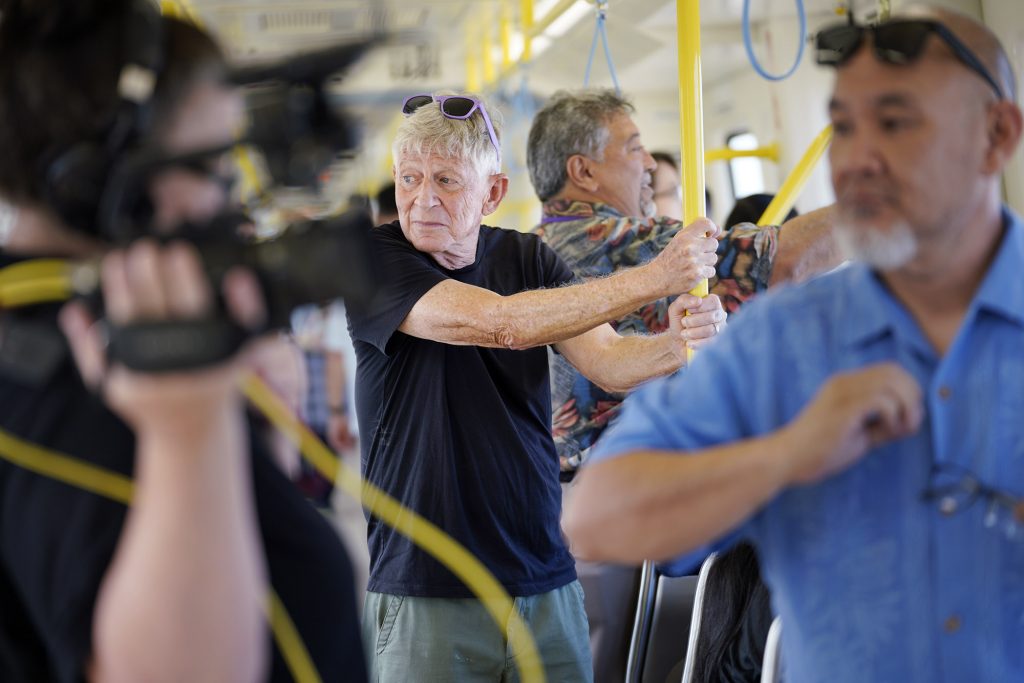
The job had limits though. There was no other role I could have auditioned for because of what I looked like and who I am. Just as it made no sense to have cast my role with a dreadlocked 20-year-old local male.
Now compare that to the place where I live now. There is a small drama club with varying acting experience. Most of the performances are staged readings rather than fully performed plays.
Old folks performing for a captive audience of other old folks in the building? It sounds pretty cheesy, even a little sad. Sure, on the surface.
But for the performers it’s much more than that. It’s liberating.
You are eligible to play any character you want. If the play has child characters, some 85-year-old great-grandma is going to have to do it and relish the challenge.
Putting yourself out there in public performance when you never did it before or when your on-stage circumstances were more big-time and conventional — that’s an adventure.
Why do it? It’s performance, the chance to express, to work hard, to feel the power of the spoken word even though those words are spoken in a very different setting.
For a new performer, it’s a chance to get over your fears. For a more experienced actor, it’s a chance to get over yourself.
Most of all, it’s a gig — a chance to perform and exercise your chops in a new place in a new way. Something old, but at the same time something new.
And that’s a high.
Dick Van Dyke, who turns 100 this week, says he’s lived so long because he’s stubbornly refused to give in to the bad stuff about aging. Instead, he says, “I have been in a full-on bear hug with the experience of living.”
And the guy is still performing. Not as in his big-star days as an amazing actor, dancer and comedian.
He still gets invitations to perform in big venues in New York and Chicago, but that’s become too hard physically.
Now, his performances are in situations many notches below his stardom days, like singing with the Vantastix, a group of guys he’s been singing with for 20 years. Low key for sure. Here’s a video of them performing from a table at an LA diner.
God knows, that’s not the same as performing with Julie Andrews, Mary Tyler Moore or Carl Reiner. So what?
“When we sing,” Van Dyke says, “my heart just soars. Because I’m still doing what I love.”
Dick Van Dyke is definitely not a washed-up actor because washed-up actors succumb to the boundary they can no longer cross. Van Dyke found new boundaries and took them on.
That’s pretty much the same with the grandmas and grandpas who decide to take tap dancing. Or people with Parkinson’s disease who take dancing classes.
Taking on new challenges. Still doing what they love.
And by the way, Van Dyke still dances: The old soft shoe. Spontaneously in his kitchen with his wife when the spirit moves them.
 Sign up for our FREE morning newsletter and face each day more informed.
Read this next:

Local reporting when you need it most
Support timely, accurate, independent journalism.
Honolulu Civil Beat is a nonprofit organization, and your donation helps us produce local reporting that serves all of Hawaii.
ContributeAbout the Author