Why Doesn't The Hawaiʻi Legislature Have An Electronic Voting System?
Most states have them, and some lawmakers argue it would improve transparency and jolt some of their colleagues out of their complacency.
December 7, 2025 · 6 min read


About the Author

There’s something missing in the Hawaiʻi Legislature that you’ll find in almost every other statehouse in America.
Electronic roll call systems allow legislators to quickly vote yea or nay, often with the push of a button. The results are instantly displayed on a reader board along with the lawmakers’ names and how they voted.
In Hawaiʻi, you could be sitting in the gallery watching intently and still not understand what just happened when a bill is considered in a floor session. That’s partly because of a long-established procedure in which roll calls are rarely held and doing nothing equals voting yes.
Often the public has to wait hours, or even until the next day, for the Legislature’s website to tell you who supported or opposed a measure.

It’s one more example of how legislative leaders in Hawaiʻi are doing their constituents few favors when it comes to helping the public observe and understand the labyrinthian lawmaking processes.
The last time the Legislature lifted the veil in any significant way on how it operates was when it adopted video streaming and recording of all floor sessions and committee meetings on YouTube, and it took a global pandemic to make that happen.
Springing for an electronic roll call system is far from the biggest reform needed at a Capitol mired in pay-to-play politics and backdoor decision-making, but it might be a symbolically important one.
Shouldn’t Voting Require Doing Something?
Electronic roll call systems were discussed as recently as last year when Democrats considered what rule changes they wanted for the 2025-2026 legislative biennium.
“People have seen it in action in other places, and there wasn’t a lot of resistance to the idea,” Rep. Amy Perruso says. “There also didn’t seem to be a lot of ‘rah, rah, rah, let’s do it’ type energy for it.”
Perruso is game for bringing the topic back up but said “it might not be a super robust conversation this session, especially with everything that’s happening fiscally. I think a lot of people are kind of in a low-energy space.”

To House Minority Leader Lauren Matsumoto, an electronic roll call system is long overdue.
“For one, the people who are in the gallery have a really difficult time following along with what’s happening,” she said. “So I think right then it’ll be increased transparency, understanding how everybody is voting.
“A second reason is we are really unique in our state in that you are a presumed yes vote unless you stand up and say otherwise. So you could essentially just sit in your chair and do nothing the entire time, and you’ll be registered for yes votes and there’s no action that needs to be taken. You just have to be physically present in your seat.
“So I do think having the buttons will have more accountability for how we’re doing things, and have active participation while we’re voting.”
Democratic Rep. Kim Coco Iwamoto said the current voting procedure “breeds this kind of passivity when I think being a representative should be an active process.”
“You just literally do nothing. I mean, you can’t even tell that people have read the bills.”
Hiding From Controversy
Could all those automatic yes votes be one of the reasons Hawaiʻi legislators so rarely vote no?
An analysis produced with Civil Beat’s new Digital Democracy AI tool found that out of 94,561 total individual votes cast on bills last session during committee hearings and floor sessions, 92,717 were yes votes while just 1,934 were no votes. That works out to voting yes 98% of the time.

Explore detailed legislator profiles, voting records and what happens in hearings on Digital Democracy.
Legislative leaders really like yes votes. In fact, when they’re preparing to take final action on a measure in the House, they ask for advance warning from any lawmakers who plan to vote no in the form of green slips from Democrats and pink slips from Republicans delivered pre-floor session.
And if opposition seems substantial enough to threaten a bill’s passage on the floor, they sometimes recommit it to a committee, effectively killing it. This happened last session with a measure to prohibit new non-medical immunization exemptions for school-aged children.
When the Legislature scuttles bills that promise controversy, “the public is denied a public debate to watch,” Iwamoto said.

Unfortunately, the Legislature’s predilection for smooth sailing on a sea of yes votes would not necessarily change with the arrival of an electronic roll call system.
Consider California, another state where Democrats control the Legislature. The Golden State’s Assembly has long employed such equipment. But out of more than 1 million votes cast since 2017, members of the majority party have voted in opposition less than 1% of the time, according to the news organization CalMatters.
Unknown Price Tag
It’s generally only the state houses and assemblies that put their members’ names up in lights because they’re so much bigger than the state senates. Even in California, electronic roll call is used only in the 80-member Assembly, not the 40-member House.
In Hawaiʻi, there are 51 representatives and 25 senators.
Sen. Jarrett Keohokalole said while he could see the value of installing such a system in the Hawaiʻi House, “I’m not sure it adds a whole lot more transparency in the Senate, because we’re such a small body.”
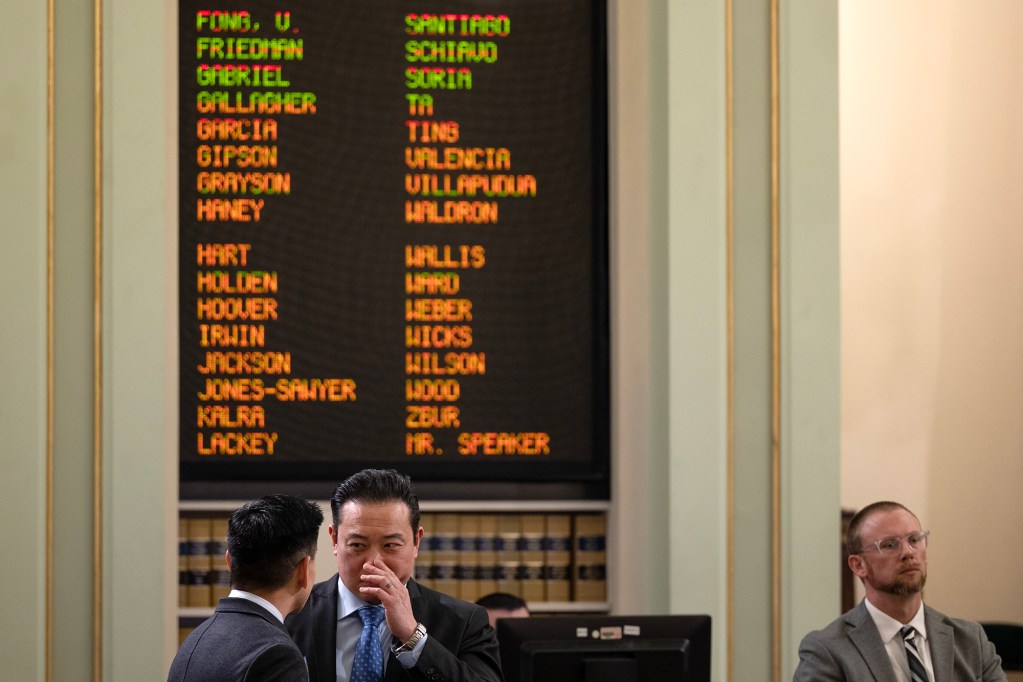
Apparently, no one has obtained an estimate of how much it would cost to install electronic roll call in Hawaiʻi. The House’s chief clerk, Brian Takeshita, did not agree to be interviewed for this report.
Vermont is also considering such a move and has obtained early estimates ranging from $475,000 to $700,000. But Vermont’s House has 150 members — almost three times as many as in the islands.
When an electronic roll call system was installed in New Hampshire, it cost about $500,000, according to a 2018 University of Vermont report. But the New Hampshire House has a whopping 400 members.
If a push-button system were installed in Hawaiʻi, it might have to have a third button in addition to yea and nay. That’s because this is the only state where legislators can officially vote yes “with reservations.”
Still more evidence that our lawmakers have a hard time just saying no.
 Sign up for our FREE morning newsletter and face each day more informed.
Read this next:

Local reporting when you need it most
Support timely, accurate, independent journalism.
Honolulu Civil Beat is a nonprofit organization, and your donation helps us produce local reporting that serves all of Hawaii.
ContributeAbout the Author