Kirstin Downey: This Lush Big Island Estuary Has Just Been Saved
The 81-acre site was being eyed by real estate developers but Hawaiʻi County just bought it and a local fishing group will manage it.
January 16, 2026 · 7 min read


About the Author

Neighbors on the Big Island shared the news and grew concerned: An existential threat was looming for a beloved local fishing area, the Kawainui Makai estuary, home to a dramatic waterfall and freshwater stream that pool into the ocean off the Hāmākua Coast, creating a prime marine habitat.
After decades when local people who knew the situation could freely access the iconic property — some 81 acres of pristine land bordering the Kawainui Stream — it was heading onto the private real estate market.
It’s a site so lushly beautiful that it seems almost otherworldly, like a jungly, sylvan setting for “Lord of the Rings.” The waterfall plunges about 30 feet, creating a picturesque centerpiece in the middle of the dense foliage, then cascades down and becomes a meandering stream entering the ocean.
The property, located alongside Onomea Scenic Drive, a 4-mile loop off Highway 19 north of Hilo, was put up for sale in 2023 by Na ʻĀina Kai Botanical Garden, which was founded by Ed and Joyce Doty of Kauaʻi. Ed died in 2008, and when Joyce died in 2022, the Kauaʻi nonprofit decided to sell off this property to better focus on work on its home island, according to the real estate agent who listed the property, Jared Gates.

Ideas showcases stories, opinion and analysis about Hawaiʻi, from the state’s sharpest thinkers, to stretch our collective thinking about a problem or an issue. Email news@civilbeat.org to submit an idea or an essay.
Out-of-state buyers were already said to be circling, ready to subdivide and convert the property into two separate walled-off estates.
Big Island resident and community activist Tawn Keeney, former physician to the Hāmākua Sugar Plantation, and his daughter Phaethon, who manages the Honokaʻa People’s Theater, heard about it and arranged for Gates to let them tour the property.
Then the Keeneys reached out to two people — tropical horticulturalist Ed Johnston, an avid environmentalist from Pepeeko, and Blake McNaughton, president of the nonprofit Mākahanaloa Fishing Association. The two men happened to be neighbors as well.
Johnston had a history of fighting to preserve local lands. In the 1990s, Johnston was active in the five-year effort to open the shoreline access to Onomea Bay, now part of the statewide Nā Ala Hele trail system.
Johnston was worried. When the site had been owned by the Hāmākua Sugar Plantation, local residents were permitted free and open entry to the shoreline.
“You could go anywhere,” he recalled. “They left the access open.”
Then, after Hāmākua folded in 1994, the subsequent owners, Na ʻĀina Kai, were also agreeable. But any future owners, he feared, would not likely see things the same way.
McNaughton, a Hawaiʻi island native, leads the fishing association, a 300-family organization that advocates for local, subsistence fishing rights and water access. That group, too, became alarmed.
“Generations have fished here,” McNaughton said.
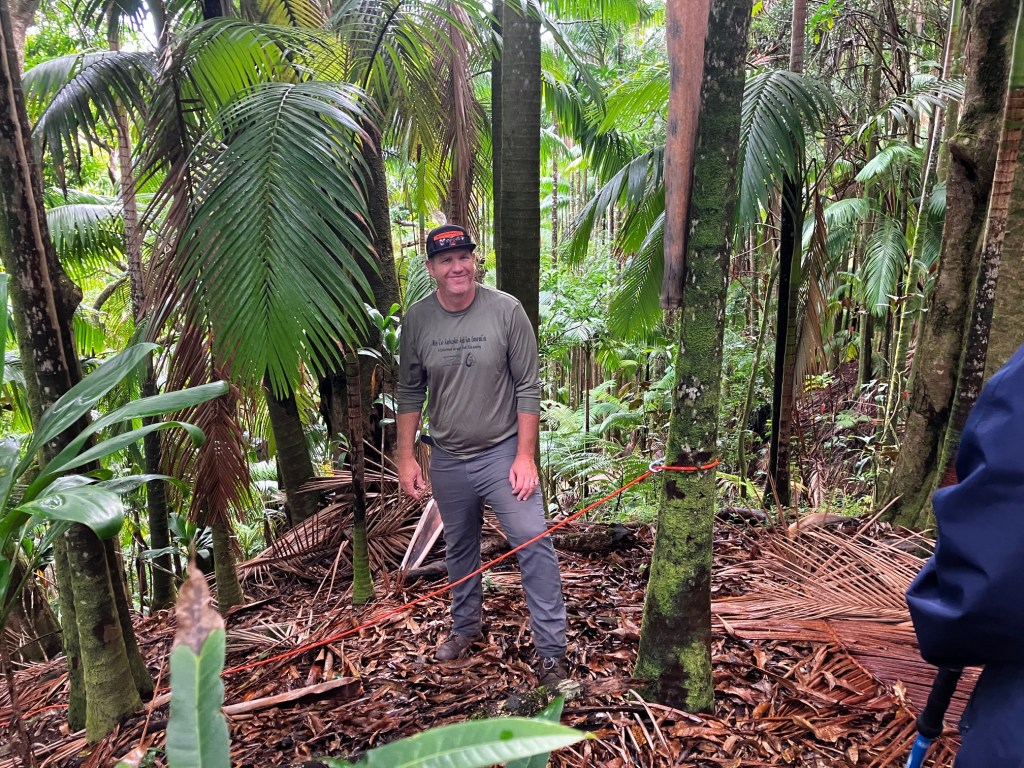
Gates, the real estate agent, was already having misgivings about selling the property for private development. Each time he visited the site, he became more firmly convinced that the property needed to be protected.
Now, thanks to the collaboration between this small group of community activists and orchestrated by Gates, the property has been purchased by Hawaiʻi County and preserved in perpetuity, under the active management and stewardship of the fishing association. County officials will oversee this stewardship to ensure that the fishing association does a good job administering the site.
The property officially changes hands Friday when the sale is recorded.
It was purchased thanks to $6.2 million in funding provided by Hawai’i County’s Public Access, Open Space and Natural Resources Preservation Commission, a program established by the county in 2006. The program was backed by Hawai’i County voters, who approved a charter amendment that called for 2% of property tax revenue to be dedicated to acquiring and preserving at-risk properties on the Big Island.
County officials called the transaction “an extremely rare opportunity” to buy one of the “best-preserved” stream systems on the island.
Environmentalists around the state had also been concerned about preserving the property. Last year, the cash-strapped Hawaiʻi Legacy Land Conservation Commission voted to provide $1 million in state funds for the site’s purchase, far less than the $6.2 million that was needed, but a symbolic contribution from the agency nonetheless.
In December 2024, three Legacy Land commissioners visited the site, noting that prospective buyers from out of state were scheduled to view it the next day.
“This property is of very high value, and clearly threatened by development by private investors,” the commissioners reported. “The marketing is described for ‘luxury homes’ and ‘private beach,’ indicating that access isn’t coming with possible new owners,” they reported.
Only insiders know how to traverse the densely vegetated property, which features two sharply plunging ravines overlooking the rocky stream below. Hardy visitors must steady themselves with ropes as they make their way down steep, slippery banks.
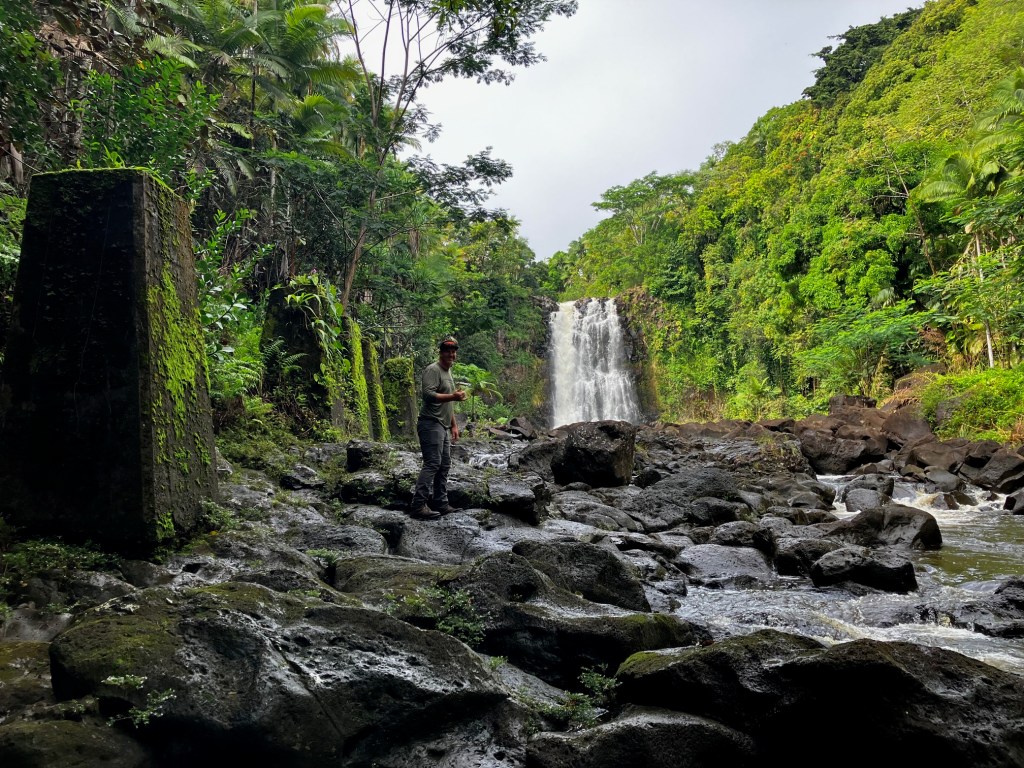
The site has always been difficult to access. The embankments on the two opposite sides of the stream were once linked by a soaring railway trestle, part of a daring and expensive feat of engineering that cost $60,361 a mile, bankrupting the Hilo Railroad Co. in 1916, but creating a rail line that lasted until World War II, when people shifted to automobile travel. The railroad was finally abandoned after it was damaged by the 1946 tsunami, but historic remnants of it remain intact throughout the property.
But even with such legendary access problems, generations of local kids have known the property as a place they could jump off the white bridge and plunge into a waterhole below. Local fishermen navigate the paths to a cliff overlooking the sea and use a ladder to clamber down.
The property includes two separate parcels of land, shaped like butterfly wings, covering the north and south banks of Kawainui Stream. The site, ironically enough, is also known to be home to the endangered orangeblack Hawaiian damselfly.
There’s also a large forest of teak and mahogany trees that can be harvested to provide financial support for the care and stewardship of the property.
The transaction came to a successful conclusion because so many people came together to make it happen, Phaethon Keeney said. She said that the project’s supporters had pushed on every door to make it possible.
“We needed the right mayor, and the right county officials, to all pull through,” she said.
Gates said finalizing the transaction in this way feels like a lifetime triumph for him.
“I’m super thrilled to be part of something that comes back to the community as a resource, it’s kind of ‘ultimate,'” Gates said. “After 20 years of doing real estate, this is the most meaningful transaction I’ve done, and that says a lot.”
McNaughton said he thinks the group was fortunate in the particular timing that the property came on the market after the real estate frenzy of the early pandemic was over.
“The billionaire’s market cooled off,” he said. “A lot of billionaire money came to the Big Island during Covid. This came on the market at the right time for us. It seemed like we were in the right place in the universe.”
McNaughton said his group is turning its efforts to developing a site stewardship plan in conjunction with local community leaders and Hawai’i County government officials. The goal, he said, is to protect the site but also enable more generations of people to fish there to feed their families.
“Our mission is to keep that resource accessible,” he said. “There’s so much ʻāina. You can do a lot.”
Civil Beat’s coverage of environmental issues on Hawaiʻi island is supported in part by a grant from the Dorrance Family Foundation.
Correction: The last name of Tawn and Phaeton Keeney has been corrected in this story.
 Sign up for our FREE morning newsletter and face each day more informed.

Local reporting when you need it most
Support timely, accurate, independent journalism.
Honolulu Civil Beat is a nonprofit organization, and your donation helps us produce local reporting that serves all of Hawaii.
ContributeAbout the Author