The Plurality Voting System Is Failing Hawaiʻi Voters
People frequently are forced to vote for someone other than their preference, keeping us in a two-party duopoly.
January 16, 2026 · 6 min read


About the Author

In order for the government to represent the people, the people must have an effective means of expressing their preferences through voting. If the voting system is flawed, the people are incapable of electing the people they desire and have difficulty holding the people currently in power accountable for any perceived failures.
The current plurality voting system is incapable of fairly handling an election with more than two choices. The consequences of this massive weakness compound into a poor selection and an inability of the voters to honestly express their preferences.
People frequently are forced to vote for someone other than their primary preference, and their options get constrained before they even get to that point. The primary voting process, before the general election, tries to compensate, but still leaves many without any influence over the result. Particularly when one party is dominant and the primary is party restricted, as is the case in Hawaiʻi.

Ideas showcases stories, opinion and analysis about Hawaiʻi, from the state’s sharpest thinkers, to stretch our collective thinking about a problem or an issue. Email news@civilbeat.org to submit an idea or an essay.
This party restriction also crosses over all offices, meaning if there is a viable candidate of a non-dominant party in one race, they can’t vote for them without sacrificing their preferences between dominant party candidates in all other races. During the general election, they’re left to vote only for the candidates that prevailed in the party primaries.
The inability of the current system to handle more than two people is also what pushes the system into a two-party duopoly. Two parties invariably rise to the top and then gain dominating power in a way that makes it very difficult for anyone outside of those parties to compete.
The parties are privately controlled and do not have to answer to the voters, which gives them undue influence over the result of the primary step selection process and over how elected officials behave, which is how for example the Democrats ended up stuck with Kamala Harris as their 2024 nominee despite her not even winning a single state primary vote. They got forced into Joe Biden as the Democrat choice, despite his apparent cognitive condition, and then Harris right after when Biden dropped out. Democrats voted against her previously, but this time had no choice.
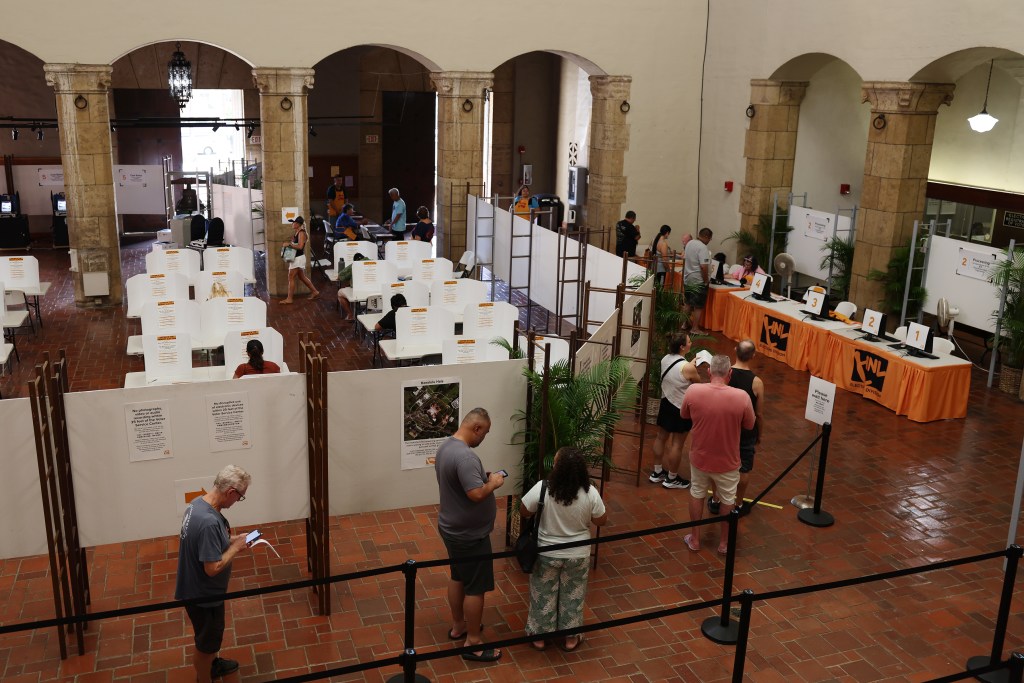
It doesn’t take any special insight in such situations to see voter choice is artificially constrained and the democratic process is failing.
The two-party system pushes everyone into tribalism and prevents people from acting as individuals. This tribalism leads to people acting with group-think and a team-based view instead of thinking for themselves.
Instead of representing the proper nuances of their own opinions and the people they wish to represent or support, people are pressured into voting down party lines on everything and conforming to a single party view, often dictated by those already in power (both those elected into government and those in the party and media systems of control and influence). You can see this in Congress, as the votes tend to split down party lines with little deviation.
This means many people that might be a good representative never even make it to the general ballot. They don’t run due to the broken nature of the voting system, or they do run and the people who want to vote for them don’t, because of the risk that comes with a solitary vote in a multi-candidate election when you don’t know how others will vote. Everyone’s vote is corrupted by this system.
Some less conventional, third-party or nonpartisan candidates may end up joining one of the two major parties with the intent of deviating or splitting out of it after they’ve achieved their first election. But they may end up stuck within the party instead of being truly independent.
People get ideologically pushed into one of two camps and then are much more easily manipulated into certain perspectives and views and into what they should view as important and what their position on any given issue should be. Thinking for yourself becomes socially and politically dangerous because that causes nuance and deviation in a system that rewards polarized conformity. This punishes honest candidates, which propagates many liars throughout the system.
If you trick people into having unrealistic standards, the only people that will cross that unrealistic threshold are the liars, because the honest people get filtered out and the liars promote unrealistic standards that favors them. Voters collectively flip back and forth between two sides of the same coin and fail to ever solve core issues, because both sides are corrupted.
People are slowly beginning to try to change the voting systems, but most are still ignorant of the options and may not realize how much difference could be made with this one change, as the effect would ripple throughout all politics.
There has been some slow and limited adoption of ranked choice voting among some states, but they all use the instant run-off method. This method is a half-measure that does not solve the core issues and may discourage the adoption of ranked voting, as people are ignorant of superior alternatives and those in power prefer the system that got and keeps them in power.
There is a type of ranked voting system that uses a more promising system — the Condorcet method. This pairs all candidates against each other to see who might win against all others, using people’s ranked ballots. When nobody wins all matches, the “Split Cycle” completion method breaks these circular ties to fairly determine a winner.
This method, better than others, rewards voters for fully and honestly expressing their preferences between candidates and fully utilizes those expressed preferences to elect a winner. It avoids the spoiler effect and avoids people unwittingly hurting their preferences by voting honestly. The primary process and party restrictions can be eliminated, with all candidates on a single ballot.
If voting is a civic duty for all citizens, then the only way to fulfill that duty is to demand from your legislators that the voting system be meaningfully improved to allow voters the capacity to honestly express their preferences among all candidates.
 Sign up for our FREE morning newsletter and face each day more informed.
Community Voices aims to encourage broad discussion on many topics of community interest. It’s kind of a cross between Letters to the Editor and op-eds. This is your space to talk about important issues or interesting people who are making a difference in our world. Column lengths should be no more than 800 words and we need a photo of the author and a bio. We welcome video commentary and other multimedia formats. Send to news@civilbeat.org. The opinions and information expressed in Community Voices are solely those of the authors and not Civil Beat.
Read this next:

Local reporting when you need it most
Support timely, accurate, independent journalism.
Honolulu Civil Beat is a nonprofit organization, and your donation helps us produce local reporting that serves all of Hawaii.
ContributeAbout the Author